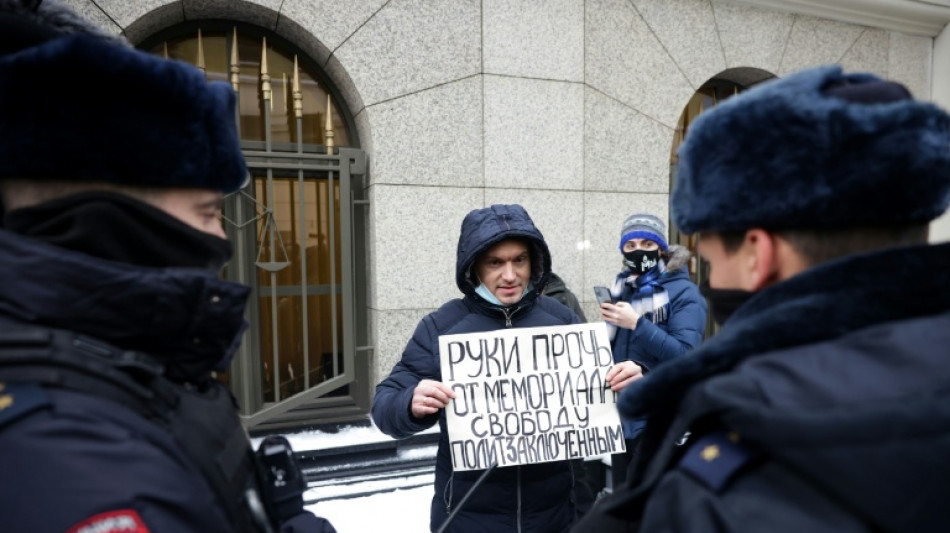
Russia bans Nobel-winning rights group, raids independent newspaper, in one day / Photo: Dimitar DILKOFF - AFP
Russia banned the Nobel Prize-winning human rights group Memorial and raided the offices of the independent newspaper Novaya Gazeta Thursday, in fresh blows to already diminished civil liberties in the country.
Memorial and Novaya Gazeta, both founded around the collapse of the Soviet Union, are Russia's two most reputable and renowned organisations reporting and documenting human rights abuses.
Since sending troops against neighbouring Ukraine four years ago, the Kremlin has not only suppressed opposition to the war, but also launched a wider crackdown on dissent, something unseen since Soviet times.
Memorial was founded in the late 1980s to document victims of Soviet-era political repression during which millions of people perished in the Gulag penal system.
Under pressure from the government almost since its birth, it was formally liquidated by Russia's Supreme Court in 2021 and since then has largely operated from abroad.
Thursday's court ruling to label Memorial as "extremist" effectively outlaws any cooperation with the rights group and makes its supporters subject to prosecution.
Novaya Gazeta, established in 1993, was for years Russia's leading independent outlet and was targeted heavily for its critical reporting and investigations into rights violations and corruption.
On Thursday, Russian law enforcement agents raided its offices and detained one of its top investigative journalists, the outlet said.
The paper, which used to be published several times a week, cut down production inside the country after the war began, but its online version was still available despite court orders.
Some of its staff were forced into exile and founded the online outlet Novaya Gazeta-Europe.
- Symbol of hope -
Memorial's first chairman was the Nobel Prize-winning Soviet dissident Andrei Sakharov and the group established the largest publicly available database on Gulag victims.
A symbol of hope during Russia's chaotic transition to democracy in the 1990s, it has since documented the country's slide into authoritarianism under President Vladimir Putin.
It has listed hundreds of political prisoners in modern Russia, among them critics of Putin and opponents of the Ukraine war.
Memorial has also documented rights violations linked to Russia's brutal wars in Chechnya and Syria, the plight of Ukrainian prisoners of war and kept a list of prisoners persecuted for their religion, including more than 200 Jehovah's Witnesses.
It counts more than 1,000 political prisoners in Russia as of 2026 -- up from 46 in 2015, amidst a crackdown on dissent during the Ukraine war.
The head of Memorial's legal department, Natalia Sekretaryeva, told AFP the Supreme Court's ruling was "absurd" but expected.
- 'Lawlessness' -
Novaya Gazeta was founded by Dmitry Muratov, its long-standing editor-in-chief who jointly won a Nobel Peace Prize in 2021.
He had to formally step down from the post two years later after being declared a "foreign agent," a label akin to being an enemy of the state.
One of the early investors in the newspaper was Mikhail Gorbachev, the last leader of the USSR and the father of the perestroika liberal reforms.
After Thursday's raids, which started in the morning were still ongoing well into the night, the police detained one of the paper's top investigative reporters on alleged illegal personal data use, Novaya Gazeta said.
The journalist, Oleg Roldugin, reported on corruption in Russia's top brass, including former President Dmitry Medvedev and the influential head of the Chechen Republic, Ramzan Kadyrov.
"We are concerned about the condition of our colleagues and demand an end to this lawlessness!" the paper said on social media.
They include Anna Politkovskaya, who spent years investigating allegations of abuses by Russia's military during its campaigns in Chechnya.
She was found dead in her apartment block on President Vladimir Putin's birthday in October 2006.
J.Jaspers--LCdB