Venezuela rescuers in final push to find survivors as families mourn / Photo: Rosali Hernandez - AFP
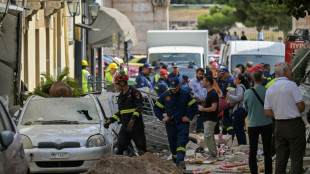
Rescuers from around the world pushed Tuesday to save any final survivors trapped under mountains of rubble after Venezuela's massive quakes that killed over 1,700 people, with tens of thousands still unaccounted for.
The twin quakes of magnitude 7.2 and 7.5 -- the strongest to hit the South American nation in more than a century -- likely damaged or destroyed 58,870 buildings, according to a preliminary assessment of satellite data published by NASA.
By the latest official count, some 1,700 are dead and 5,000 are injured, with no governmental word on the number of missing. Other estimates place these in the tens of thousands.
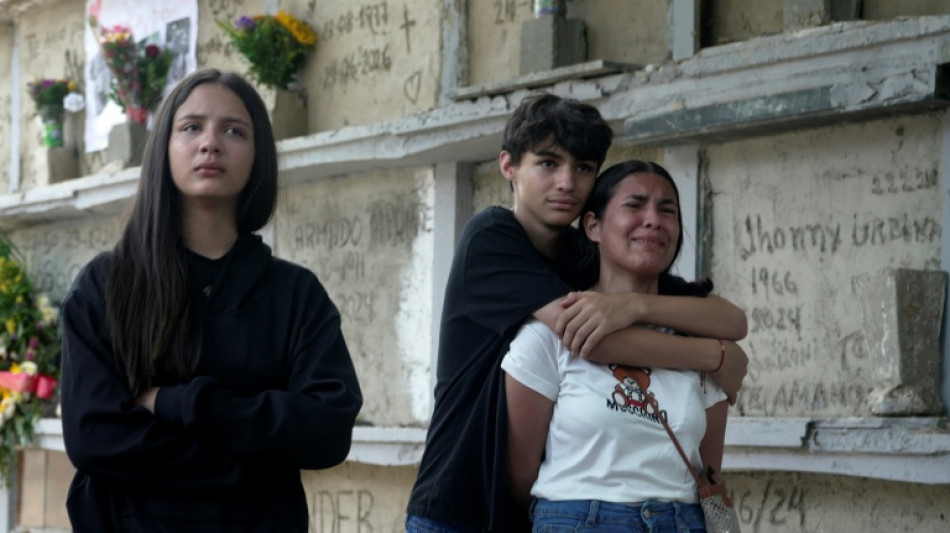
At the only public cemetery in the capital Caracas, the two crematory ovens have been working at full capacity.
Between Friday and Sunday, 60 to 70 burials were held each day.
A cry of "Mom, I love you!" rose above a steady low sobbing and the sound of shovels mixing cement.
When workers began to seal the niche of his nephew, Sergio Vergara fell to his knees. He was the one who found him, along with his entire family, in a collapsed building in the hardest-hit state of La Guaira.
"It was a horrible experience, pulling him out, his children," said the 42-year-old man.
Five days after the powerful back-to-back quakes flattened entire neighborhoods, the task of recovering the dead loomed large and hopes of finding survivors faded.
Around 50,000 people are still listed as missing, according to the United Nations, which estimates that the disaster generated roughly 1.2 million tons of debris in La Guaira state.
On Monday, a new 4.6-magnitude tremor rekindled fear among the population.
- Bodies in warehouse -
The US military repaired and reopened on Monday the Port of La Guaira, where an AFP correspondent saw a warehouse storing hundreds of unidentified bodies encased in white and black body bags as well as a few coffins. The USS Fort Lauderdale was docked and delivering aid.
Dozens of people from the devastated region waited outside the makeshift morgue for news of their relatives as forensic personnel in blue uniforms examined the corpses.
US airmen were also helping restore traffic at Simon Bolivar International Airport near Caracas, which was also heavily damaged.
The government has militarized La Guaira and imposed a permit requirement to enter the disaster zone.
Residents are not hiding their anger over the government's slow and limited aid in a country mired in a deep crisis that has driven millions to emigrate in recent years.
A total of 27 countries have mobilized nearly 40 search and rescue teams. They include more than 2,000 troops and personnel, along with more than 160 dogs, according to Gianluca Rampolla, the United Nations coordinator in Venezuela.
She said the United Nations will provide 10,000 body bags, though it hopes the final toll will be lower.
- 'My family is there' -
The critical 72-hour window during which survivors were still likely to be found, however, closed Saturday at 6:04 pm.
Still, rescuers on Monday pulled out a 21-year-old man identified as Aaron Levi from under the rubble in the coastal town of Tanaguarena, according to a video shared by a photographer who witnessed the operation.
At the Caracas cemetery, many are still waiting for the remains of their loved ones who are presumed dead.
"My family is there -- I'm told my sister and her children are there, as well as the children of my brother," Wilker Molalla told AFP as he waited to identify the remains.
"There were 11 people in my household; only two of us survived because we were at work," he said, referring to his brother.
The United Nations said that some seven million people in this country would be affected by the disaster, with the quakes knocking a $6.7-billion hole in the economy -- or six percent of Venezuela's GDP.
Opposition leader Maria Corina Machado, who after years in hiding staged a dramatic escape from Venezuela in December to receive the Nobel Peace Prize, accused the government of blocking her return.
The government of interim president Delcy Rodriguez has not commented on the matter, nor has Washington, which is coordinating operations on the ground.
I.Kusters--LCdB