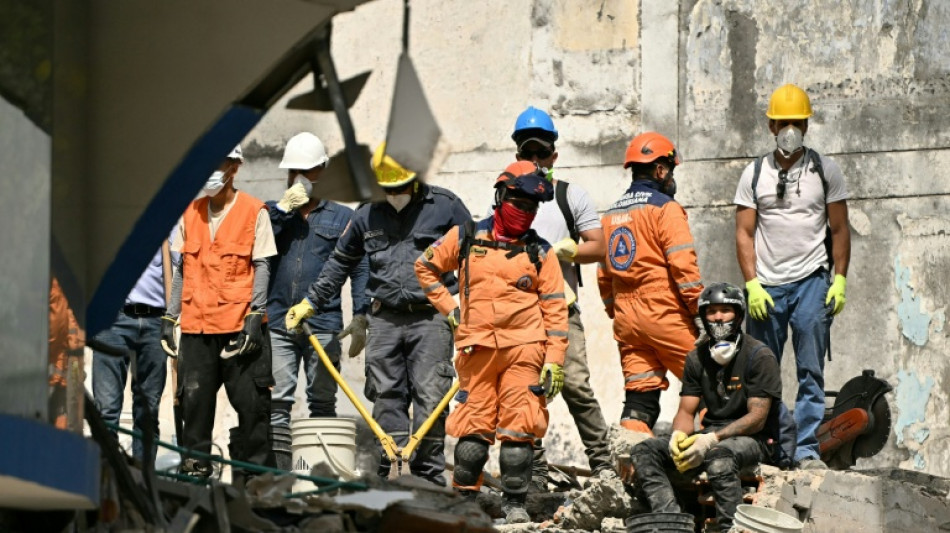
Colombia hopes for miracles as search for quake victims goes on / Photo: Luis ACOSTA - AFP
The chances of finding earthquake survivors in Colombia dropped significantly on Friday, four days after the 7.4-magnitude tremor struck, though rescue efforts plowed ahead as hundreds remained missing.
Volunteers and rescuers persevered with the grueling task of digging through the rubble, looking for any signs of life after the critical 72-hour window passed.
The strongest quake to hit the South American nation this century devastated the western cities of Cali and Pereira and destroyed nearly 13,000 homes across the coffee-growing region and along the coast.
At least 287 people are dead, while thousands more are injured and some 379 people are unaccounted for, President Abelardo de la Espriella said Thursday.
Armed with a helmet and a flashlight, Hernan Giraldo had no intention of giving up on his son.
Juan Felipe Giraldo, the 24-year-old buried amid the shards of a ruined hotel, is supposed to get married on Sunday.
"If he comes out alive, the wedding will take place afterwards," his father told AFP.
"What matters is that he's alive," said the 43-year-old.
- Damaged morgue -
De la Espriella has faced a tough first week in office, with multiple cities shattered by the tremor and the government yet to publish reconstruction cost estimates.
The newly appointed president has declared an "economic emergency" and spent the week visiting quake-hit cities, promising rent subsidies to those who lost their homes.
The World Bank said Friday it was disbursing $200 million in emergency funds for the disaster response, as well as a mechanism to assess economic losses to help "prioritize aid and reconstruction efforts."
The quake damaged a morgue in Colombia's third-largest city Cali, which currently counts the most fatalities.
Bodies are instead being transported to the nearby city of Palmira, where dozens of people have gathered, hoping for news of missing loved ones.
Luis Arturo Rios, 70, heard that his friend's body was there, and rushed to find out for himself.
"We're waiting to recover the body so we can bury her," he told AFP.
The impoverished Choco region on the Pacific coast also suffered immensely, with some of its remote communities unreachable by authorities to assess the damage.
- 'They can count on us' -
In some places, the stench of decaying bodies has crept into the air.
David Tamayo, head of Colombia's disaster relief agency, acknowledged that the "likelihood of finding survivors is going to diminish" after Thursday.
"But our commitment is to never stop searching... The order is to not rest until we find all the missing persons," he said in a video posted by his agency.
Colombians outside the quake zone have mobilized in massive numbers to ease victims' suffering.
Hundreds of volunteers hurried through the packed parking lot next to Bogota's largest stadium, forming human chains to pass donated water bottles, food provisions, sanitary products and bedding to the sorting area.
The diligent crowd occasionally burst into applause or cheered each other on to keep spirits high.
Luz Mary Gonzalez, a teacher, sat on the ground with a dozen more volunteers, writing messages of solidarity to be slotted into donation boxes.
"We are happy to do our small part," she told AFP. "Our hearts are with them... They can count on us."
De la Espriella's hard-right administration is facing criticism over allegedly blocking rescue teams from countries with leftist leadership, but it denies the accusation.
Colombia has accepted aid from the United States, El Salvador, Ecuador and Israel, all with right-wing governments, disaster authorities said
Mexico's leftist President Claudia Sheinbaum said Thursday that Colombia had refused entry to Mexican rescuers over an alleged lack of correct certification.
B.Hendrix--LCdB