'Azzedine Alaïa: Sculpting Fashion' Retrospective Opens at Legion of Honor
The first United States retrospective dedicated to the work of Azzedine Alaïa has opened at the Legion of Honor in San Francisco. Running through April 11, 2027, 'Azzedine Alaïa: Sculpting Fashion' presents a comprehensive survey of the Tunisian-born designer’s career, highlighting his reputation as the 'King of Cling' and his enduring influence on haute couture.
The first United States retrospective dedicated to the work of Azzedine Alaïa has opened at the Legion of Honor in San Francisco. Titled 'Azzedine Alaïa: Sculpting Fashion,' the exhibition runs through April 11, 2027, and offers a comprehensive survey of the Tunisian-born designer’s career, highlighting his reputation as the "King of Cling" and his enduring influence on haute couture.
While Alaïa may not be a household name to the general public, his designs have defined the wardrobes of some of the most iconic figures in pop culture. His work has been worn by Tina Turner during her 1985 "Private Dancer" tour, Lady Gaga, Grace Jones for her role in the James Bond film "A View to a Kill," Rihanna at the 2013 Grammy Awards, and former First Lady Michelle Obama.
The exhibition is curated by Laura Camerlengo of the Fine Arts Museums of San Francisco and Olivier Saillard, director of the Fondation Azzedine Alaïa. It traces the life and career of Alaïa (1935-2017), who was born in the Arab quarter of Tunis to a farming family but considered himself a French designer.
Alaïa’s artistic foundation was laid early, influenced by Mrs. Pineau, a midwife from his neighborhood who became a friend and mentor. She introduced him to issues of "Vogue" magazine, which sparked his interest in fashion. He subsequently attended the Ecole des Beaux-Arts in Tunis, where he trained as a sculptor. Although he concluded he lacked the skill to become a great sculptor, the principles of form and structure he learned there became central to his approach to dressmaking.
Arriving in Paris in 1956, Alaïa initially worked as a free agent, producing garments in the styles of Christian Dior and Cristobal Balenciaga for private clients such as actresses Arletty and Greta Garbo, and banking socialite Helene de Rothschild. He also designed for the dancers at the Parisian burlesque club Crazy Horse. From 1959 to 1964, he worked at the House of Guy Larouche to refine his craft before founding his own house in 1964.
Alaïa viewed his work as a form of sculpture, believing he was sculpting women’s bodies through fashion. He would literally piece dresses onto models or clients, ensuring a natural fit based on his mastery of proportions and intuition. He crafted every garment himself, from pressing to finishing. His designs, particularly those from the late 1960s and 1970s during the women’s equality movement, were lightweight and liberating, allowing women freedom of movement without restriction.
"I make clothes. Women make fashion," Alaïa said. This statement reflected a subtle feminist redefinition of womanhood through couture, highlighting the natural curves and musculature of the female body while providing both strength and allure.
French magazine Elle described him as a "provocateur of seduction." Alaïa earned the nickname "King of Cling" for his cinched waists and form-fitting silhouettes, which he believed gave women an attitude of power. He played a significant role in ending the baggy, androgynous styles popular in the 1970s. Instead, he offered supple leather, often accented with small metal grommets, and stretch knits that celebrated the female form.
In 1980, Alaïa produced his first ready-to-wear collection using chiffon and leather, favoring the color black. He was also an innovator in knitwear and one of the first designers to put women in leggings made of lycra, appealing to active women. Despite his success, he remained critical of the fashion industry, particularly its oppressive calendar. In 1987, he began presenting collections only when he felt they were ready, and by 2000, he stopped doing runway shows entirely, feeling that elaborate productions sidelined the clothes.
"I never followed fashion. It was the women who dictated my approach," Alaïa said. Rather than adhering to frantic production schedules or making seasonal changes, he honed his technical mastery and adapted new materials through research and experimentation.
By the late 1980s, minimalism became fashionable, and Alaïa’s maximalist aesthetic fell out of favor. However, he continued his demanding craftsmanship and maintained his list of private clients, while also undertaking creative work for ballets and operas. By 2000, he experienced a creative rebirth and became highly sought after again. His garments project a sense of timelessness, designed to last and be worn for decades, defying fleeting trends.
Alaïa was gay and met German artist Christoph von Weyhe in Paris around 1961; they remained life partners until Alaïa’s death in 2017. Von Weyhe (1937-2025), known for his atmospheric landscapes, particularly of Hamburg, co-founded the Fondation Azzedine Alaïa to preserve Alaïa’s expansive collections of fashion history, art, and design.
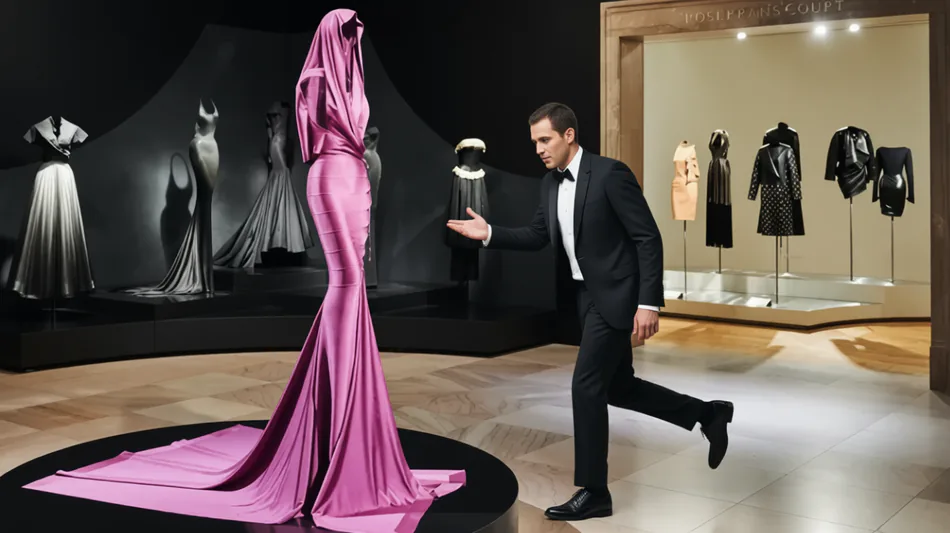
The exhibition is presented in five sections in the lower-level galleries, with themes including sculpture and shape, silhouettes and suiting, black and white haute couture, bandage dresses—a specialty of Alaïa—and construction and craftsmanship. On the first floor, a gallery is dedicated to Alaïa’s role as a collector of high fashion, featuring pieces from his personal collection, including works by Chanel, Schiaparelli, Adrian, McCardell, Dior, and Balenciaga.
For Alaïa, preserving fashion honored the stories it contained, from the creator and technique to the women who wore the garments. Garments are displayed on invisible mannequins, appearing to float, accompanied by photos of the famous models, actresses, and society figures who wore them.
Among the standout pieces in the collection is an ensemble featuring a maroon and white striped dress, petticoat, and leather corset. A black lambskin leather coat with metal eyelets and a white wedding dress made from viscose jersey and lame leather also draw attention. Other notable items include a denim dress with a zigzagging metal zipper, a midnight blue silk chiffon gown with a long train, and a black dress with a PVC inlay and silver necklace.
Many of the dresses feature hoods and halters, suggesting mystery and 1930s Hollywood glamour. The final wall text summarizes Alaïa’s impact: "Alaïa was a visionary artist who cultivated a fiercely proprietary aesthetic. His mastery of construction and knowledge of the female form resulted in some of the most technically sophisticated and visually captivating garments of the twentieth and twenty-first centuries, sculptural pieces built to outlast the fleeting whims of the runway."
'Azzedine Alaïa: Sculpting Fashion' is on display at the Legion of Honor, 100 34th Ave., San Francisco, through April 11, 2027. Admission costs $20-$35.
B.Janssens--LCdB