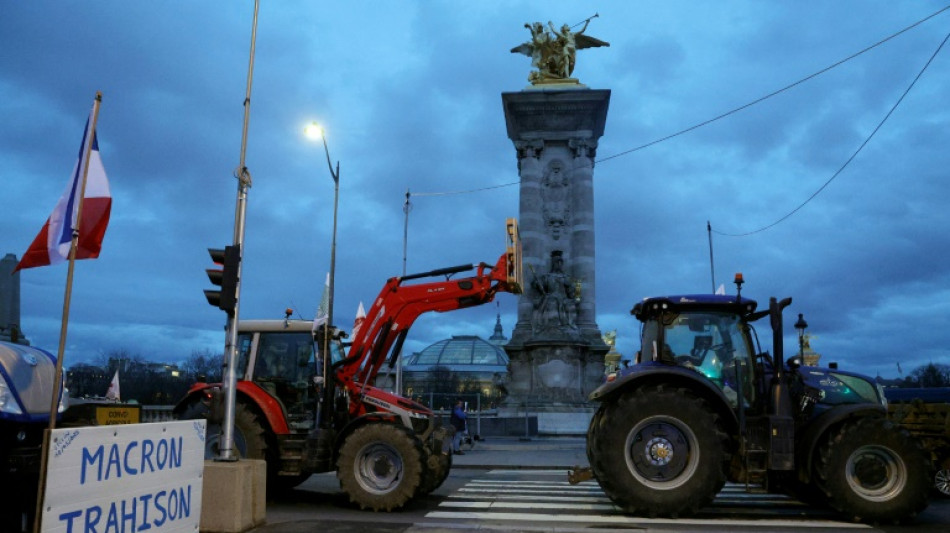
Fuming French farmers camp out in Paris despite government pledges / Photo: GEOFFROY VAN DER HASSELT - AFP
French farmers said Tuesday they and their tractors would be spending the night in Paris, even after Prime Minister Sebastien Lecornu promised an "emergency bill" to help alleviate their woes including the EU-Mercosur trade deal.
Hundreds of tractors rolled into Paris earlier in the day, reflecting a deep sense of malaise afflicting France's agricultural sector, with the planned signing of an accord between the European Union and the Mercosur bloc seen as the last straw.
Farmers have complained about economic uncertainties and environmental rules, and have since December staged protests and set up roadblocks over the government's handling of a lumpy skin disease outbreak in cattle.
Lecornu said on Tuesday he had tasked his Agriculture Minister Annie Genevard to prepare "an emergency agriculture bill" to address their concerns after hundreds of farmers drove their tractors into Paris in protest.
This bill would be "focused on several priorities: water, predation, and production resources" and be presented by the start of an agricultural show next month, he added on X.
The FNSEA, France's leading agricultural union, however said it was not enough.
"We decided ... to stay here for the night," said Damien Greffin, one of the union's vice presidents, outside the lower house of parliament.
- No cows at agriculture show -
Arriving from towns around Paris and beyond, the protesters earlier in the day had parked their tractors not far from the parliament.
"We're at the end of our tether," said one of the activists, Guillaume Moret, 56.
"We haven't made any money from our farms for three years," said Moret, head of the FNSEA branch for the Paris region.
The FNSEA and another union, Jeunes Agriculteurs, are demanding "immediate action" from the government.
The government last week already announced a planned 300-million-euro ($350-million) package to support the farmers, as well as other measures including an increase in the number of wolves that can be killed.
In a move highlighting the atmosphere, France's biggest agricultural show will this year feature no cows -- a first since the event's creation in 1964.
Farmers, driven by health concerns and a sense of solidarity with breeders affected by the lumpy skin disease outbreak in their cows, have refused to present their cattle at the fair in February.
The event's chairman, Jerome Despey, called the move a "blow to the show".
- Wolves, fertilisers -
Several days before the scheduled signing of the EU-Mercosur agreement in Paraguay on Saturday, the FNSEA reiterated its opposition to the deal.
Police said earlier some 400 protesters had gathered near the parliament building. The FNSEA put turnout at over 500 tractors and 800 farmers.
Most of the European Union's 27 nations back the Mercosur trade deal, which supporters argue is crucial to boost exports, help the continent's ailing economy and foster diplomatic ties at a time of global uncertainty.
The deal, more than 25 years in the making, would create one of the world's largest free-trade areas, boosting commerce between the EU and the Mercosur bloc comprising Brazil, Paraguay, Argentina and Uruguay.
But farmers in France and several other countries fear being undercut by an influx of cheap beef and other agricultural products from South America.
M.Lenaerts--LCdB