Election campaign deepens Congo's generational divide / Photo: Daniel BELOUMOU OLOMO - AFP
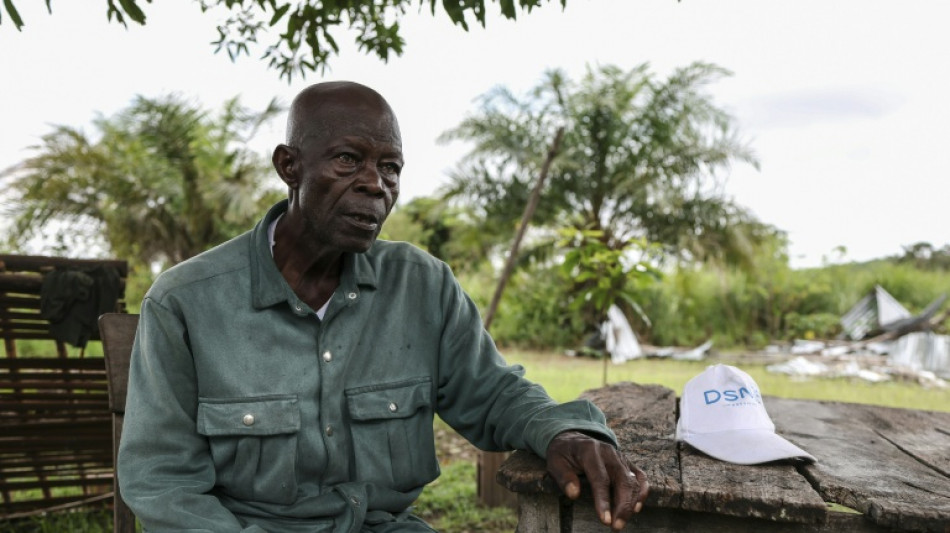
"Hoodlums," muttered 80-year-old village chief Joseph Batangouna as he walked past a group of young people sitting by the side of road in Mayitoukou, Congo-Brazzaville.
Sunday's presidential election has laid bare tensions between the generations.
With 82-year-old Denis Sassou NGuesso, the current president, running for a fifth term to add to his 40 years already in power, there is little doubt as to the outcome.
Turnout risks being low -- not something Batangouna wants to see.
"On Sunday, we have to go and vote Sassou!" he told the youngsters in his village.
Not all of them were convinced.
"Me, I won't go and vote because it's always the same ones who are there" in power, said 27-year-old labourer Guelord Mienagata.
Mayitoukou lies just 30-odd kilometres (nearly 20 miles) from the capital Brazzaville, but some of its 167 residents feel forgotten by those in power.
Pool region, to which the village belongs, has a reputation as one of the most unstable in the country since the 1997 civil war, when many people fled.
"People's feet were swollen from all the walking they had done," recalled Batangouna, who served as a sergeant at the time.
"We don't want to flee any more. We don't want that any more."
Batangouna served under Sassou Nguesso, who won the conflict -- and he still feels that only the current president can keep the peace in the country.
Sassou Nguesso, he said, "has no competition". In Mayitoukou, he insisted, there would be no need for a second round of voting. "We are going to turn out in force!" he said.
But not all local people feel the same way.
- 'Easy money' -
A group of young people sheltered under a thatched hut by the side of the road, absorbed in a game of poker. They slapped down their cards, playing for pile of coins in the middle.
Some of them had no intention of obeying their village chief.
"Me, I'm not going to vote," said Benie Mbakani, seated at a neighbouring table, as Batangouna looked on.
"I don't want to hear that!" the village chief shouted.
But Mbakani was unmoved. "We have the right to vote for who we want!" he replied, getting up from the table.
"The shame of it!" said Batangouna, outraged at being openly defied in front of foreign visitors.
Benie Mbakani and Guelord Mienagata also made it clear they would not be following the village chief's injunctions.
They accused him of having made the most of the good life during his military career, while they, as part of the young generation, struggled.
They both told how they had left for the capital in search of work but their hopes of finding opportunities there had come to nothing.
In the end, they both returned to the village where making charcoal brings them between 100,000 and 300,000 CFA francs (150-450 euros) a month.
"In Congo, there's nothing, there's no economy," said Mienagata.
"We have jobs, but we don't make anything," he added, as he took an axe to a tree stump in a neighbouring plot.
- Farming drive -
More than half the population of Congo live below the poverty threshold.
Batangouna denounced what he said was young folk's obsession with easy money, and the damage they were doing to the once vast forests next to the village.
He said he and his wife Antoinette had worked their land for decades to grow manioc and bananas on steep fields that had taken a toll on his wife's back.
He wanted to see the villagers back in the fields, following the injunctions of the president to develop agriculture.
In Mayitoukou, only the older generation was heeding the call, said one village elder, Antoine.
The young folk were always insulting him behind his back, the village chief complained.
Antoine said that when he tried to stop local youngsters from cutting down trees, he was beaten and accused of witchcraft.
As the two old men told their stories, a youngster brushed past them, a machete slung over his shoulder.
On his tee-shirt, in large, glittery letters, were the words: "I hate you."
P.Verhoeven--LCdB