Spain wildfire burns campsite to ash, leaving tears and despair / Photo: Roland LLOYD PARRY - AFP
Magaly Vargas sobbed as she stared down at the square of grey ash where her caravan once stood.
"This is where I used to live," she cried. "There's nothing left of it. It's awful. Awful."
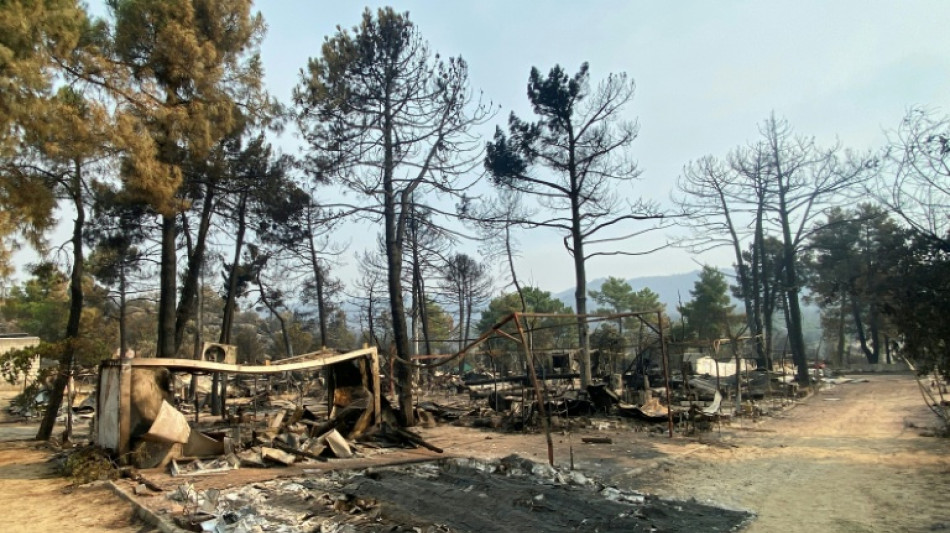
Around her, crumpled sheet roofs and bars of twisted metal jutted from the ruins of the Pantano del Burguillo camping ground west of Madrid, ravaged by Spain's worst wildfire on record.
More than 30 people were evacuated from the site on the shore of the Burguillo reservoir when the flames attacked on Friday, including Vargas, 64, who handled its public relations. They were among scores of thousands of people ordered to leave their homes across the region.
"This is a house. This was a mobile home," said the site's co-owner Maria Angeles Canete, 54, pointing to the remains of the structures whose plastic walls melted and disappeared in the inferno.
Along with her husband Miguel Pascual, 58, she owned this and one other nearby camping ground. Both were destroyed.
"We have lost everything," Canete said, fighting back tears. "We have nothing."
- Trees lit up -
When the fire approached on Friday, Canete and Pascual fled by boat onto the reservoir.
"The trees lit up with flames," she recalled. "Then something went bang and we heard the gas canisters exploding."
They returned later to find the whole camp burnt to the ground. Stacks of smashed porcelain plates and pots lay in the embers.
"I don't sleep at night," Canete said. "It's a horrible memory. It's the worst thing that could happen to you in life -- to see your business burning down bit by bit and no one coming to help you."
On the slopes around the site stretched acres of charred earth, rocks and pines, with burnt houses and outhouses, their walls and windows scorched black.
Here and there columns of grey smoke billowed from the ground and a sharp smell of smoke hung in the air.
On a track up the hill from the reservoir, a baby deer lay dead where it fell, legs splayed, its hair burnt off, tongue lolling out of its mouth.
In the nearby town of El Barraco, firefighters sat at a cafe in dirty overalls, exhausted after working through the night.
- Burnt olives -
Elsewhere in this eastern part of the Castilla y Leon region, some locals were returning to their villages following last week's evacuations.
David Sanchez, 48, a decorator, went back to work in the village of Cebreros on Monday after two nights at his brother's home in another village.
White smoke still clouded the sky. Specks of ash floated down and settled on cars. At the edge of town, dry vegetation smoldered by the roadside.
Sanchez had a small parcel of land where he grew olives and pistachios -- all now destroyed by the flames.
"I'll just have to clean up and plant them again. It's a shitty situation to be honest," he said.
"And now the fire has started again down there" in the valley, where local people were working to isolate the flames, he added.
His workmate Oscar Espinosa, 20, said he left the village on Thursday but came back on Friday and went out to nearby woodland to help stop the spread of the fire by clearing ground with tools.
"It's hell -- everything is burning," he said. "All our hills have been burnt. All the greenery that we had has been devastated."
- Holiday season -
To the west, in the historic town of El Escorial, a bigger campsite reopened on Monday after 5,000 guests were evacuated from it. Holidaymakers queued up at reception.
In the ash of Pantano del Burguillo, Maria Angeles Canete had no such hope for her business.
"It was a lovely campsite," she said. "A family place were people felt good all year round. People came from countries all over. They can't come anymore."
J.Jaspers--LCdB