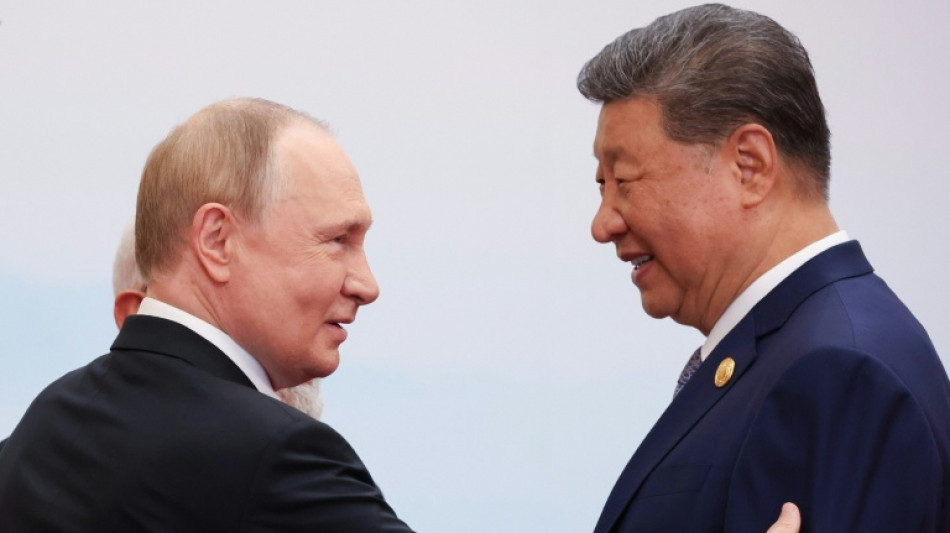
Putin, Xi hold talks in Kyrgyzstan as regional summit begins / Photo: Alexander KAZAKOV - POOL/AFP
Russia's Vladimir Putin and China's Xi Jinping began talks Monday in Kyrgyzstan, where a dozen other heads of state also gathered for a two-day summit of the Shanghai Cooperation Organisation (SCO), which seeks to be a counterbalance to the West.
Iran's leader Masoud Pezeshkian, Turkey's Recep Tayyip Erdogan, India's Narendra Modi and Pakistan's Shehbaz Sharif were also among those in Bishkek to attend the summit of the regional SCO bloc, which celebrates its 25-year anniversary.
The summit takes place four-and-a-half years into Moscow's Ukraine invasion and six months into the war between Washington and Tehran.
Putin and Xi have previously used SCO summits to promote their vision of a multipolar world and present a united front against the West.
Xi told Putin he was "happy" to see him, saying Russia-Chinese ties have become "more solid" and that their "prospects will be even brighter".
"The amount of uncertainty and unpredictability in the international order has obviously increased," the Chinese leader said.
Putin told Xi that: "Cooperation is successfully developing on all fronts." The pair last met in May.
Russia's economy has become increasingly dependent on China during its 4.5-year invasion of Ukraine. Western countries have called on Beijing to pressure Moscow to end its offensive.
The Kremlin's spokesman Dmitry Peskov told Russian media the pair only discussed the Ukraine war "in passing".
Putin is also expected to hold separate talks with Iranian President Masoud Pezeshkian.
Russia and Iran -- among the most sanctioned states in the world -- have massively deepened their military and economic ties since Moscow invaded Ukraine.
- War not 'in our interest' -
US President Donald Trump has warned Moscow and Beijing against arming Iran.
Putin's meeting with Pezeshkian will come days after the CIA's director John Ratcliffe made a rare trip to Moscow, with US media speculating he could have discussed Ukraine and Iran with his Russian counterparts.
Speaking in Bishkek after the first exchange of fire between the United States and Iran in a month, Iran's Pezeshkian said continuing the war was not in Tehran's interests.
"We continue to strive for a path of agreement and understanding, and we believe that continuing the war is neither in our interest, nor in the interest of the region," he told India's Modi.
Putin, Xi, Pezeshkian, Modi and Sharif are due to take part in a plenary session chaired by Kyrgyz leader Sadyr Japarov.
The SCO has historically focused on economic issues but has gained momentum in recent years under Moscow's and Beijing's leadership.
On top of its 10 members, it now has 15 "dialogue partners", including Turkey, Saudi Arabia and Qatar.
It also has two observer countries: Afghanistan and Mongolia.
- Real and trade wars -
The Bishkek summit takes place at a time when some SCO members are in the midst of real wars -- the Ukraine and Iran conflicts -- or trade wars, with the imposition of US tariffs on Chinese and Indian goods.
This month, the US slapped secondary sanctions on Iran's trading partners in the sectors of gold, technology, digital assets, aviation and maritime transport, aiming to cripple Tehran's economy.
Washington has also threatened Iran's allies with sanctions.
China, a major importer of Iranian oil, responded by saying it would "firmly defend" its interests.
Iran, living under sanctions since its 1979 revolution ended with Islamic authorities taking charge, has regularly said it will not cave to economic pressure.
But Pezeshkian has acknowledged his country faces "economic difficulties".
Iran only joined the bloc in 2023.
But concrete benefits of the group are uncertain, he said, as "in times of crisis, these alliances have rarely allowed Iran to resolve its difficulties".
While the bloc claims to represent some 40 percent of the world's population and 25 percent of global GDP, it remains diverse, with disagreements among members.
G.Wouters--LCdB