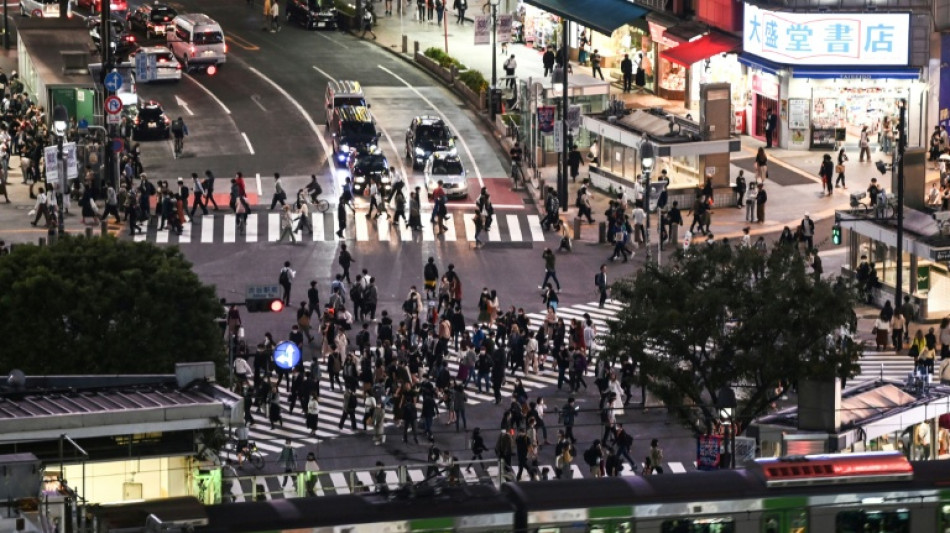
Japan to relax overtime regulation under workaholic PM / Photo: CHARLY TRIBALLEAU - AFP/File
Japan will ease overtime regulation starting Tuesday in a move meant to help spur economic growth but criticised as a relapse into the country's ingrained workaholic culture.
The move comes after the government led by Prime Minister Sanae Takaichi -- a self-proclaimed workaholic -- adopted a growth strategy in July calling for revisions to the current oversight of work hours.
The change in part reflects calls from certain business sectors for more flexible work styles as they grapple with a deepening labour shortage.
Roughly 40 percent of businesses in Japan are operating under specific labour-management agreements that legally allow monthly overtime of up to 100 hours, according to the labour ministry.
But those companies were still advised by authorities to cap overtime at 45 hours each month, with that guidance considered on par with regulation.
That was because exceeding that threshold can increase risks for so-called "karoshi", or deaths from overwork, a labour ministry official told AFP.
Under the new rule that took effect Tuesday, labour standards inspection offices will no longer pressure businesses over the 45-hour limit.
A Japan Chamber of Commerce and Industry survey showed in May that this pressure was "restricting" activity of around 20 percent of Japan's small and mid-sized businesses, especially in short-staffed industries such as construction, transport and hospitality.
Critics, however, said the move reversed steps taken by Japan to modernise its corporate culture long centred around marathon work hours.
- 'Corporate warriors' -
Once a bastion for "corporate warriors" fiercely devoted to their jobs, the country has in recent years ratcheted up efforts toward a better work-life balance, especially after the 2015 suicide of an exhausted 24-year-old employee at advertising giant Dentsu.
"This is an unacceptable shift away from, and abolition of, the policy that urged companies to shorten work hours," the National Confederation of Trade Unions in Tokyo, commonly known as Zenroren, said in a statement.
The possible shift toward more work is on brand for Takaichi, who herself declared she "shall work, work, work, work and work" when elected as head of her conservative ruling party in October.
And in an X post widely derided for "showing off" her dedication to work, she wrote in July she has been chronically sleeping just "zero to three hours" as prime minister.
The labour ministry stresses that it will keep tabs on companies to ensure they take measures to protect the wellbeing of employees.
It will "continue to provide the necessary guidance if there is a high risk that health problems caused by excessive work may arise," the ministry said in a statement.
And the policy shift, it says, doesn't affect all businesses in Japan.
Those without special labour-management agreements in the first place will remain legally obliged to keep monthly overtime to 45 hours or less.
There are also some companies where going even a minute beyond the statutory working hours -- typically eight hours a day, 40 hours a week -- is illegal.
K.Cox--LCdB