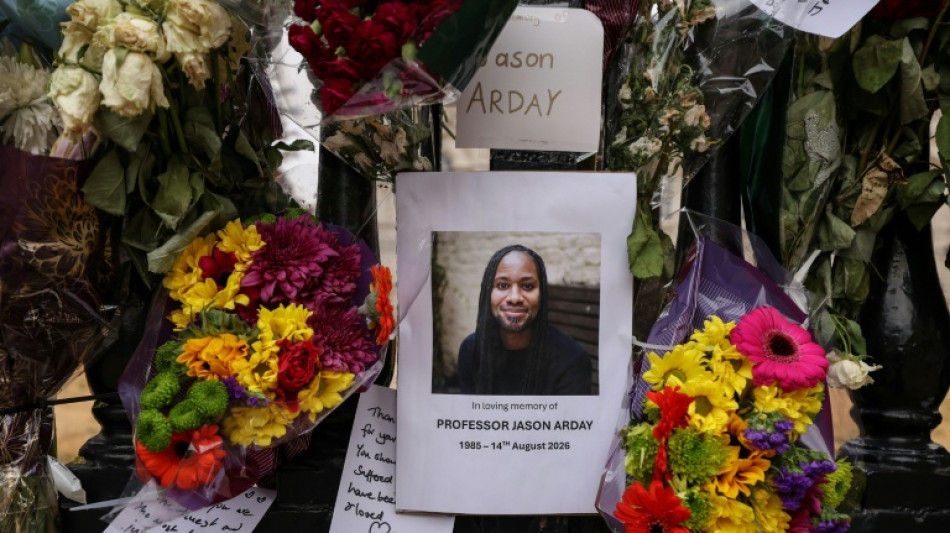
'Lonely place': Black UK academics slam racism after Arday's death / Photo: Chris RADBURN - AFP
When Jason Arday was hired in 2023 aged 37, he was Cambridge University's youngest-ever black professor, one of only a small number at the prestigious institution -- and in Britain.
Since Arday died on Friday amid a storm of plagiarism accusations and suggestions that he was hired because of his race, black academics have pointed out that they remain grossly underrepresented at UK universities.
At the end of 2024, there were only 270 black university professors in the UK, or just around one percent of the total, according to government data.
While universities have improved their intake of students from ethnic minority backgrounds in recent years, the proportion of black academics in senior positions remains negligible.
"In the case of senior members of staff, especially at professorial level, there is a clear dominance of white males," said Robin Cohen, an emiratus professor at the University of Oxford and an expert on Equality, Diversity and Inclusion (EDI) programs -- the British counterpart of what is known as DEI, or affirmative action, in the United States.
As allegations emerged that Arday had plagiarised sections of his doctoral thesis and exaggerated claims about his personal achievements, right-wing media and commentators were quick to claim that black academics were unduly benefiting from diversity policies.
"As a black professor in the UK I'm used to seeing many assumptions of positive discrimination," Steven Spoel, a biology professor at the University of Edinburgh, told AFP.
"I think a lot of black academics in the community are feeling eyes watching them and questions being asked on whether they should be where they are," said Spoel.
- Diversity 'push-back' -
For Michael Bankole, a politics lecturer at King's College London, the pile-on against Arday went beyond reasonable scrutiny of his work.
"It felt that Jason was being used to highlight that black scholars, when they do reach this position of professorship, aren't deserving," Bankole told AFP.
"He's being used as a vehicle to push back against EDI entirely."
Arday resigned as a sociology of education professor earlier this month after Cambridge announced that it would hold an independent investigation into his hiring.
The academic -- who was diagnosed with autism and other developmental difficulties as a child -- his family and his supporters have alleged that he was the victim of a racist "campaign of sustained abuse" and a media witchhunt.
The Runnymede Trust where Arday was previously a board member, said in a statement that black scholars are "both excluded and exceptionalised" in British higher education.
And an "ideological assault on equity, diversity and progressive anti-racist work" has "intensified in recent years", according to the think tank, which works for racial equality.
According to Cohen, the controversy, which has dominated UK headlines for weeks, was deepened by the anti-DEI wave sweeping the United States.
"The anger and visibility of the campaign against Jason Arday was definitely fuelled by the influence of the righteous right in the USA," Cohen told AFP.
The American acronym DEI has now been "imported" to the UK, Cohen said, alongside the idea that "undeserving minority candidates have been employed or promoted at the expense of better white candidates".
-'Existing in a silo' -
In universities, black academics say, the reality is very different.
For Bankole, being one of just a few black politics scholars feels like "existing in a silo".
"Academics like me are constantly on these fixed-term contracts ... trying to make a way into academia," Bankole told LBC talk radio.
Roadblocks facing black researchers range from a lack of role models to an expectation that they need to "outperform" their peers, said Spoel.
"It's a very lonely place and it's a very threatening place," he said. "You have to deal with the fact that you are highly visible and yet so isolated."
The Society of Black Academics said the response to Arday's death had been one of "grief and anger", but also "something closer to recognition".
"We know what it is to be watched more closely than others, to carry more than our own reputation," the society said in a statement.
Arday's own research focused on dismantling barriers for black and minority academics, with former students and mentees at a London vigil remembering how he encouraged them to pursue careers in higher education.
When he was hired by Cambridge, the university leadership noted Arday's experiences highlighted the challenges faced by minorities at leading universities, and that it was trying to "address this by creating academic spaces where everyone feels they belong".
In his resignation letter, Arday wrote: "I no longer wish to feel as though I am living under a constant spotlight, where every aspect of my life is subject to public examination and judgment."
U.Laurent--LCdB