'I started crying': Battle to tame fresh blaze near French seaside / Photo: Ed JONES - AFP
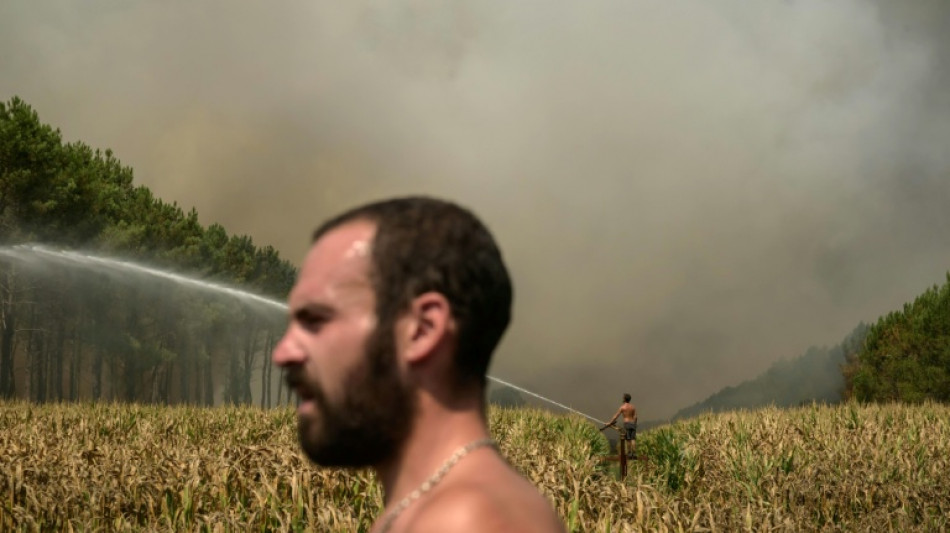
To one side, blue sky, to the other, ashen smog, as erratic winds fanned the flames from the forest fire threatening to raze even more of the French coast.
North of the beach town of Lanton, a full squadron of firefighting aircraft circled over and above the trees, disappearing into the haze to drop their seawater payloads in a bid to keep Wednesday's major outbreak from turning into a self-propelling inferno.
On the ground, a line of fire trucks, tankers and hefty vehicles laden with cisterns of water by an army of dust-crusted volunteers stretched for several hundred metres along the road surrounding the forest.
With the Bordeaux region on alert for a fresh heatwave as temperatures approached 40C and the strong winds acting as bellows, many feared that it would not take much for a blaze like Lanton's to jolt France's worst wildfires since 1949 back into life.
"I'm 67 years old and I've never seen anything like this," said Jean-Claude Bonnet, part of a crew of helpers aboard a Renault Midliner 150 truck carrying refills for the firefighters' hoses.
"We were driving along the road toward here, and then I started crying," he said.
"The worst part is seeing the animals that have been burnt to death by the side of the road.
"It's an ecological disaster -- call it what you will."
- 'What the hell is going on' –
With the firefighters fearing the blaze would jump the 50 metres (165 feet) or so across a corn field separating the burning forest from a so far untouched wood, one of their number spent hours hosing gallons of water onto the forest edge while standing amid the crops.
Back on the road, a group of sweat-flecked volunteers went around handing out bottles of lemonade and cool cans of Orangina, France's flagship citrus soda pop, to stave off the stifling heat.
Some conceded that working in the smog all day had given them a headache. None complained. All knew someone who had it worse than them.
As the flames crept up the pine trees nearby, Lanton's recently elected mayor Loic Ballongue admitted he was initially caught off guard by the spontaneous grassroots movement that brought the volunteer vehicles' convoy from far across the region.
"I said to myself, 'What the hell is going on?'" Ballongue told AFP.
"Then I asked the local authorities, 'What's all this commotion -- should we let them through or not?'"
"And actually, it really took off," said the mayor, praising the volunteers' commitment.
- 'Roll up our sleeves' -
While spirits were high among the helpers, many expressed frustration at the state's response to a blaze that has so far consumed more than 42,000 hectares (103,000 acres).
"Get the prefect out!" chanted one gang, taking aim at an official accused of having prioritised the upmarket Cap Ferret peninsula at the expense of less-favoured communities nearby.
"They've been warning about drought for years and we're not making more firebreaks, we're not making more Canadair firefighting planes," said Frederic Freund, a watersports club owner who had come to pitch in.
"It feels a bit as though everything's been done in a rush because we're forced to do so."
For them, and for those peddling the swirl of online disinformation that has sprung up around the fire, Ballongue had a blunt message.
"I advise them to turn off the TV, log off social media and go for a nice walk," the mayor said.
Bonnet, the volunteer, insisted that "this is not the time for pointing fingers", urging the region to keep showing "solidarity".
Around an hour after the last water-bombing plane made a pass over the fire, the flames returned with a vengeance.
L.Moonen--LCdB