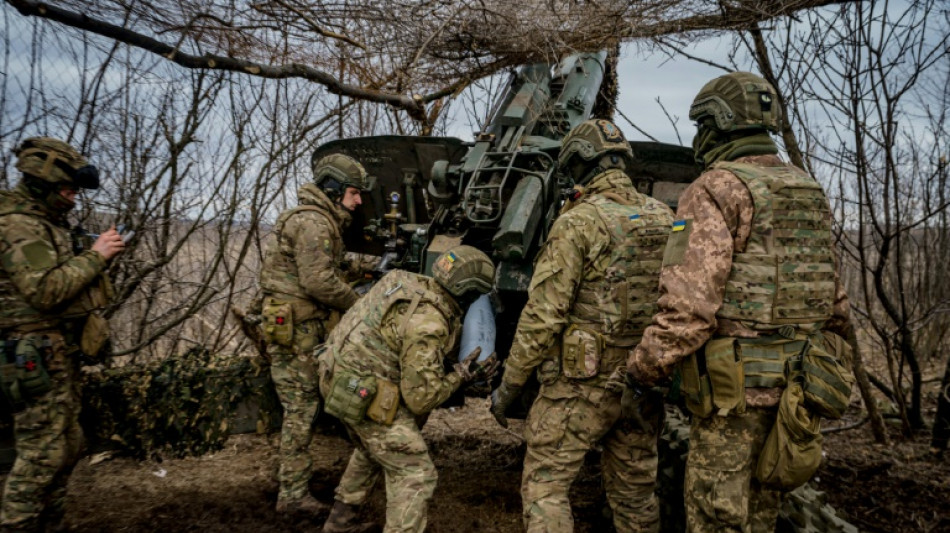
Wagner chief says Ukraine's Bakhmut 'practically surrounded' / Photo: Dimitar DILKOFF - AFP
The head of Russian mercenary group Wagner said Friday the group had "practically encircled" Bakhmut, an industrial city in eastern Ukraine that has seen the fiercest fighting of Moscow's invasion.
The Kremlin meanwhile warned the West against providing more arms to Ukraine, as key Kyiv backers President Joe Biden and German Chancellor Olaf Scholz were set to meet in Washington.
Ukraine has said it will defend "fortress Bakhmut" for as long as possible but this week officials said the situation was becoming increasingly difficult.
Russia is determined to seize Bakhmut -- a now-destroyed city once known for its sparkling wine -- as part of its wider aim of capturing the entire Donetsk region.
"Wagner paramilitary group units have practically surrounded Bakhmut, only one road remains" to be captured, Yevgeny Prigozhin said in a video on Telegram.
The stocky 61-year old has regularly been posting about advances of Wagner, his once-shadowy force that has taken centre stage in the fight in eastern Ukraine.
He has said in recent weeks that his fighters have seized three villages north of Bakhmut -- Yagidne, Berkhivka and Paraskoviivka.
- 'Let them leave' -
"If earlier we were fighting against the professional army, we now increasingly see old people and children," Prigozhin said, in the video released Friday.
"They are fighting, but their life expectancy in Bakhmut is now very short, one day or two," Prigozhin said, calling on Ukrainian President Volodymyr Zelensky to "let (Ukrainian soldiers) leave".
Ukrainian troops have held out for months, fighting brutal trench warfare and artillery battles that have flattened large portions of the city.
Zelensky this week said that the fighting was "only increasing."
His comments followed an assessment from the commander of Ukraine's ground forces Oleksandr Syrskyi, who said the situation was "extremely tense" in the city.
Only around 4,500 civilians remain in the destroyed city, which had a population of about 70,000 before the conflict, Ukrainian officials said.
- Moscow to take 'measures' at border -
Both Ukrainian and Russian forces have reported heavy casualties in the struggle for the control of the city, whose symbolic importance outstrips its military significance.
The fight for the city has also exposed political rivalries between Prigozhin and Russia's regular army.
Last week, he issued an unprecedented call to Russians to take his side and urged the defence ministry to share ammunition with his fighters.
While the hotspot of the fighting is in the east of Ukraine, Russia said this week that a group of Ukrainian combatants had crossed into the southern Bryansk region.
Kyiv dismissed the claims as a "deliberate provocation".
Moscow says its regions bordering Ukraine are routinely shelled by Ukrainian forces, but the reported incursion was a rare instance of fighting inside Russia.
The Kremlin said Friday it would take steps to prevent cross-border incursions which killed two.
"Measures will be taken to prevent similar events in the future," Kremlin spokesman Dmitry Peskov told reporters.
Scholz's first trip to Washington since February 2022 offers the leaders the opportunity to demonstrate their resolve in backing Ukraine against Russia.
"(Arms deliveries) place a significant burden on the economies of these countries and negatively affect the well-being of citizens of these countries, including Germany," Peskov told reporters.
"It is obvious that this will prolong the conflict and have sad consequences for the Ukrainian people," he added.
L.Moonen--LCdB