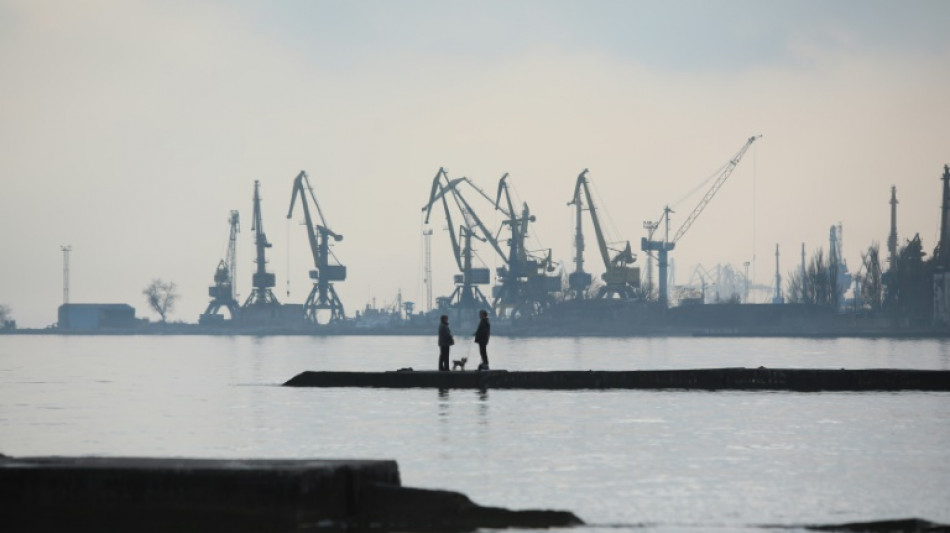
Ukraine port city Mariupol blockaded by Russian forces
Invading Russian troops have blockaded the strategic Ukrainian port city Mariupol, its mayor announced Saturday, as Moscow and Kyiv aimed to hold new talks over the weekend.
While laying siege to Mariupol for days, Russian forces also cut its electricity, food, water, heating and transportation in the depths of winter, prompting comparisons to the Nazi blockade of Leningrad in World War II.
"For now, we are looking for solutions to humanitarian problems and all possible ways to get Mariupol out of the blockade," said mayor Vadim Boychenko. He called for a ceasefire and a humanitarian corridor for food and medicine.
Since President Vladimir Putin's army invaded on February 24, Russia has pummelled Ukrainian cities, killed hundreds of civilians and assaulted Europe's largest atomic power plant.
The invasion has drawn condemnation and severe sanctions from Western nations balancing punishment of the Kremlin with fears of a hazardous escalation.
Moscow has seized two key cities in its 10-day-long invasion, Berdiansk and Kherson on Ukraine's southern Black Sea coast.
But capturing Mariupol, a city of about 450,000 people on the Azov Sea, would represent a bigger prize for Russian forces as it would deal a severe blow to Ukraine's maritime access and connect troops coming from annexed Crimea and the Donbas.
Kremlin spokesperson Dmitry Peskov said late Friday that Moscow was waiting for a third round of talks with Ukraine in Belarus, and one of Kyiv's negotiators said it hoped to hold them this weekend.
"The third leg could take place tomorrow or the day after, we are in constant contact," Ukrainian presidential advisor Mykhailo Podolyak said Friday.
As Russia bombed cities across the country, the Ukrainian military said on Facebook that Moscow's main focus was to encircle Kyiv.
In a hospital in the Ukrainian capital, wounded soldiers told AFP of their grim battle against the Russian advance, and vowed to return to the frontline.
"We were on reconnaissance and came across an enemy column that had made a breakthrough," said Motyka, 29, who was hit by shrapnel on his right side.
"We fought them and killed their soldiers on foot, but they showered us with mortar fire."
Ukrainian President Volodymyr Zelensky was set to appeal to Washington for more assistance Saturday. He will address the US Senate as some lawmakers urged President Joe Biden to take tougher measures, including banning Russia's oil imports.
- No no-fly zone -
Zelensky had earlier criticised NATO for ruling out a no-fly zone, saying the Western military alliance had essentially given "the green light for further bombing of Ukrainian cities and villages".
In the northern city Chernihiv, 47 people died Thursday when Russian forces bombed residential areas, including schools and a high-rise apartment block, according to local officials.
"We are faced together with what is President Putin's war of choice, unprovoked, unjustified, and a war that is having horrific, horrific consequences," US Secretary of State Antony Blinken said in Brussels.
"We're committed to doing everything we can to make it stop."
Putin on Friday told his Belarusian counterpart Alexander Lukashenko that "the tasks set for the (Ukraine) operations are going according to plan and will be fulfilled in their entirety".
With fears growing of nuclear conflict, the US and Russian armed forces have set up a new direct phone line to reduce the risks of "miscalculation," the Pentagon said Friday.
Russian forces attacked and seized the Zaporizhzhia nuclear plant on Friday, pushing Kyiv to accuse Moscow of "nuclear terror".
Ukrainian monitors say there has been no spike in radiation after a fire in a training facility.
Moscow denied it had shelled the plant.
- Media exodus -
Peskov called on Russians "to unite around our president" after thousands braved mass arrests at anti-war demonstrations this week.
In an apparent response to the unrest, Russian authorities have imposed a news blackout and several media outlets have halted operations.
Multiple media websites, including the BBC, were partially inaccessible in Russia.
Twitter was restricted and Facebook blocked.
The BBC and Bloomberg said they were suspending work in Russia after lawmakers in Moscow approved legislation to impose fines and jail terms of up to 15 years for anyone publishing "fake news" about the army.
"This legislation appears to criminalise the process of independent journalism," BBC Director-General Tim Davie said in a statement.
CNN said it would halt broadcasting in Russia, while independent Russian newspaper Novaya Gazeta said it would remove Ukraine content in the wake of the new law.
- 'Whole world against you' -
Putin has been unmoved as Russia has become an economic, sporting and cultural pariah.
But UN prosecutors at The Hague are investigating a possible war crime in the eastern city of Kharkiv, where authorities say residential areas were indiscriminately shelled.
Ukrainian Foreign Minister Dmytro Kuleba demanded a special tribunal, alleging there were "numerous cases of, unfortunately, when Russian soldiers rape women in the Ukrainian cities".
In Geneva, the UN Human Rights Council voted to create a top-level investigation into violations committed in the invasion.
"The message to Putin has been clear: you're isolated on a global level and the whole world is against you," Ukrainian ambassador Yevheniia Filipenko said after the vote.
The UN Security Council will hold an emergency meeting Monday on the humanitarian crisis in Ukraine and discuss a possible draft resolution, diplomats told AFP Friday.
The UN says more than 1.2 million refugees have flooded into neighbouring countries.
The global body's food agency has warned the conflict will create a food crisis in Ukraine and worsen global food insecurity, with Moscow and Kyiv providing around 29 percent of the global wheat trade.
A.Peeters--LCdB