Ukrainians run for their lives from Russian bombs
Exploding shells blew apart roadsides Saturday and Russian warplanes bombed stretches of the horizon as thousands of Ukrainians scrambled to escape Kyiv’s war-shattered outskirts by any means possible.
The roads on Kyiv's western edge bear witness to a human tragedy whose scale grows ever greater as Russia's assault on the Ukrainian capital becomes more determined and indiscriminate.
The Russian forces' initial assault on Kyiv -– launched with missile strikes and an airborne assault on an airbase -- stalled at the end of last week.
The two sides have since been locked in a long-range shelling war along Kyiv's outskirts that has put working class towns such as Bucha and Irpin in the line of fire.
But people fleeing the two towns said their resolve to stay broke down when Russian warplanes started circling overhead and dropping bombs on Friday.
"Warplanes. They are bombing residential areas -- schools, churches, big buildings, everything," accountant Natalia Dydenko said after a quick glance back at the destruction she left behind.
The 58-year-old was one of thousands of people walking with their children and whatever belongings they could carry down a road leading toward central Kyiv and away from the front.
The metric booms of Russia bombs dropped from warplanes circling over Bucha and Irpin provided a morbid backdrop for their desperate march.
"It began two days ago. It wasn’t as heavy before, but two days ago it started getting really heavy," she said.
- 'We had to run' -
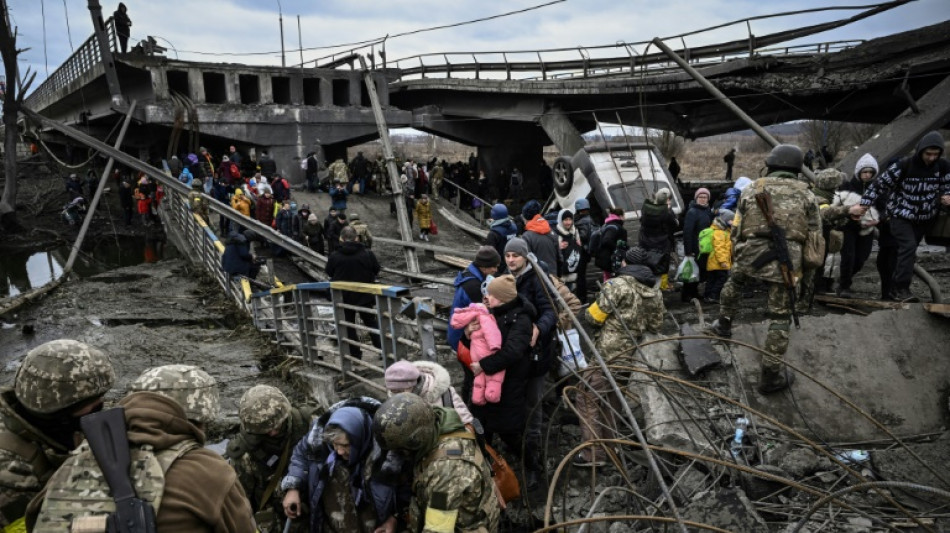
People were trying to get to the remains of a bridge leading to Kyiv over the Irpin River which Ukrainian forces blew up last week to stall the Russian advance.
Ukrainian soldiers with assault rifles swinging off their shoulders helped wheelchair-bound pensioners and mothers with prams cross a few wooden planks tossed over the river on Saturday.
Thousands of people massed in stony silence under the shattered remains of the original concrete bridge while awaiting their turn to pass.
A group of soldiers was digging anti-tank missile launchers into foxholes on the Kyiv side of the river.
Another group was preparing new supplies of shoulder-launched missiles and Kalashnikovs that could be ferried back across the wooden planks toward the front.
A long-range missile whistled overhead.
A hollow thud about half a minute later signalled still more destruction somewhere in the general vicinity of northern Kyiv.
"We were waiting it out. But yesterday, when a plane flew by and dropped something on us, we simply had to run," said Galina Vasylchenko, walking with her 30-year-old daughter toward the makeshift bridge.
- Shift in tactics -
The seeming shift in Russia's strategy from shelling to aerial bombings is a bad omen for the Ukrainian capital.
Russian warplanes have bombed and killed dozens in the central town of Chernihiv and the eastern city of Kharkiv in the past week.
Many analysts felt that Kyiv's heritage -- as well as a plethora of churches that answer to the Moscow patriarchate -- would keep Russia from bombing the city of three million people.
But the destruction is creeping closer to Kyiv.
The town of Bucha -- the further out of the two towns -- had witnessed the first fighting and parts of the area are now all but razed to the ground.
That same level of violence is now raining down on Irpin.
A supermarket and petrol station that on Friday stood at a large junction on the border between Bucha and Irpin was just ruins on Saturday.
Soldiers were ushering the fleeing residents onto buses on the Kyiv side of the Irpin River because walking on that part of the city's streets was no longer safe.
- 'Nowhere to go' -
Thousands more piled their belongings into cars and tried to get out of Irpin by taking a circuitous route that leads to Kyiv's main train station from the southwest.
A queue of cars stretching at least five kilometres (three miles) snaked its way past dozens of sandbagged checkpoints manned by armed Ukrainian volunteers in western Kyiv on Saturday.
Many had signs reading "children" taped to their windshields.
"They have nowhere to go," she said. "But it is very unsafe to stay."
S.Leysen--LCdB