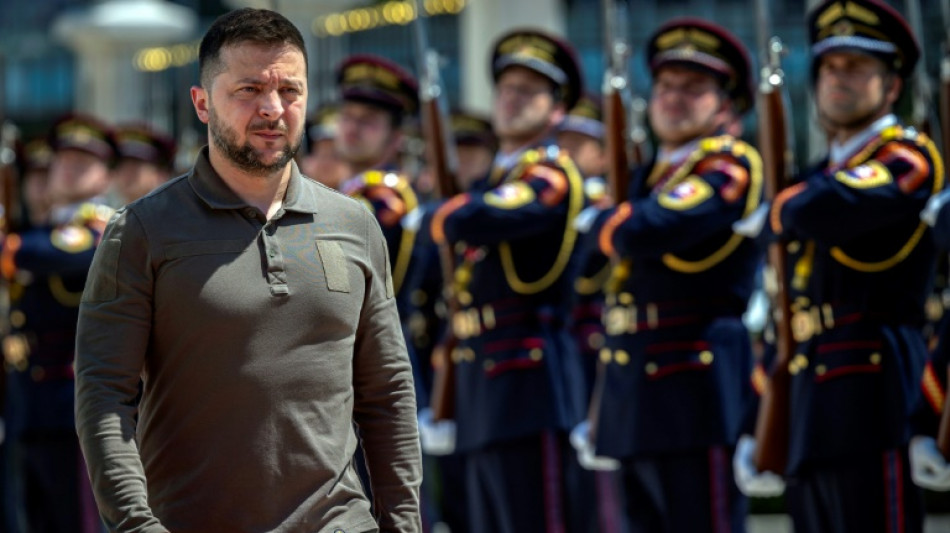
Zelensky wins Erdogan's NATO backing after securing US cluster bombs / Photo: TOMAS BENEDIKOVIC - AFP
President Volodymyr Zelensky on Saturday secured Turkey's crucial backing for Ukraine's NATO aspirations after winning a US pledge for cluster munitions that could inflict massive damage on Russian forces on the battlefield.
Washington's decision to deliver the controversial weapons -- banned across a large part of the world but not in Russia or Ukraine -- dramatically ups the stakes in the war, which entered its 500th day Saturday.
Zelensky has been travelling across Europe trying to secure bigger and better weapons for his outmatched army, which has launched a long-awaited counteroffensive that is progressing less swiftly than Ukraine's allies had hoped.
He called the latest US arms package "timely, broad and much-needed", tweeting that it "will provide new tools for the de-occupation of our land".
But US President Joe Biden admitted that supplying Ukraine with weapons that are capable of covering several football fields with hundreds of multiple small explosives was "a difficult decision".
"And by the way, I discussed this with our allies," Biden told CNN. "The Ukrainians are running out of ammunition."
- No immediate NATO membership -
AFP teams on the ground have seen both Ukraine and Russia use their existing stocks of the weapons, whose use humanitarian groups strongly condemn.
They warn that many bomblets go undetonated, potentially endangering civilians for years to come.
Defending the US move, National Security Advisor Jake Sullivan argued there was "a massive risk of civilian harm if Russian troops and tanks roll over Ukrainian positions and take more Ukrainian territory".
Russian officials issued no immediate response.
Zelensky has been also pushing hard for membership of NATO, arguing that Ukraine had turned into Europe's last line of defence against Russia's aggression.
The White House said membership would come in the "not too distant future", but not at next week's summit in the Lithuanian capital Vilnius.
Kyiv "still has further steps that it needs to take before membership", Sullivan said.
- Kremlin watching 'closely' -
Zelensky's talks in Turkey -- a strategic member of NATO on uneasy terms with the West -- were being watched closely by the Kremlin, which has tried to break its international isolation by cultivating strong relations with Recep Tayyip Erdogan.
Erdogan has tried to portray himself as a neutral mediator, substantially boosting wartime trade with Russia while supplying Ukraine with drones and other weapons that helped keep Kremlin forces from seizing Kyiv in the first weeks of war.
But while reaffirming his longstanding call for both sides to enter peace negotiations, Erdogan risked drawing the ire of Russian President Vladimir Putin by delivering unequivocal support for Ukraine's NATO aspiration.
"There is no doubt that Ukraine deserves membership of NATO," Erdogan told a joint media appearance with Zelensky in Istanbul.
"I was glad to hear that the president said that Ukraine deserves to become a NATO member," Zelensky added in his own remarks.
The messages threatened to tear at Erdogan's ties with the Kremlin, which warned ahead of the meeting that it would be watching the outcome of Zelensky's visit "very closely".
Erdogan said he will personally be able to brief Putin on the negotiations when the Kremlin chief makes his first visit to Turkey since the invasion next month.
The Turkish leader said he and Putin would discuss possible prisoner swaps, which Erdogan has helped to arrange in the past.
Erdogan added that he would push Putin to extend a deal that Turkey and the United Nations brokered last year under which Ukraine was able to ship grain to the global market.
The deal will expire on July 17 unless Russia agrees to its renewal.
- 'Progress' on nuclear inspections -
The head of the UN's nuclear watchdog said on Friday that it was "making progress" on inspecting several areas of the Zaporizhzhia nuclear plant in Ukraine, after claims it had been mined.
Ukraine and Russia have accused each other of planning a provocation at the Russia-controlled site, raising alarm over the threat of radioactive disaster at Europe's largest nuclear plant.
Ukraine's military this week claimed "external objects similar to explosive devices" had been placed on the outer roof of the third and fourth reactors at the site.
They had "not seen any indications of explosives or mines", he said, although he added IAEA officials had not yet been able to visit the facility's rooftops.
Rescuers on Friday found a tenth body in the rubble of buildings in Lviv after the biggest Russian missile attack on civilian infrastructure in the western Ukrainian city since the invasion, its mayor said.
The strike also wounded 42 people, including three children, Ukraine's interior ministry said.
burs-zak/rox
K.Cox--LCdB