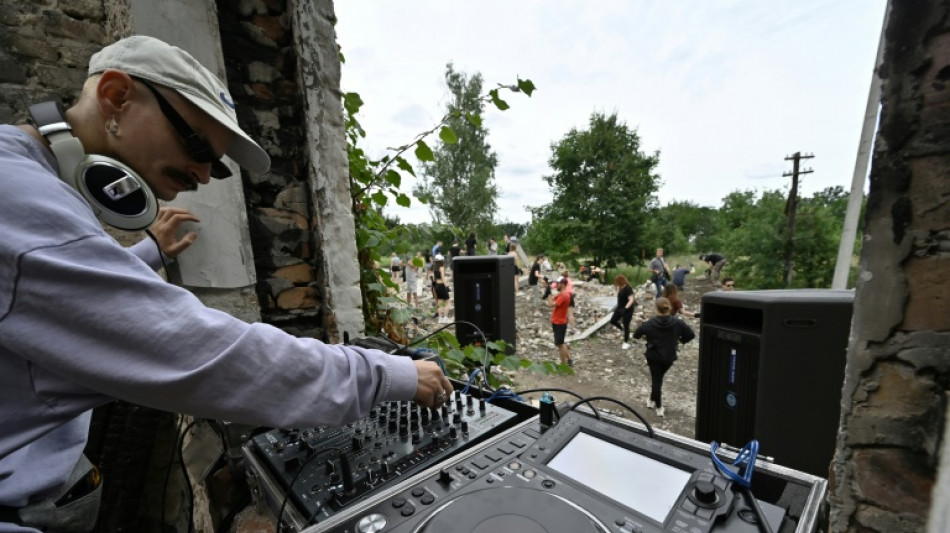
Ukrainian partygoers help clear away ruins of war / Photo: Genya SAVILOV - AFP
To the sound of club beats, hundreds of young Ukrainians swarmed over the ruins of bombed-out homes in several villages in the north of the country this weekend.
The gathering in the Chernigiv region was no ordinary party but part of an initiative for volunteers to help clear away debris and rebuild their country.
"This is an example of how young people can be useful, while not compromising the way we like to spend our time listening to music," said Dmytro Trofymenko, a DJ.
"We're cleaning up the consequences of Russian occupation," said the moustachioed 31-year-old as volunteers dressed to party formed a human chain to carry away bricks from a ruined building.
The initiative called Repair Together started out last year and has been active in different parts of Chernigiv that were either under Russian control or on the front line for several weeks.
"We communicate with the local authorities. They give us a list of buildings and addresses that need to be dismantled," said Bogdan Bieliaiev, 29, one of the organisers.
Professional builders then get to work once the debris has been cleared away.
- 'Supports mental health' -
There are regular outings in the summer and most of the volunteers come from the capital Kyiv or the surrounding region.
Bieliaiev estimated up to 350 people were taking part in this weekend's gathering and the average age was around 25.
"Most of them want to help. They don't want to be at home," he said.
Oleksandra Horgan, a 28-year-old agriculture expert wearing sunglasses and a leopard-print kerchief on her head, said she was "inspired by patriotism".
"Unfortunately, my hometown is currently occupied. I cannot physically help them, only financially. I feel like somehow, this way, I'm making up for it," she said.
Yaryna Kvasnii, 21, said: "Sometimes you want to help people with your hands.
"Plus it benefits the community. They don't need to hire anyone, just proactive young people who will do it for free."
After a hard day's work, the volunteers took time to relax, joining in celebrations for the folk tradition of Kupala Night -- usually held on the day of the summer solstice.
The volunteers stripped down and took a dip in a nearby lake, some of them wearing embroidered linen shirts and elaborate crowns made of flowers.
Later, they danced around a fire.
Anna Pendyukh, a 30-year-old graphic designer, said the gatherings were a way of getting rid of "a lot of negativity".
"It's non-stop outdoor fitness, company, people, socializing. It's very important in wartime, it supports mental health."
"This is the most constructive, non-destructive way to do that," she said.
O.Dupont--LCdB