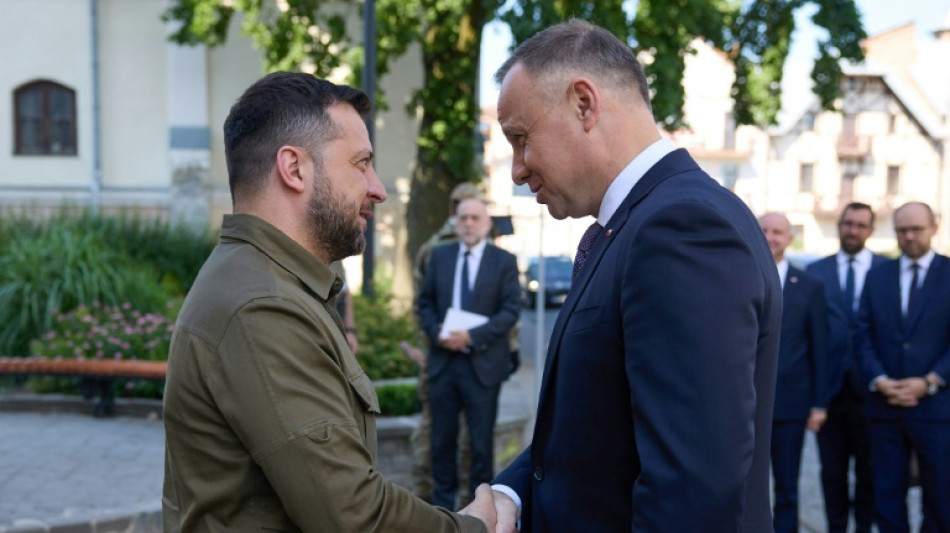
Zelensky eyes 'best possible result' from NATO summit / Photo: Handout - UKRAINIAN PRESIDENTIAL PRESS SERVICE/AFP
Ukrainian President Volodymyr Zelensky on Sunday voiced hope for the "best possible result" from an upcoming NATO summit where Kyiv is hoping for a clear signal that it could one day join the alliance.
After meeting his Polish counterpart Andrzej Duda, Zelensky said the two discussed the summit starting in Vilnius on Tuesday and agreed to "work together to get the best possible result for Ukraine".
Poland is one of Ukraine's biggest supporters within NATO and has said it wants "security guarantees" for the country from other NATO members.
Zelensky has said he does not expect Ukraine to actually join NATO until after the war but he hopes the summit will give a "clear signal" on the intention to bring Ukraine into the alliance.
US President Joe Biden, who set off on Sunday for Britain on his way to the NATO summit, said he hoped the military alliance leaders would "lay out a rational path for Ukraine to be able to qualify to be able to get into NATO".
Speaking to CNN, he said there were also "other qualifications that need to be met, including democratisation".
"I don't think there is unanimity in NATO about whether or not to bring Ukraine into the NATO family now, at this moment, in the middle of a war," he added.
Bringing Ukraine in now, Biden said, would mean "war with Russia" because of the NATO commitment to collective defence.
- 'Destructive course' -
Zelensky returned from Turkey on Saturday after a regional tour to drum up support ahead of the summit with Western allies, who have pledged billions in military aid.
He was accompanied by five top commanders from the Azov regiment who were supposed to have remained in Turkey until the end of the conflict under a prisoner exchange deal with Moscow.
Their return to Ukraine angered the Kremlin, with spokesman Dmitry Peskov quoted by Russian news agencies on Saturday as saying that it was "a direct violation" of the agreement with Turkey.
One of the men, Denys Prokopenko, was quoted by Interfax Ukraine news agency as saying that he would return to the front.
"That is why we have come back to Ukraine. It is our main aim," said Prokopenko, who along with the others had been living in Turkey since September.
Peskov said the return was linked to the "failure" of Ukraine's counteroffensive, and Ankara's desire to show "solidarity" ahead of the NATO summit.
"Preparations for the NATO summit are underway and of course there has been a lot of pressure on Turkey," he said.
Turkish Foreign Minister Hakan Fidan spoke to his Russian counterpart Sergei Lavrov on Sunday and the two discussed the issue of the Azov commanders, the Russian foreign ministry said in a statement.
The Turkish minister was told that sending military supplies to Ukraine was a "destructive course", the ministry said.
- 'Country of the brave' -
Russian troops invaded Ukraine on February 24, 2022.
The UN has documented the deaths of 9,000 civilians since then, including 500 children, as a result of the conflict, although it estimates the real toll may be much higher.
Zelensky hailed Ukraine as "the country of the brave" in a video clip released on social media on Saturday, the 500th day of the war.
The video showed him visiting Snake Island in the Black Sea -- a symbol of Ukraine's defiance against Russia.
The island was captured by Russian forces shortly after the start of the invasion.
A radio exchange went viral in which Ukrainian soldiers told the crew of Russia's attacking warship demanding their surrender to go away, using a swearword.
The Ukrainian soldiers were taken prisoner but later exchanged for Russian captives and the island was recaptured by Ukrainian forces in June last year.
- Danger 'for many years' -
Zelensky last week also won a US pledge for cluster munitions that could inflict significant damage to Russian forces.
Washington's decision to supply Ukraine with cluster bombs -- banned across a large part of the world -- has proved highly controversial.
Biden admitted that it had been "a difficult decision", while humanitarian groups strongly condemned it.
Cambodian Prime Minister Hun Sen, whose country still grapples with deadly war remnants, on Sunday urged Ukraine not to use cluster bombs.
He cited Cambodia's "painful experience" of US cluster munitions dropped in the early 1970s, a foreign legacy that has left tens of thousands maimed or killed.
Russia, which itself uses cluster munitions in Ukraine, said the decision was an "act of desperation" that would have "no effect" on the conflict.
S.Leysen--LCdB