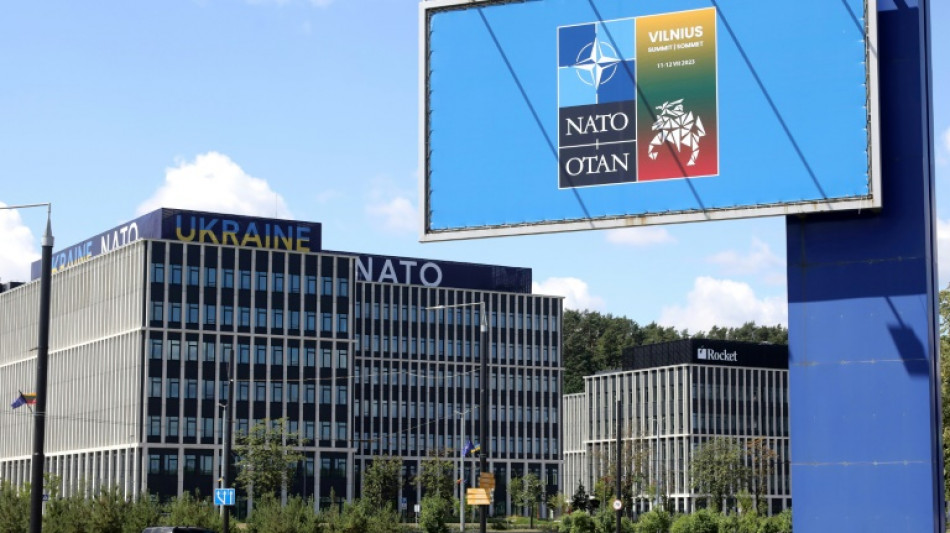
NATO wrestles with Ukraine bid at summit on Russia's doorstep / Photo: PETRAS MALUKAS - AFP
NATO leaders will grapple with Ukraine's membership ambitions at their summit Tuesday, their determination to face down Russia boosted by a breakthrough in Sweden's bid to join the alliance.
German Patriot missile systems and French fighter jets were guarding the skies as NATO heads gathered in Lithuania, on NATO's eastern flank and a land once occupied by Moscow.
Ukrainian President Volodymyr Zelensky is expected to head to Vilnius for the two-day summit to make the case that Kyiv has earned the right to join when the Kremlin's invasion ends.
"Ukraine deserves to be in the alliance. Not now, because now there's war, but we need a clear signal," Zelensky said in Kyiv on the eve of the summit.
The Western military alliance is set to offer its full-throated backing for Kyiv's quest for victory, but its 31 nations are divided over how far to go on letting Ukraine join their ranks.
While Ukraine's neighbours have pushed for an explicit timetable, heavyweights the United States and Germany are reluctant to go beyond an earlier vow that it will become a member one day.
US President Joe Biden has said there is no agreement to offer Kyiv membership while its war with Russia rages, as this would drag NATO directly into the conflict.
"I don't think there is unanimity in NATO about whether or not to bring Ukraine into the NATO family now," Biden told CNN.
But the alliance is offering Kyiv a branch by simplifying its eventual accession bid and dropping a requirement that it complete a formal road map of reforms.
As Ukraine wages a punishing counter-offensive, dominant powers the United States, Britain, France and Germany have been negotiating long-term commitments on weapons supplies with Kyiv.
These fall far short of Zelensky's desire to be under NATO's collective defence umbrella, but could reassure him that his nation can keep on fighting.
Drawing up something similar to the US arrangement with Israel -- which sees Washington sending $3.8 billion (3.5 billion euros) of weapons each year for a decade -- is one possibility.
- NATO overhaul -
The biggest war in Europe since World War II has propelled NATO into the most sweeping overhaul of its defences since the end of the Cold War.
Alliance leaders should sign off on new regional plans to protect against any potential Russian attack and agree to bolster defence spending targets.
But letting Ukraine in remains a step too far for some for now.
Diplomats have been wrangling up to the wire over the exact wording final communique as they seek to convince Ukraine it is moving forward.
In 2008, NATO left Ukraine in a grey zone by vowing it will become a member but failing to back that up with any concrete progress.
Kyiv's push to join the Western bloc enraged Putin and was used as a pretext by the Kremlin leader to justify his war.
- Turkey backs Sweden -
But more than 500 days into the conflict, Putin is facing a greater NATO presence lined up against Russia.
After hours of talks, Turkey's President Recep Tayyip Erdogan on Monday ended months of deadlock by agreeing to forward Sweden's application for NATO membership to his parliament for approval.
NATO chief Jens Stoltenberg hailed a "historic day" that should help clear the way for Sweden to become the second new member since Finland joined in April.
Turkey has been holding up Sweden's application to join the Atlantic alliance, accusing Stockholm of harbouring Kurdish activists Ankara regards as terrorists.
In a joint statement Stockholm said it will now "actively support" efforts to reinvigorate Turkey's long-stalled accession bid for the EU.
Hungary is also yet to approve it, although Prime Minister Viktor Orban's government has vowed it will not be the last to make the step, implying it will move soon.
B.Janssens--LCdB