Israel protesters up resistance after judicial clause voted through / Photo: JACK GUEZ - AFP
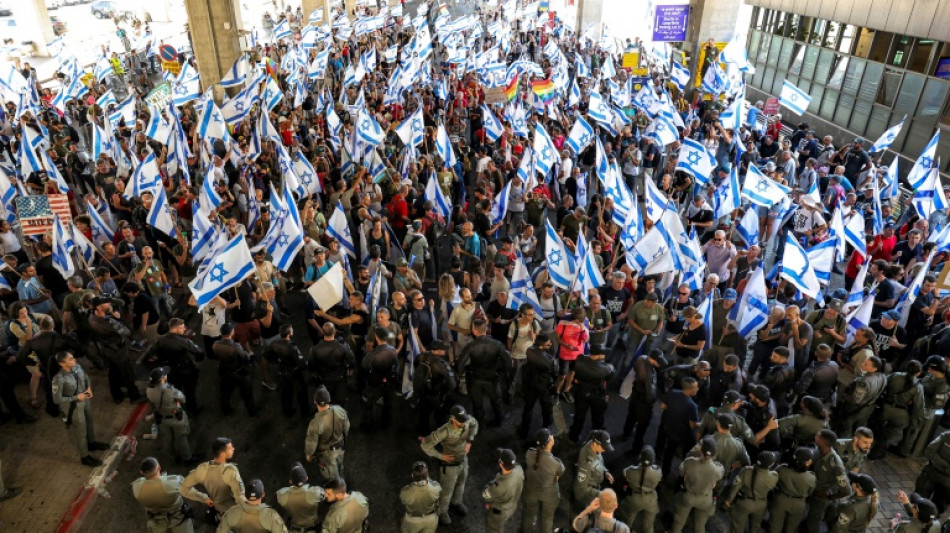
Israeli protesters blocked highways and converged on the Tel Aviv airport Tuesday, stepping up resistance to the hard-right government's judicial overhaul package opponents say threatens democracy.
Dozens of people were arrested, said police, who used water cannon and deployed mounted officers to disperse demonstrators in the commercial capital, Tel Aviv.
Announced in January by the government of Prime Minister Benjamin Netanyahu, the plan has split the nation and sparked one of the country's biggest ever protest movements, with weekly demonstrations often by tens of thousands.
Protests erupted across the country after parliament adopted, overnight Monday-Tuesday, a key clause of the package in a first reading.
Demonstrators blocked roads across Israel and gathered at Ben Gurion Airport near Tel Aviv, where local media reported thousands of protesters had converged.
Police reported more than 70 arrests nationwide.
"This is the last chance that we have in order to fight against this kind of demolishing (of) the Israeli democracy," said Yair Bortinger, 47, a high-tech worker.
"We show everybody that we are a force that they need to reckon with," he added outside an airport terminal, where crowds blew horns and waved Israeli flags.
Elsewhere, demonstrators brought traffic to a standstill along highways between Tel Aviv and Jerusalem.
Protest organisers said dozens of rallies would be held across the country.
- Biden seeks 'moderation' -
At Ben Gurion Airport, demonstrator Sivan Levin, 48, said the government is "taking away our rights and that's what we are fighting against."
"The airport symbolises our connection to the world and we want the whole world to know that our democracy is in danger," said Levin, also employed in the economically vital high-tech sector.
Other rallies are slated later Tuesday outside Netanyahu's Jerusalem residence and in front of the Tel Aviv mission of Israel's top ally, the United States.
The latest parliamentary vote aimed to scrap the "reasonability" clause, through which the judiciary can strike down government decisions.
Under the measure, Netanyahu was forced in January to remove from his cabinet Aryeh Deri of the ultra-Orthodox Jewish party Shas, over a previous tax evasion conviction.
The proposals would also give the government a greater say in the appointment of judges.
Speaking in parliament during the overnight debate, opposition leader Yair Lapid vowed the bill would not make it through its second and third readings.
Following stiff opposition and growing international criticism -- including from US President Joe Biden -- Netanyahu ordered a "pause" in March to allow for talks on the proposals.
That cross-party dialogue collapsed last month.
In a CNN interview aired Sunday, Biden said he hoped Netanyahu would "continue to move towards moderation and change in the court".
The Israeli premier told the Wall Street Journal last month that he had removed one of the most controversial elements of the overhaul, a clause that would allow parliament to override Supreme Court rulings.
- 'Historic proportions' -
Netanyahu returned to power in December at the head of a coalition with ultra-Orthodox and extreme-right allies. His administration argues the judicial revamp is necessary to ensure a better balance of power.
While protesters see a threat to democracy, Justice Minister Yariv Levin told parliament that the current system contradicts democracy.
"The whole responsibility lies with the government, while a handful of judges -- who are not required to report to the public -- take the authority for themselves," he said.
Opponents have accused Netanyahu, who is on trial for corruption charges he denies, of trying to use the reforms to quash possible judgements against him. The prime minister has rejected the accusation.
Netanyahu had announced the March pause with the country gripped by a general strike. Arnon Bar-David, chairman of the Histadrut trade union confederation which called that walkout, told Netanyahu "the ball is in your court" now.
The bill is set for further discussion in the parliamentary justice committee on Tuesday before it returns to the chamber.
In the absence of lasting negotiations with the opposition, the cabinet is now determined to press on with the legislative process.
President Isaac Herzog on Sunday decried "a blunder of historic proportions".
"An agreement is attainable," he said in a statement. "And yet, still no one is willing to sit down and talk, now, without preconditions."
U.Smet--LCdB