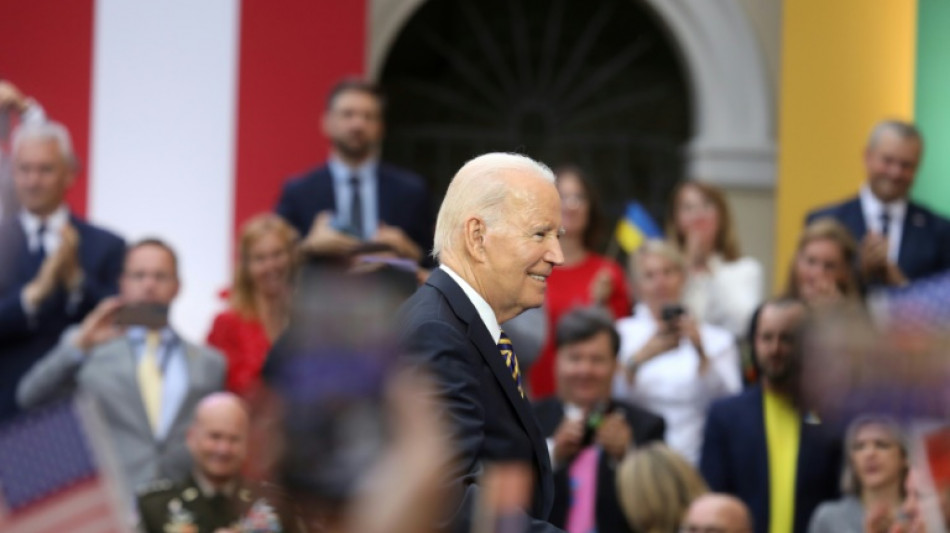
Biden had to be an Erdogan whisperer. But then came Zelensky / Photo: PETRAS MALUKAS - AFP
Joe Biden already had his work cut out to prevent Turkey from spoiling the NATO summit. What wasn't expected was that Ukraine's Volodymyr Zelensky would be the one casting an even bigger cloud -- and testing the US president's diplomatic powers in real time.
Biden has celebrated what he calls unprecedented Western unity in support of Ukraine and NATO as one of the main achievements of his first term.
And the Vilnius NATO summit this week was meant to showcase that record ahead of his re-election fight next year.
Yet instead, as Biden flew to Europe on Sunday, the threat of embarrassing failure loomed.
NATO member Turkey had long threatened to torpedo the bid of Sweden to become the alliance's latest entry. Now, less than two days before the start of the summit in Lithuania, Turkish President Recep Tayyip Erdogan was suddenly out with a new and seemingly unrealistic demand: renewed EU membership talks for Turkey in exchange for giving Sweden the NATO green light.
Biden didn't wait, reaching Erdogan on the phone from Air Force One from over the Atlantic for a talk that lasted almost an hour. The very next day, Erodgan dropped his opposition.
To be sure, plenty of frantic diplomacy took place in the interval. Erdogan talked to the NATO secretary general, to Sweden's prime minister and EU chief Charles Michel.
And Biden's role remained discreet, with the contents of his in-flight phone call private, although it did include an arrangement for the two leaders to sit down in person once they'd both got to the NATO summit.
National Security Advisor Jake Sullivan would not, for example, confirm that the long-delayed sale of US F-16 fighter jets to Turkey was a bargaining chip or that Biden strong-armed Erdogan.
"His focus in that conversation was really on how the US and Turkey could move forward positively -- not, you know, trying to paint a negative or dark scenario," Sullivan said.
But Sullivan was also clear that Biden deserved credit.
NATO's expansion and newfound sense of purpose is "in no small part thanks to President Biden's personal leadership."
- Enter Zelensky -
No sooner was the Turkey spat cleared than Biden and his key allies faced a jarring new challenge Tuesday: a furious Zelensky.
Zelensky came to the NATO summit as the alliance's main focus, leader of a country whose defiance against Russian invasion has captured Western hearts -- and geostrategic priorities.
Over the last year and a half, NATO countries, led by the United States, have poured vast amounts of weapons and economic aid into Ukraine, enabling it to wreck Kremlin leader Vladimir Putin's dream of unstoppable conquest across the ex-Soviet republic.
Ukraine, though, came to the summit wanting much more: NATO membership and with it the ultimate security guarantee of collective defense and a nuclear umbrella.
When the alliance made clear that it was sticking with the US position of keeping Ukraine out for the foreseeable future -- arguing that it fears whipping up World War 3 -- Zelensky's frustration boiled over.
In a tweet that rocked the whole summit, he called NATO's position "absurd" and a sign of "weakness".
Twenty four hours later, however, Zelensky's tone had markedly softened, allowing the summit to close on a note of relative harmony.
This time, the White House diplomatic efforts -- part cajoling, part arm around the shoulder, part promises -- were more visible.
At what US officials said was Biden's instigation, the G7 countries banded together to vow massive, long-term aid packages for Ukraine, ensuring that it would not be abandoned even outside of NATO.
At the same time, firm words were issued to remind the world that Ukraine had hardly been badly treated.
"We're not just sitting around. We are providing an unbelievable amount of weaponry and military assistance to Ukraine," Sullivan said sharply.
Then during a one-on-one meeting Wednesday with Zelensky, Biden was empathetic, acknowledging the "frustration" for a nation desperate to fend off invaders.
Mollified, Zelensky noted that the United States had already delivered more than $40 billion in military aid and said -- repeatedly and effusively -- that he was thankful.
"It's huge support," he said in one of several such statements. "Thank you very much that all these days you are with us. I mean, you and Americans, all of Americans, and Congress."
Biden responded by thanking Zelensky for "acknowledging the American people".
U.Smet--LCdB