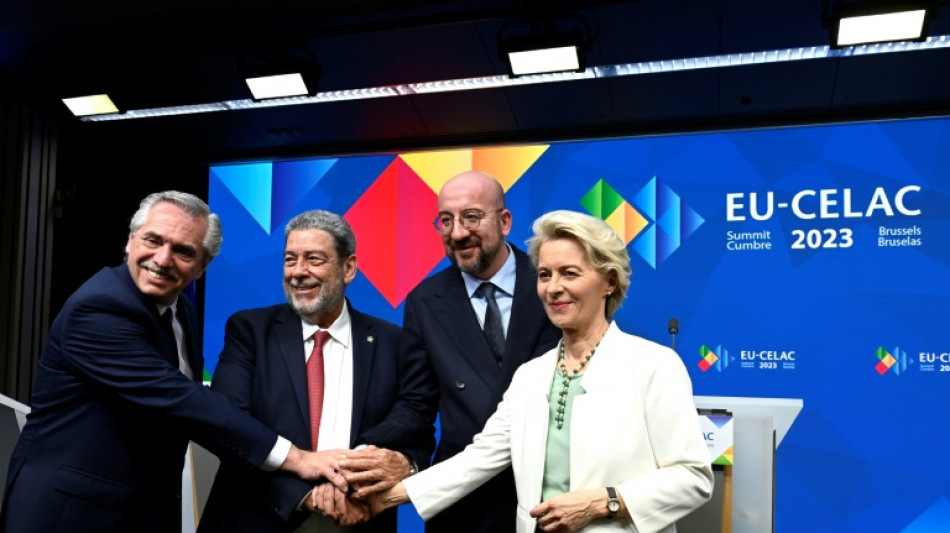
EU's Latin America summit underscores rift over Russia / Photo: Jean-Christophe VERHAEGEN - AFP
European, Latin American and Caribbean leaders n Tuesday failed to agree on a statement holding Russia to account for the war in Ukraine, highlighting their differences over the crisis.
The joint communique issued after the EU and the Community of Latin American and Caribbean States (CELAC) summit expressed "deep concern" about the conflict but contained no mention of Russia.
"We cannot make this summit between the European Union and CELAC be a summit on Ukraine," said CELAC president Prime Minister Ralph Gonsalves of Saint Vincent and the Grenadines, at the final press conference.
"But clearly Ukraine is a matter of great importance to Europe and the world -- other conflicts too, in the world," he said.
And, even this position -- adopted after the first such summit in eight years -- was rejected by one of the approximately 60 countries represented, understood to be Nicaragua.
Before the talks, European leaders such as Luxembourg's Prime Minister Xavier Bettel had said it would be "a shame" if the leaders failed to state clearly that "Russian aggression" was the cause of the deadliest war in Europe in decades.
Summit host Charles Michel, the president of the European Council, said Europe would always reiterate its determination to "defend Ukraine against this aggression by Russia and if you look at this declaration ... there are a number of points that refer to that situation."
But the word "Russia" did not appear in the communique.
Gonsalves played down this omission in colourful terms.
- Naked lambada -
"There's a reaffirmation of positions and a ticking of the box. It doesn't mean that you have to go and do the lambada in the nude any time a subject is raised. The language is there, I don't know what we need to do more than this," he said.
"Clearly we have concerns. Europe has concerns about Ukraine. The concerns for us about Ukraine -- among other things -- would be the terrible suffering that is taking place among peoples that are involved in the conflict."
He stressed that the suffering was not only caused by the war, but the Western economic sanctions imposed as a consequence of it, and added: "We are responsible people, we put things down in words. You don't have to dramatise everything."
Diplomats said Nicaragua, Cuba and Venezuela had opposed language criticising Russia, and other countries -- while agreeing to support Ukraine's sovereignty -- had stressed that different crises and conflicts were also worthy of the world's attention.
The statement expressed "deep concern" over the devastating effects of the conflict on Ukraine and on the global economy, and affirmed "the need to respect the sovereignty, political independence and territorial integrity of all nations."
Latin American leaders came to the summit hoping to make progress unblocking a stalled EU trade deal, and Caribbeans wanted to discuss reparations for European colonialism and slavery.
The leaders acknowledged that CELAC had raised the issue of reparations, and said they "profoundly regret the untold suffering inflicted on millions of men, women and children as a result of the trans-Atlantic slave trade ... a crime against humanity".
The president of the European Commission, Ursula von der Leyen, said after the summit that she was very confident that talks on implementing the EU-MERCOSUR trade pact between Brussels and Argentina, Brazil, Paraguay and Uruguay would succeed in the "coming months".
Irish leader Leo Varadkar said talks had gone late into the night on Monday and that the CELAC countries raised valid points about other wars and crises that have not gripped Brussels' attention as Ukraine has.
"But two wrongs don't make a right. What Russia is doing in Ukraine is wrong and it's really important that we're clear about that here," he said.
- Forgotten wars? -
In the opening session on Monday, Gonsalves cited the crisis in Haiti, the Palestinian struggle for statehood and various wars in Africa as deserving of European attention.
As the leaders met in Brussels, Russia refused to extend a deal to allow Ukrainian grain exports through the Black Sea, drawing a warning from the UN that millions of the world's poorest would "pay the price".
Poland's Mateusz Morawiecki was blunt, arguing that countries which once suffered from European colonialism should recognise that Russia is now an imperialist threat.
"Here in Europe it's hard to imagine, but in Latin America, Russia is presented as a peaceful country that has been attacked by NATO," he said.
I.Kusters--LCdB