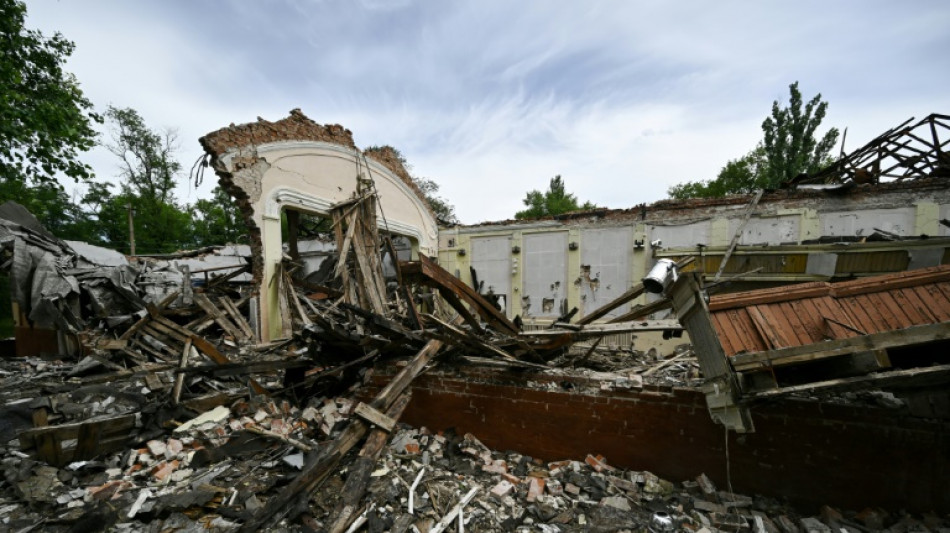
Russia hits Ukraine's Odesa for third night after grain deal exit / Photo: Genya SAVILOV - AFP
Russian strikes hit the Ukrainian port of Odesa for a third consecutive night since Moscow pulled out of a grain export deal, officials said Thursday, as Crimean authorities said a teenager had died in Kyiv's latest attack on the peninsula.
At least 20 people were wounded following strikes on Odesa and the southern port city of Mykolaiv, local officials said, posting images showing buildings in flames with facades partially destroyed.
An "administrative building" in Odesa's city centre was destroyed and others damaged, according to a spokeswoman for Ukraine's southern military command, who said details were still being clarified.
A previous round of overnight strikes on Odesa destroyed 60,000 tonnes of grain meant for export, Kyiv said on Wednesday, with President Volodymyr Zelensky accusing Moscow of "deliberately" targeting the supplies.
Moscow's invasion of Ukraine last year saw Black Sea ports blocked by warships until the gain agreement, brokered by the United Nations and Turkey in July 2022.
The Kremlin said on Monday it was exiting the deal, after months of complaining that the parts that had allowed the export of Russian food and fertilisers had not been honoured.
The deal enabled the export of more than 32 million tonnes of Ukrainian grain over the last year, bringing relief to countries facing critical food shortages such as Afghanistan, Sudan and Yemen.
Wheat prices soared on the European stock exchange on Wednesday.
Also Wednesday Moscow said it would consider cargo ships travelling to Ukraine through the Black Sea potential military targets.
A senior United States security official later told AFP that Russia was considering attacking civilian ships on the Black Sea and putting the blame on Kyiv.
National Security Council spokesman Adam Hodge cited Russia's release of a video showing its forces detecting and destroying an "alleged Ukrainian sea mine".
"Our information indicates that Russia laid additional sea mines in the approaches to Ukrainian ports," he said.
"We believe that this is a coordinated effort to justify any attacks against civilian ships in the Black Sea and lay blame on Ukraine for these attacks."
- Attack in Crimea -
In Crimea, a drone strike launched by Ukraine damaged four "administrative buildings" and killed a teenage girl, its Moscow-installed governor said early Thursday.
The strike appeared to be the latest attack by Kyiv on the key supply artery for Russian forces fighting in Ukraine.
It came a day after a fire at a military site in Crimea forced authorities to evacuate thousands of civilians.
Officials have not specified the cause of the blaze, but some Russian media reported that detonations were heard in the area and footage showed columns of black smoke in the sky.
Earlier this week Ukraine used waterborne drones to attack the Kerch bridge, the only bridge connecting Russia to annexed Crimea.
Russian President Vladimir Putin vowed to retaliate for the attack, which killed two civilians and left their child wounded.
Russia annexed Crimea from Ukraine in 2014, a move not recognised by the international community.
Kyiv has repeatedly said it plans to take back the peninsula.
- 'Robbing the world' -
With the daily strikes in Odesa, Russian President Vladimir Putin "is robbing the world of any hope of Ukrainian grain", German Foreign Minister Annalena Baerbock said on Twitter.
Ukraine said it was prepared to continue grain exports despite the end of the deal and called on other countries to help.
Meanwhile, Ukraine's European neighbours urged the EU to extend a grain import ban until the end of the year, amid fears local farmers would be undercut by diverted Ukrainian supplies.
In June, Brussels agreed to allow Poland, Bulgaria, Hungary, Slovakia and Romania to restrict imports of grain from Ukraine through September.
On the front, fighting is concentrated in eastern Ukraine, where Kyiv's counteroffensive is so far struggling to break through Russia's defensive lines despite extensive support from its allies.
The Russian army said it had advanced one kilometre (less than one mile) along the frontline in Ukraine's northeastern region of Kharkiv.
burs-rma/yad
P.Verhoeven--LCdB