Iraqis, Iranians rally as Swedish diplomats leave Baghdad in Koran row / Photo: - - AFP
Protesters took to the streets of the Iraqi and Iranian capitals Friday to denounce Sweden's permission for protests that desecrate the Koran, as Stockholm withdrew staff from its Baghdad embassy.
Hundreds of people gathered in Baghdad's Sadr City after Friday prayers, chanting "Yes, yes to Islam, yes, yes to the Koran", an AFP correspondent said.
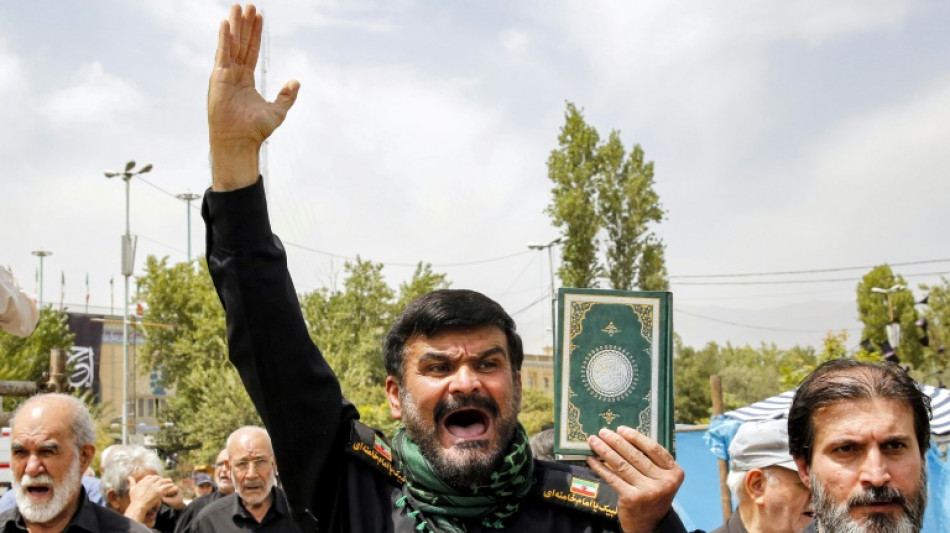
In Tehran, hundreds of protesters, waving Iranian flags and carrying copies of Islam's holy book, chanted "Down with the United States, Britain, Israel and Sweden" as some set the blue-and-yellow Swedish flag ablaze.
The rallies came amid heightened tensions between Sweden and Iraq over a Sweden-based Iraqi refugee who last month burnt pages of the Koran outside Stockholm's main mosque.
In the latest such incident on Thursday, the refugee, Salwan Momika, stepped on the Koran but did not burn it, triggering renewed condemnation and calls for protest across the Muslim world.
Sweden on Friday cited security concerns in a decision to relocate embassy staff and operations from Baghdad to Stockholm, after protesters stormed the embassy compound in a pre-dawn raid this week.
"The embassy's operations and its expatriate staff have been temporarily relocated to Stockholm for security reasons," the Swedish foreign ministry said.
The Iraqi government condemned the attack on the embassy. It also retaliated against the protest in Sweden by expelling its ambassador, vowing to sever ties and suspending the operating licence of Swedish telecom giant Ericsson.
"The expulsion of the ambassador is too little, we want more," said protester Sabbah al-Tai, 45, in Sadr City, a working-class district of Baghdad.
The crowd gathered there at the order of influential Shiite cleric Moqtada Sadr, whose followers were behind the embassy raid late Wednesday.
Carrying parasols to shield from the baking summer heat, some protesters set fire to rainbow flags, an action Sadr says highlights the "double standard" of Western governments in defending LGBTQ rights while allowing the desecration of religious texts.
"Through this demonstration, we want to send a message to the United Nations," said Amer Shemal, a Sadr City municipality official, calling on member states to "penalise any desecration of holy books -- those of Islam, of Christianity, of Judaism".
"These are all holy books," said Shemal.
- 'Disgraceful' -
Regional powerhouses Saudi Arabia and Iran announced in separate statements late Thursday they had summoned Swedish diplomats to protest the permission Stockholm had granted to Momika's actions on free speech grounds.
Saudi Arabia, home to Islam's holiest sites, said it would urge "the Swedish authorities to take all immediate and necessary measures to stop these disgraceful acts", according to a foreign ministry statement.
Iranian foreign ministry spokesman Nasser Kanani said Tehran holds "the Swedish government fully responsible for the consequences of inciting the feelings of Muslims around the world".
Kanani condemned "any insult to religious sanctities and holy books anywhere and by anyone", arguing "freedom of speech used to attack dignity, morals and religious sanctities... has no value."
Protesters in Tehran as well as other major Iranian cities, including Mashhad in the northeast, Tabriz in the northwest and Isfahan in the centre, heeded a call from authorities for nationwide demonstrations after Friday prayers.
The June Koran burning, during the Eid al-Adha holiday, had sparked indignation and diplomatic protests across the Muslim world.
On Thursday, the 57-member Organisation of Islamic Cooperation denounced the latest Stockholm protest as "another provocative attack" that could not be justified under the right to freedom of expression.
In Lebanon, the leader of the pro-Iranian Hezbollah movement Hassan Nasrallah called for expulsion of the Swedish envoy there and the recall of Lebanon's ambassador to Sweden.
"It's the minimum required," he said.
S.Denis--LCdB