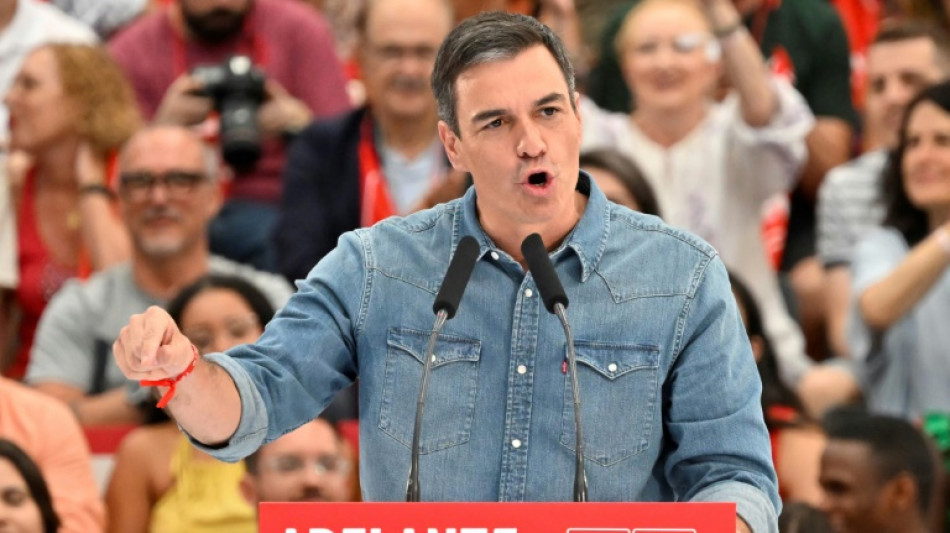
Right expected to make comeback as voting ends in Spain / Photo: JAVIER SORIANO - AFP
Voting closed in Spain's closely watched snap election Sunday which was expected to oust the left and bring in the right-wing Popular Party, which will likely need support from the far right to govern.
The vote took place just three weeks after Spain took over the rotating presidency of the European Union, and the expected shift to the right would deal a fresh blow to the European left.
Polls closed at 1800 GMT and although Spain does not publish exit polls, figures from a last-minute Sigma Dos poll taken in the days before the vote, suggested Alberto Nunez Feijoo's PP would win 145-150 seats, falling short of the 176-seat absolute majority required to govern alone.
Three other polls carried out just before the vote, whose results cannot be legally be published until after voting closes, all showed the PP winning, but without an overall majority, suggesting it would need support from the far-right Vox to form a government.
The results are expected to start trickling in after 1900 GMT
Two hours before the close, turnout stood at 53.12 percent, nearly 4.0 percentage points lower than the previous 2019 election, with many voting earlier in the day to avoid the scorching heat.
Spain has never previously held an election at the height of summer and in parts of the south, temperatures were touching 40 degrees Celsius (104 Fahrenheit).
"Spain can begin a new era," said Feijoo as he cast his ballot, while Socialist Prime Minister Pedro Sanchez said it was a "very important" moment, "not only for us but for Europe and the world".
Were Vox to enter government, it would be the first time the far-right had hold a share of power in Spain since the Franco dictatorship ended in 1975.
Vox is part of a Europe-wide trend that has seen far-right parties taking power, either alone or in coalition, in places like Hungary, Italy and Finland.
Sanchez warned that a PP-Vox government would take Spain into "a dark time warp that will leave us who knows where".
Among its election pledges, Vox wants to overturn laws on gender violence, LGBTQ rights, abortion and euthanasia as well as outlawing separatist parties and defending traditions such as bullfighting.
In an op-ed in France's Le Monde, former British premier Gordon Brown called Vox's agenda "chilling", warning its entry into government "would push Europe one step further into a right-wing abyss".
- 'Should be forbidden' -
Since the vote took place at the height of summer, many people were on holiday and so a record 2.47 million people casting their vote by post.
Many voters also said they had cast their ballots earlier to avoid the scorching heat. At the polling stations, electric fans were working overtime to keep people cool.
"Holding the vote at this time of year is ghastly... it should be forbidden," 80-year-old Maria Suner told AFP at a polling station in central Madrid.
Sanchez, 51, called the snap poll after his Socialist party and its far-left allies were heavily defeated in local and regional elections at the end of May.
Despite a strong economic performance on his watch, Sanchez's standing has suffered due to the political deals his minority coalition has had to make to push through legislation.
Since Sanchez became premier in 2018, Spain's economy has outperformed most of its EU peers, growing by 5.5 percent last year, with inflation dropping below 2.0 percent, a rarity in Europe.
He has also introduced a sharp rise in the minimum wage, higher pensions and free commuter rail travel.
But his government's reliance on Catalan and Basque separatist parties to pass legislation has hurt his standing, as has his occasional deals with Bildu, the heir of the political arm of the disbanded Basque separatist group ETA.
Another major blow was a botched rape law that let more than 1,000 convicted sex offenders secure a reduction in their sentences.
If the PP and Vox fall short of a working majority, that would give the Socialists a chance to form another government because they have more options to create alliances.
Analysts could not rule out the possibility that neither side could secure a working majority, which would force a repeat election, as happened in 2019.
"With an absolute majority or not, we need a government from this," 30-year-old advertising agent Daniela Fite told AFP.
N.Moens--LCdB