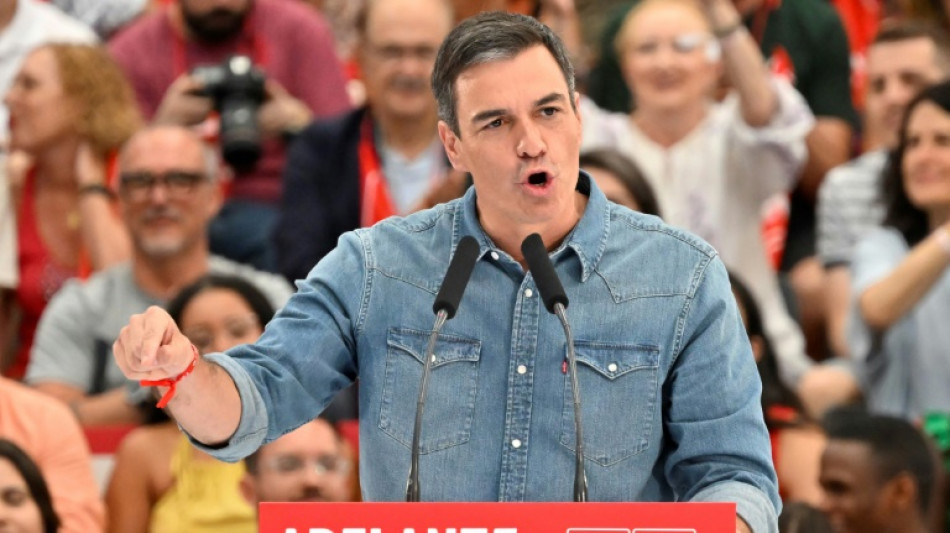
Left and right neck-and-neck in key Spain vote as count advances / Photo: JAVIER SORIANO - AFP
Widely expected to win Sunday's snap election, the right-wing Popular Party was only a handful of votes ahead of the Socialists with two-thirds of the votes counted, leaving Prime Minister Pedro Sanchez a chance to cling onto power.
With more than 67 percent of the ballots counted, the PP had 131 seats while the Socialists had 128 in the 350-seat parliament, official figures showed.
The far-right Vox had 33 seats while the radical left-wing Sumar had 30, with both sides racing to reach 176, the figure needed to form a governing majority.
Polls had predicted a decisive victory by Alberto Nunez Feijoo's PP but without a working majority, which would force it to turn to Vox for support to govern.
The vote took place just three weeks after Spain took over the rotating presidency of the European Union, and the expected shift to the right would have dealt a fresh blow to the European left.
Polls closed at 1800 GMT and figures from a last-minute Sigma Dos poll taken in the days before the vote, suggested the PP would win 145-150 seats, with the figures aligning with three other similar polls.
Spain has never previously held an election at the height of summer and in parts of the south, temperatures were touching 40 degrees Celsius (104 Fahrenheit).
"Spain can begin a new era," said Feijoo as he cast his ballot, while Socialist Prime Minister Pedro Sanchez said it was a "very important" moment, "not only for us but for Europe and the world".
Were Vox to enter government, it would be the first time the far-right had hold a share of power in Spain since the Franco dictatorship ended in 1975.
Vox is part of a Europe-wide trend that has seen far-right parties taking power, either alone or in coalition, in several countries.
The party, which jointly rules three of Spain's 17 regions with the PP, ran an election campaign pledging to roll back laws on gender violence, LGBTQ rights, abortion and euthanasia, as well as a democratic memory law honouring the victims of the Franco dictatorship (1939-1975).
Sanchez warned that a PP-Vox government would take Spain into "a dark time warp that will leave us who knows where".
In an op-ed in France's Le Monde, Britain's former prime minister Gordon Brown called Vox's agenda "chilling", warning its entry into government "would push Europe one step further into a right-wing abyss".
- 'Should be forbidden' -
With the vote taking place at the height of summer, many people were on holiday and so a record 2.47 million voters cast their ballots by post.
At polling stations, where electric fans were working overtime to keep people cool, many voters said they had cast their ballots earlier in the day to avoid the scorching heat.
"Holding the vote at this time of year is ghastly... it should be forbidden," 80-year-old Maria Suner told AFP at a Madrid polling station.
Despite a strong economic performance on his watch, Sanchez's standing has suffered due to the political deals his minority coalition has had to make to push through legislation.
Since Sanchez became premier in 2018, Spain's economy has outperformed most of its EU peers, growing by 5.5 percent last year, with inflation dropping below 2.0 percent, a rarity in Europe.
He has also introduced a sharp rise in the minimum wage, higher pensions and free commuter rail travel.
Another major blow was a botched rape law that let more than 1,000 convicted sex offenders secure a reduction in their sentences.
Feijoo, 61, has vowed to overturn many of Sanchez's laws, including one allowing anyone 16 and over to change their ID card gender on the basis of a simple statement.
If the PP and Vox fall short of a working majority, that would give the Socialists a chance to form another government because they have more options to create alliances.
O.Seuren--LCdB