Protests rage as Israeli lawmakers to vote on divisive reforms / Photo: Menahem KAHANA - AFP
Israeli lawmakers on Monday prepared for a final vote on a major component of the hard-right government's controversial judicial overhaul, even as US President Joe Biden called for postponing the "divisive" bill that triggered months of mass protests.
Lawmakers debated through the night amid last-ditch efforts by Israel's President Isaac Herzog to reach a compromise. He met Prime Minister Benjamin Netanyahu at a hospital where he had undergone surgery to fit a pacemaker.
On Monday, Netanyahu was discharged from Sheba Medical Center, the hospital said.
Netanyahu had vowed from his hospital room on Sunday that he would go to parliament for the vote after his release.
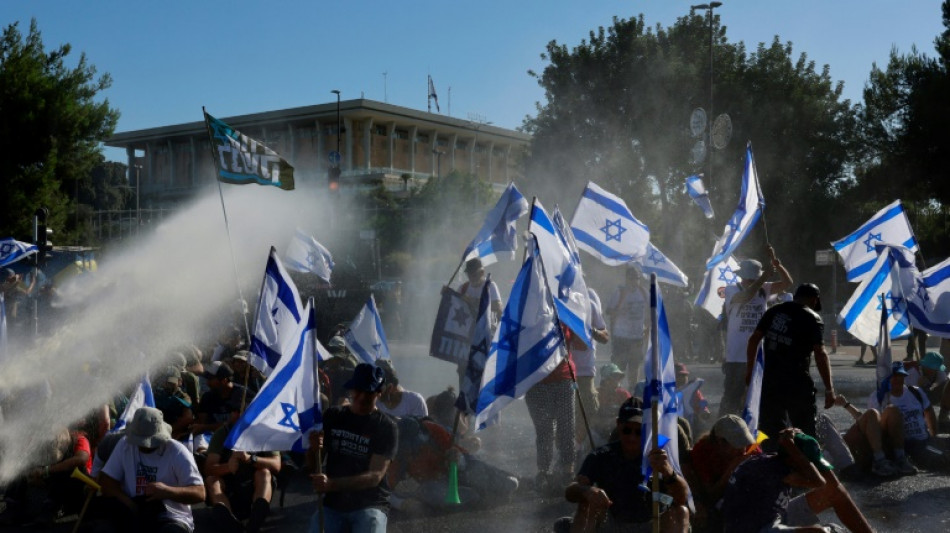
On Monday, police used water cannon to disperse hundreds of protesters who blocked the entrance of parliament, an AFP correspondent reported, adding some protesters were arrested.
Many had converged near parliament over the past two days to oppose Netanyahu's proposal to curb the powers of the Supreme Court as part of the revamp.
The proposed judicial revamp has split the nation and, since its unveiling in January, set off one of the biggest protest movements in Israel's history.
Critics fear the changes will undermine Israel's democracy.
Thousands of demonstrators backing the government and its reform plans had also rallied in Tel Aviv, the epicentre of the anti-government protests.
Voting is to begin at 12:00 midday Monday (0900 GMT) on the draft law which would limit judges' ability to strike down government decisions they deem "unreasonable".
As the crisis looked set to peak, Biden urged Israeli leaders to postpone the vote.
"From the perspective of Israel's friends in the United States, it looks like the current judicial reform proposal is becoming more divisive, not less," he said in a statement first published by news site Axios and later shared with AFP.
"It doesn't make sense for Israeli leaders to rush this -- the focus should be on pulling people together and finding consensus."
- 'Time of emergency' -
Herzog, who returned from a visit to the United States on Sunday, plunged directly into arriving at a compromise, also meeting opposition leader Yair Lapid.
"This is a time of emergency. An agreement must be reached," Herzog said in a statement issued by his office.
His office declined to comment on his talks with Netanyahu and Lapid.
The announcement from Netanyahu's office that the 73-year-old was having a pacemaker fitted came days after he had been hospitalised for a reported spell of dizziness.
"We're continuing our efforts to complete the legislation, and the efforts to do it in agreement (with the opposition)," he said on Sunday afternoon.
"Either way, I want you to know that tomorrow (Monday) morning I'm joining my friends at parliament," he said.
The driving force behind the reforms, Justice Minister Yariv Levin, said the bill being put to lawmakers had already undergone changes to accommodate critics, but added that the coalition was still open to "understandings".
"Understandings means the opposition's willingness to make concessions too," he told supporters at the Tel Aviv rally on Sunday.
Netanyahu's government, which includes far-right and ultra-Orthodox Jewish allies, argues that the proposed reforms will prevent overreach by unelected judges and ensure a better balance of power.
- 'We can still stop' -
Opponents accuse Netanyahu, who has been fighting corruption charges in court, of a conflict of interest and some protesters have labelled him the "crime minister".
"We have to keep up the pressure, we have to safeguard our democracy," said one demonstrator, Amir Goldstein.
Inside the chamber on Sunday, Lapid echoed such concerns.
"We want to continue to live in a Jewish and a democratic state ... We must stop this legislation," he said.
Opposition leader Benny Gantz issued a similar call.
If approved, the "reasonability" clause would be the first major component of the reforms to become law.
Other proposed changes include allowing the government a greater say in the appointment of judges.
The protests have drawn support from across the political and social spectrum, among secular and religious groups, peace activists, blue-collar and tech sector workers, and military reservists.
The political battle over the judicial overhaul comes against a backdrop of rising Palestinian-Israeli violence.
One protester opposed to the judicial package, Shanna Orlik, said she was rallying against what she called a "misogynist and far-right government".
"We don't have a constitution, and the only thing that protects our rights is the Supreme Court, and the government intends to destroy that," she said.
P.Matthys--LCdB