Israel MPs approve key judicial reform clause as protests flare / Photo: Menahem KAHANA - AFP
Israel's hard-right government on Monday pushed through parliament a key clause of its controversial judicial reform package despite months of mass protests and concerns voiced by foreign allies.
Prime Minister Benjamin Netanyahu and his coalition allies approved the bill in a Knesset vote boycotted by opposition lawmakers, some of whom shouted "shame, shame".
Critics charge the judicial revamp will undermine Israel's liberal democracy by removing checks and balances on the executive, while the government argues it needs to curb judicial overreach.
The bill, passed with 64 votes in the 120-seat chamber, aims to limit the powers of the Supreme Court in striking down government decisions which the judges deem "unreasonable".
The reform package has triggered one of the biggest protest movements in Israel's history since it was unveiled by the government in January.
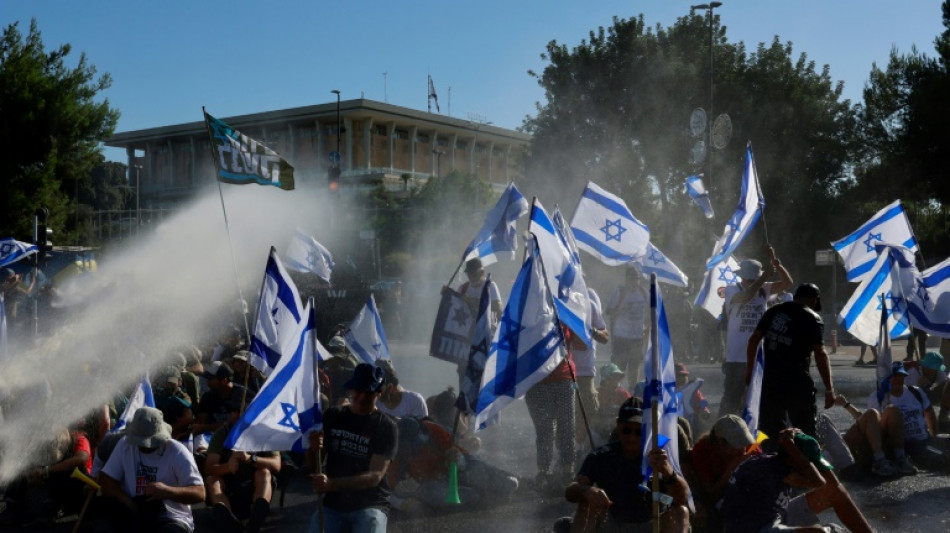
The bill was passed hours after Netanyahu, 73, returned to the Knesset -- only a day after undergoing surgery to have a pacemaker fitted -- as police outside the legislature used water cannon and mounted officers were deployed against a crowd of demonstrators.
President Isaac Herzog -- who had tried but failed to broker a compromise after half a year of mass street protests -- earlier warned that Israel faced a "national emergency".
Netanyahu's coalition government, which includes far-right and ultra-Orthodox Jewish parties, argues that the proposed changes are needed to ensure a better balance of power.
Israel's traditional bedrock ally Washington had on Sunday reiterated concern about the political turmoil, with Biden urging Israeli leaders to postpone the vote.
"From the perspective of Israel's friends in the United States, it looks like the current judicial reform proposal is becoming more divisive, not less," he said in a statement first published by news site Axios and shared with AFP.
"It doesn't make sense for Israeli leaders to rush this -- the focus should be on pulling people together and finding consensus."
While legislators met inside, protesters outside parliament booed, beat drums, blew horns and chanted "shame".
- 'Heading towards disaster' -
Herzog, just back from a Washington trip, had gone to Netanyahu's hospital room on Sunday in a last-minute effort to reach a compromise.
Herzog warned that "there are foundations for understandings" but the sides would have to "show responsibility" to close the gap.
Netanyahu had said Sunday afternoon that "we're continuing our efforts to complete the legislation, and the efforts to do it in agreement" with the opposition.
The government had taken a "cautious path", said Justice Minister Yariv Levin, the driving force behind the revamp.
"We are not cancelling the reasonableness clause but reducing its use, so that a judge's personal opinions won't come at the expense of the people's desire," he told parliament at the end of a marathon debate before the vote.
"There is no reason to fear this amendment. There are many reasons to see in it as an important step in returning the balance between the government branches," Levin said.
But opposition leader Yair Lapid said the country was "heading towards a disaster".
Opponents accuse Netanyahu, who has been fighting corruption charges in court, of a conflict of interest, and some protesters have labelled him the "crime minister".
- 'Gateway to dictatorship'-
"This is the gateway to a dictatorship and that's why we're here. We're fighting for our democracy," said Shahaf Kushinsky, 34, a high-tech worker protesting near parliament ahead of the vote.
The "reasonableness" clause is the first major component of the reform package to become law. Other proposed changes include allowing the government a greater say in the appointment of judges.
The protests have drawn support from across the political spectrum and among secular and religious groups, blue-collar and tech sector workers, peace activists and military reservists.
The political battle over the judicial overhaul comes against a backdrop of rising Israeli-Palestinian violence, an issue which is rarely raised by demonstrators.
"They can just legislate whatever they want," Shamgar told AFP. "I will not stop protesting and I won't mind going to jail."
O.Seuren--LCdB