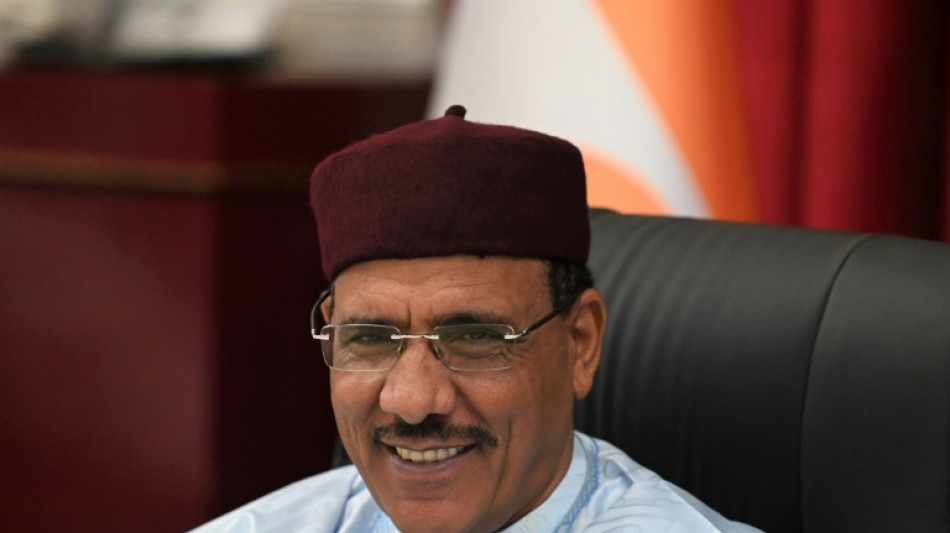
'Coup attempt' in troubled Niger as president held by guards / Photo: Issouf SANOGO - AFP/File
An attempted coup was underway Wednesday in the fragile state of Niger, where members of the Presidential Guard detained President Mohamed Bazoum, triggering a standoff with the army, sources said.
The West African bloc ECOWAS and the African Union lashed what they called an "attempted coup d'etat," a term echoed by a source close to Bazoum.
UN chief Antonio Guterres condemned "any effort to seize power by force" and urged respect for Niger's constitution, while the United States expressed deep concern and called for Bazoum to be released.
France, Niger's former colonial power, and neighbouring Algeria also issued condemnations.
One of a dwindling group of pro-western leaders in the Sahel, Bazoum was elected in 2021, taking the helm of a country burdened by poverty and a history of chronic instability.
Disgruntled members of the elite Presidential Guard sealed off access to the president's residence and offices in the capital Niamey, and after talks broke down "refused to release the president," another presidential source said.
"The army has given them an ultimatum," said the source, who spoke on condition of anonymity.
In a message on Twitter, which is being rebranded as X, the president's office said "elements of the Presidential Guard (PG) had a fit of temper... (and) tried unsuccessfully to gain the support of the national armed forces and the national guard."
"The army and national guard are ready to attack the elements of the PG who are involved in this fit of temper if they do not return to a better disposition," the presidency said.
"The president and his family are well," it added.
The reason for the guards' anger was not disclosed.
Access was blocked off to the presidential complex in Niamey, but there was no abnormal military deployment or sounds of gunfire in the area, and traffic was normal, an AFP journalist saw.
The Economic Community of West African States (ECOWAS) and AU issued separate statements condemning an "attempted coup d'etat."
The same term was used by the source close to Bazoum, who speaking on condition of anonymity, also said that the bid was "doomed to fail."
ECOWAS called for Bazoum's immediate and unconditional release, and warned that all those involved would be held responsible for his safety.
The European Union said it "associates itself" with the ECOWAS statement and condemned "any attempt to destabilise democracy and threaten the stability" of Niger.
- Coup-prone -
The landlocked Sahel state has experienced four coups since independence from France in 1960 as well as numerous other attempts on power.
Bazoum, a former interior minister, was right-hand man to former president Mahamadou Issoufou, who voluntarily stepped down after two terms.
Their handover in April 2021, after elections won by Bazoum in a two-round contest against former president Mahamane Ousmane, marked Niger's first peaceful transition of power since independence.
But reminders of the troubled past have never been far.
An attempted coup took place just days before Bazoum's inauguration, according to a security source at the time.
Several people were later arrested, including the suspected ringleader, an air force captain named Sani Gourouza, as well as Ousmane Cisse, a former interior minister under a military government of transition that ran from 2010-2011.
Five people, including Gourouza, were jailed in February for 20 years while Cisse was acquitted.
A second bid to oust Bazoum occurred in March this year "while the president... was in Turkey", according to a Niger official, who said an arrest was made. The authorities have never commented publicly on the incident.
- Poverty and jihadism -
A landlocked state in the heart of scorching Sahel, Niger is two-thirds desert and frequently ranks at the bottom of the UN's Human Development Index, a benchmark of prosperity.
It has a surging population of 22.4 million, driven by a birthrate averaging seven children per woman.
The country is struggling with two jihadist campaigns -- one in the southwest, which swept in from neighbouring Mali in 2015, and the other in the southeast, involving jihadists based in northeastern Nigeria.
Hundreds of thousands of people have fled their homes, stoking a humanitarian crisis and further straining the economy.
The poorly equipped military is receiving training and logistical support from the United States and France, which have bases there.
The mission was reconfigured after French forces quit Mali and Burkina Faso after falling out with the ruling juntas in those countries.
Mali has brought in Russian paramilitaries -- Wagner mercenaries, according to western countries, that rights monitors say have been implicated in atrocities.
L.Dumont--LCdB