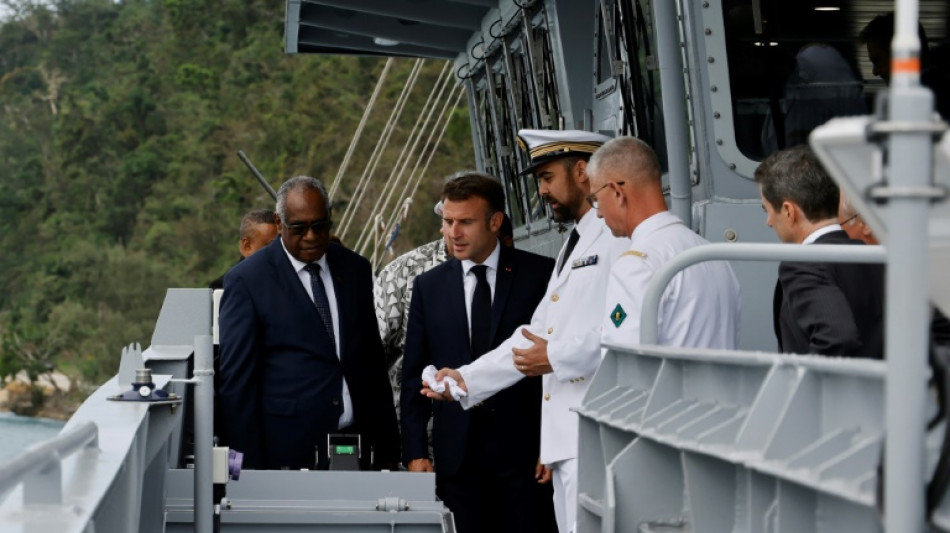
France's Macron denounces 'new imperialism' in Pacific / Photo: Ludovic MARIN - POOL/AFP
French President Emmanuel Macron denounced "new imperialism" in the Pacific during a landmark visit to the region on Thursday, warning of a threat to the sovereignty of smaller states.
Macron -- speaking in Vanuatu on the first visit by a sitting French leader to an independent Pacific Island state -- sought to offer a French alternative in a region where the US and China are competing for influence.
"There is in the Indo-Pacific, and particularly in Oceania, new imperialism appearing, and a power logic that is threatening the sovereignty of several states -- the smallest, often the most fragile," Macron said in a speech.
"Our Indo-Pacific strategy is above all to defend through partnerships the independence and sovereignty of all states in the region that are ready to work with us."
China is seeking to expand its influence in the South Pacific, notably making inroads in Solomon Islands, with which it signed a secretive defence pact last year.
Beijing also maintains sweeping, contested claims over the South China Sea.
The United States -- the dominant military force in the South Pacific since World War II -- has responded by announcing new aid, opening embassies in the region, and signing pacts including a recent defence deal with Papua New Guinea.
Macron said he felt free to issue the warning over major powers' ambitions in the Pacific because "we recognise our colonial past here in Vanuatu".
Vanuatu, a former French-British colony until independence in 1980, endured a colonial history of "grabbing wealth and exploitation of the people", he said.
"We are the heirs of this past," Macron added, listing a history since European settlement that included the trafficking of indigenous people to work on plantations.
"Vanuatu suffered a colonisation as brutal as those imposed elsewhere in Africa or Asia. This heritage must not be forgotten."
- 'Phasing out' fossil fuels -
Macron is seeking to reassert his country's significance as a "balancing power" in the region.
France has 1.6 million citizens in the Asia-Pacific across seven overseas territories, including New Caledonia and French Polynesia, and an exclusive economic zone spanning nine million square kilometres (3.5 million square miles).
But France had to reassemble its strategy in the Pacific after Australia in 2021 tore up a deal for Paris to provide a fleet of diesel-powered submarines.
Canberra opted instead for US- and British-built nuclear-powered vessels under the so-called AUKUS pact.
With climate change a priority for low-lying Pacific Island states threatened by rising seas, France and Vanuatu issued a joint call for international action.
"France and Vanuatu reiterate that the first urgency to reduce the damage caused by climate change is to accelerate the phasing out of fossil fuels," they said in a statement.
On his first 48-hour stop in the French territory of New Caledonia, some pro-independence indigenous Kanaks boycotted talks with Macron to discuss its future.
The president warned that separatism risked leading to violence as he urged the pro-independence camp to accept the results of three referendums that favoured remaining part of France.
In a sign of the global focus on the Pacific region, Macron's three-stop tour -- his next destination is Papua New Guinea -- coincided with two visits by senior US officials.
US Secretary of State Antony Blinken held talks Thursday with ally New Zealand, and warned of "predatory" Chinese investment in Tonga the day before.
US Defence Secretary Lloyd Austin also met with the government in Papua New Guinea on Thursday and announced the deployment of a US Coastguard ship there after the signing of the recent defence pact.
J.Jaspers--LCdB