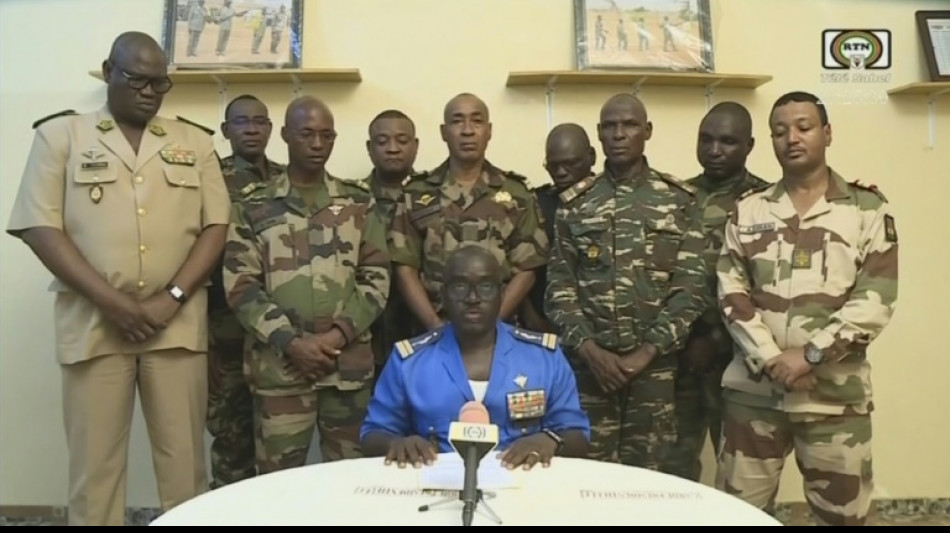
Niger military chief backs coup leaders, but president defiant / Photo: - - ORTN - Télé Sahel/AFP
Niger's armed forces chief on Thursday declared his support for troops who announced they had seized power, despite a defiant stand by the country's president, Mohamed Bazoum.
In the latest turbulence to shake the coup-prone Sahel, Bazoum was confined on Wednesday by members of his presidential guard.
Hours later, their leaders, calling themselves the Defence and Security Forces (FDS), declared they had "decided to put an end to the regime," announcing that all institutions were being suspended, the borders closed and a night-time curfew imposed.
As African and international organisations condemned the declared takeover and allies France and the United States voiced their support for Niger's elected leader, Bazoum stood his ground.
"The hard-won gains will be safeguarded," he said on Twitter, which is being rebranded as X.
"All Nigeriens who love democracy and freedom would want this."
Foreign Minister Hassoumi Massoudou said Niger's "legal and legitimate power" was the one exercised by its elected president.
There had been a "coup bid" but "the whole of the army was not involved," he told France24 television.
"We ask all the fractious soldiers to return to their ranks," he said. "Everything can be achieved through dialogue but the institutions of the republic must function."
But armed forces chief General Abdou Sidikou Issa dealt a hefty blow to those hopes.
"The military command... has decided to subscribe to the declaration made by the Defence and Security Forces... in order to avoid a deadly confrontation between the various forces," he said in a statement.
Several hundred people, some of them holding Russian flags, took part in a show of support in Niamey for the coup leaders, AFP journalists saw.
The president of neighbouring Benin, Patrice Talon, was expected in the capital for mediation efforts, the head of the Economic Community of West African States (ECOWAS) said.
- Coup-prone -
The landlocked state is one of the poorest and most unstable countries in the world, experiencing four coups since gaining independence from France in 1960, as well as numerous other attempts -- including two previously against Bazoum.
The 63-year-old is one of a dwindling group of elected presidents and pro-Western leaders in the Sahel, where since 2020 a rampaging jihadist insurgency has triggered coups in Mali and Burkina Faso.
Their juntas have forced out French troops and in the case of Mali, the ruling military have woven a close alliance with Russia.
Disgruntled members of the Presidential Guard sealed off access to Bazoum's residence and offices on Wednesday morning, and after talks broke down "refused to release the president," a presidential source said.
Bazoum supporters hours later tried to approach the official complex, but were dispersed by members of the Presidential Guard who fired warning shots, an AFP reporter saw.
The coup leaders -- 10 men in military uniform -- appeared on television overnight.
Their leader, an officer named Colonel-Major Amadou Abdramane, announced they were taking power following "the continued deterioration of the security situation, poor economic and social governance."
- Condemnation -
The parties in Niger's ruling coalition denounced "a suicidal and anti-republican madness," and condemnation poured in from regional and global leaders.
ECOWAS and the African Union each lashed what they called an "attempted coup d'etat".
The West African bloc called for Bazoum's immediate and unconditional release and warned all those involved would be held responsible for his safety.
US Secretary of State Antony Blinken said he had spoken to Bazoum to offer Washington's support, while UN Secretary-General Antonio Guterres strongly condemned "the unconstitutional change in government" in Niger
Russia, which has been isolated internationally since invading Ukraine in February 2022, joined the roll call of nations appealing for Bazoum's release.
It urged on "all parties to the conflict to refrain from the use of force and resolve all disputes through peaceful and constructive dialogue."
In Brussels, the European Union said Niger was "an essential partner... whose destabilisation would not serve the interest of anyone in the country, the region or beyond."
- Poverty and jihadism -
Bazoum took office after elections two years ago, in Niger's first-ever peaceful transition since independence.
He was a former interior minister and right-hand man to former president Mahamadou Issoufou, who voluntarily stepped down after two terms.
But an attempted coup took place just days before Bazoum's inauguration, according to a security source at the time.
A second bid to oust Bazoum occurred last March "while the president... was in Turkey", according to a Niger official, who said an arrest was made.
The nation of 22 million is two-thirds desert and frequently ranks at the bottom of the UN's Human Development Index, a benchmark of prosperity.
Niger is also struggling with two jihadist campaigns -- one in the southwest, which swept in from Mali in 2015, and the other in the southeast, involving jihadists from northeastern Nigeria.
burs-ach/ri/jmm
D.Moerman--LCdB