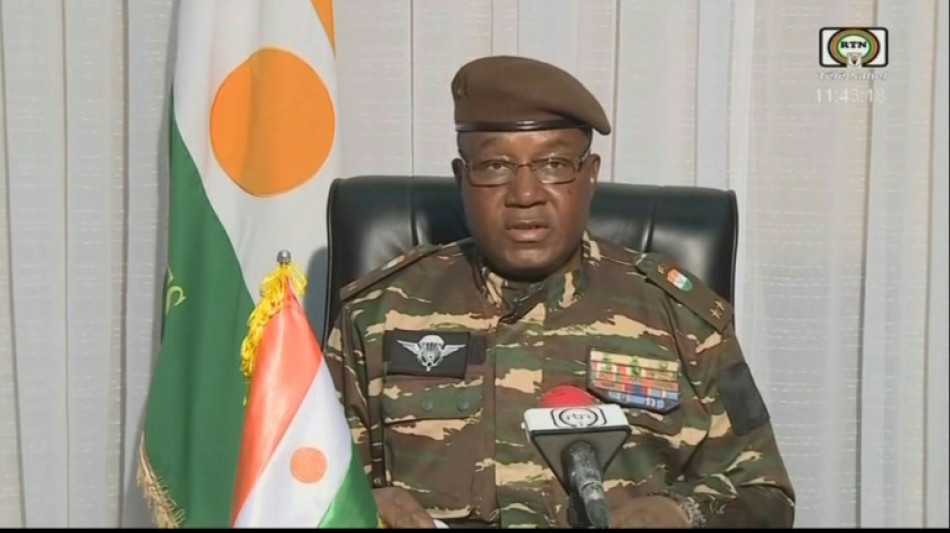
Army general declares himself Niger leader / Photo: - - ORTN - Télé Sahel/AFP
Niger's putschists named an army general as the new leader of the unstable jihadist-hit nation on Friday, the third day since elected President Mohamed Bazoum was detained.
Former colonial master France said hours earlier that it did not consider the coup "final", adding there was time for plotters to heed international calls to leave democratically-elected Bazoum in office.
But General Abdourahamane Tchiani, head of the Presidential Guard since 2011, read a statement on national TV as the "president of the National Council for the Safeguard of the Homeland".
The general presented the coup as a response to "the degradation of the security situation" linked to jihadist bloodshed.
French President Emmanuel Macron described the events in Niamey as a coup affecting the wider Sahel region as Western powers scramble to preserve a key ally in the insurgent-stricken region.
"This coup is completely illegitimate and profoundly dangerous, for Nigeriens, for Niger and for the whole region," Macron said, calling for Bazoum's release.
General Tchiani said that while Bazoum had sought to convince people that "all is going well... the harsh reality (is) a pile of dead, displaced, humiliation and frustration".
"The security approach today has not brought security to the country despite heavy sacrifices," he said.
Bazoum and his family have been confined since Wednesday morning to their residence at the presidential palace located within the Guard's military camp.
He is said to be in good health and has been able to talk by telephone to other heads of state including Macron.
The Guard's chiefs staged the coup and on Thursday they won broad army support.
Armed forces chief General Abdou Sidikou Issa swung his weight behind the putschists saying it was "in order to avoid a deadly confrontation".
The latest target of a coup in Africa's turbulent Sahel, Bazoum has tried to stand his ground as condemnations swelled from African and international organisations, allies Germany and the United States, as well as France.
"The hard-won (democratic) gains will be safeguarded," Bazoum said on Twitter, which is being rebranded as X.
French Foreign Minister Catherine Colonna had held out hope for Bazoum's position.
"If you hear me talking about an attempted coup, it's because we don't consider things final," she said. "There is still a way out if those responsible listen to the international community."
The Economic Community of West African States (ECOWAS) would hold a summit "probably on Sunday", where "possible sanctions could be decided", Colonna said.
Former colonial power France, which has 1,500 soldiers in Niger, would support sanctions.
ECOWAS has demanded Bazoum's "immediate release", saying he "remains the legitimate and legal President of Niger".
- Pro-coup demonstrations -
The landlocked state is one of the world's poorest. Since gaining independence in 1960, it has seen four coups as well as numerous other attempts -- including two previously against Bazoum.
The 63-year-old is one of a dwindling group of elected presidents and pro-Western leaders in the Sahel, where a jihadist insurgency has triggered coups in Mali and Burkina Faso.
Their juntas have forced out French troops, and in Mali the ruling military has woven a close alliance with Russia.
"What happened in Niger is nothing more than the struggle of the people of Niger against colonisers, who tried to impose their own rules of life," Wagner boss Yevgeny Prigozhin appeared to say Thursday night in a message shared by a Russian body linked to the mercenary group.
While the voice in the audio message resembles Prigozhin's, AFP was unable to confirm its authenticity.
The coup plotters had on Thursday urged "the population to remain calm", after young men ransacked Bazoum's PNDS party headquarters, setting fire to vehicles.
They had split off from a 1,000 people, mostly youngsters, who had demonstrated in the capital.
Some held Russian flags and chanted anti-French and pro-Moscow slogans.
"We want the same thing as in Mali and Burkina Faso," shouted 19-year-old student Alassane Alhousseini.
"We want to take our destiny in our own hands."
Bazoum took office after elections two years ago, in Niger's first peaceful transition since independence.
The country of 22 million is two-thirds desert and frequently ranks at the bottom of the UN's Human Development Index.
It faces two insurgent campaigns: one which swept in from Mali in 2015 and the other involving jihadists from Nigeria.
burs-bp/jmm
M.Lenaerts--LCdB