Six killed in Zelensky's hometown as Moscow bolsters onslaught / Photo: Anatolii STEPANOV - AFP
A missile strike on a residential building killed six and wounded dozens in Ukrainian President Volodymyr Zelensky's hometown on Monday, as Russia said it stepped up strikes against military facilities in response to attacks on its territory, including Moscow.
Two missiles landed close to the centre of the central Ukrainian city of Kryvyi Rig just after 9:00 am (0600 GMT), Ukrainian Interior Minister Igor Klymenko wrote on Telegram.
Among the dead was a 10-year-old girl and her 45-year-old mother, while 75 people were injured, Klymenko and local authorities said.
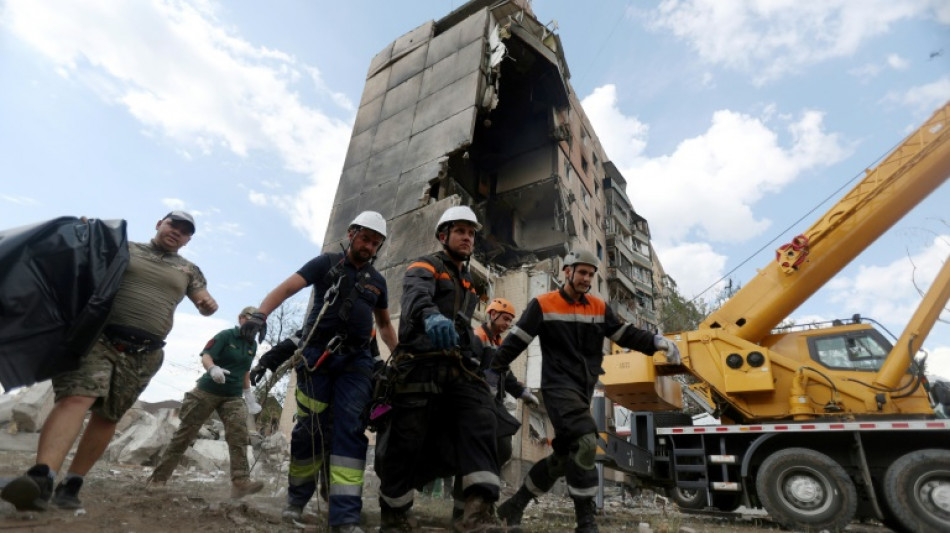
One of the strikes hit a large nine-storey residential apartment block, punching a huge hole in the facade that destroyed flats on several floors and sparked a fire.
Firefighters used a cherry-picker crane to direct jets of water at the fire, while the emergency ministry said part of the building had collapsed while the rubble was being cleared.
Russia said it had intensified attacks on military infrastructure in Ukraine after increasingly frequent drone assaults blamed on Kyiv.
Russia on Sunday said it had downed Ukrainian drones targeting Moscow and annexed Crimea in the latest wave of drone attacks.
- 'Act of desperation' -
"Against the background of the failure of the so-called 'counteroffensive', Kyiv... has focused on carrying out terrorist attacks on civilian infrastructure," Defence Minister Sergei Shoigu said Monday.
In response, "the intensity of our strikes against Ukrainian military facilities... has been considerably increased," Shoigu said.
Sunday's drone attack damaged two office towers in a Moscow business district, shattering several windows and leaving documents strewn on the ground.
The capital and its environs, lying about 500 kilometres (310 miles) from the Ukrainian border, had rarely been targeted during the conflict until several drone attacks this year.
Following the strikes, Zelensky warned Sunday that war was coming to Russia.
"Gradually, the war is returning to the territory of Russia -- to its symbolic centres and military bases, and this is an inevitable, natural and absolutely fair process," Zelensky said.
The Kremlin responded Monday, describing the strikes on the capital as an "act of desperation" by Ukraine following setbacks on the battlefield.
"It is obvious that the counteroffensive is not a success," Kremlin spokesman Dmitry Peskov told reporters, adding that the situation was "very difficult" for Ukrainian forces on the front.
"All possible measures have been taken to defend civil infrastructure" against Ukrainian strikes, Peskov added.
Ukraine began its long-awaited counteroffensive in June but has made modest advances in the face of stiff resistance from Russian forces on the frontline.
- Zelensky's hometown -
President Zelensky, who was born and grew up in Kryvyi Rig, said Russians were "continuing to terrorise peaceful cities and people".
The strikes in the city also damaged an academic building, according to the head of the city's military administration Oleksandr Vilkul.
In the southern city of Kherson, Russian shelling killed four and injured another 17, said the head of Ukraine's presidential office, Andriy Yermak.
"The enemy is hitting residential neighbourhoods," Yermak said.
Meanwhile, shelling by Kyiv's armed forces killed four people and wounded 10 in Ukraine's eastern city of Donetsk, which is controlled by Russian forces, Moscow-installed authorities said.
Russian forces had repelled Ukrainian attacks in the east and south of the country, while it continued its own offensive around Kupiansk, the defence ministry said in its daily briefing.
J.Hermans--LCdB