France readies to evacuate citizens from Niger / Photo: - - AFP
France prepared to evacuate its citizens from Niger on Tuesday, as tensions escalated after the coup last week that toppled one of the last pro-Western leaders in Africa's jihadist-plagued Sahel region.
Niger President Mohamed Bazoum was detained by his own presidential guard in a third coup in as many years in the Sahel, following putsches in neighbouring fellow former French colonies Mali and Burkina Faso.
West African leaders, supported by their Western partners, threatened to use force to reinstate the democratically elected Bazoum and slapped financial sanctions on the putschists.
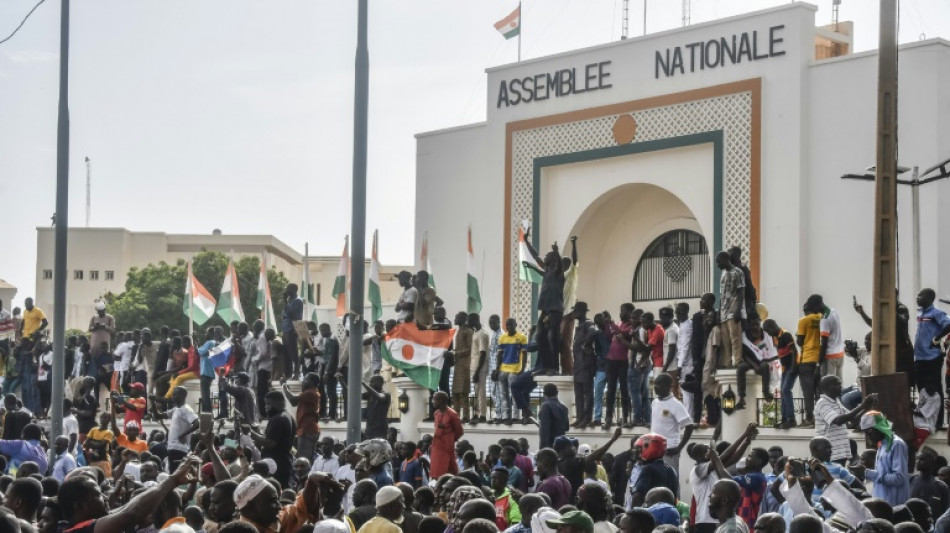
Amid the anti-French protest unleashed by the coup, Paris on Tuesday said it was moving to withdraw its nationals from the capita.
"In the face of a deteriorating security situation in Niamey... an operation of evacuation by air... is being prepared," said a message sent out by the embassy to French citizens, adding that the evacuations "will take place very soon in a very limited span of time".
Junta-led Mali and Burkina Faso on Monday warned that any military intervention in Niger to restore Bazoum would be considered a "declaration of war against their two countries.
They said the "disastrous consequences of a military intervention in Niger... could destabilise the entire region".
- Arrests -
Bazoum's PNDS party on Monday warned Niger risked becoming a "dictatorial and totalitarian regime" after a series of arrests.
Since the coup, the junta has arrested the country's oil, mining, interior and transport ministers; the head of the PNDS's executive committee; and a former defence minister, according to the PNDS.
The European Union condemned the arrest of ministers from the ousted government and demanded they be freed immediately.
At an emergency summit on Sunday, the Economic Community of West African States (ECOWAS) demanded that Bazoum be reinstated within a week, failing which it would take "all measures" to restore constitutional order.
"Such measures may include the use of force for this effect," it said in a statement.
The bloc also slapped financial sanctions on the junta leaders and the country, freezing "all commercial and financial transactions" between member states and Niger, one of the world's poorest nations, which often ranks last on the UN's Human Development Index.
Pressure to push the perpetrators of the July 26 coup to quickly restore constitutional order is building from Western and African partners, who consider Niger as essential in the fight against jihadist groups that have ravaged parts of the Sahel region for years.
Former colonial power France and the United States have between them deployed 2,600 soldiers in Niger to help battle the jihadists.
- 'Extremely dangerous' -
Niger's junta on Monday accused France of seeking to "intervene militarily" to reinstate Bazoum, which French Foreign Minister Catherine Colonna denied.
French President Emmanuel Macron on Sunday vowed "immediate and uncompromising" action if French citizens or interests were attacked, after thousands rallied outside the French embassy in Niamey. Some tried to enter the compound but were dispersed by tear gas.
Colonna said the demonstration had been "organised, not spontaneous, violent, extremely dangerous, with Molotov cocktails, Russian flags appeared, anti-French slogans (that were) an exact copy of what you can hear elsewhere".
Russia has called for the swift return of "the rule of law" and "restraint from all parties" in Niger.
Bazoum -- a Western ally whose election just over two years ago marked Niger's first peaceful transition of power since independence from France in 1960 -- was toppled on July 26 by the elite Presidential Guard.
Guards chief General Abdourahamane Tiani declared himself leader -- but his claim has been rejected internationally.
- Coups and jihadists -
Landlocked Niger became the third Sahel country in less than three years, following neighbours Mali and Burkina Faso, to be shaken by a military coup.
In all three nations, a jihadist insurgency strained fragile governments, stoked anger in the military and rained economic blows on some of the world's poorest countries.
The overthrow of elected presidents has been accompanied by anti-French, pro-Russian demonstrations.
Protesters supporting the junta say France, the country's traditional ally, has failed to shield them from the jihadists, whereas Russia would be a stronger ally.
In Mali, a 2020 putsch led to a bust-up with France, which last year withdrew its troops as the junta brought in Russian paramilitaries.
The withdrawals prompted France to reconfigure its decade-long anti-jihadist strategy in the Sahel, concentrating on Niger, where it fields 1,500 troops with a major air base near Niamey.
The latest coup, according to the putschists, was a response to "the degradation of the security situation" linked to the jihadist conflict, as well as corruption and economic woes.
B.Hendrix--LCdB