France launches evacuation flights from coup-hit Niger / Photo: - - AFP
The first of three flights to evacuate French and European citizens from Niger lifted off Tuesday evening, six days after a coup toppled one of the last pro-Western leaders in the jihadist-plagued Sahel.
"There are 262 people on board the plane, an Airbus A330, including a dozen babies," French Foreign Minister Catherine Colonna told AFP.
"Nearly all the passengers are compatriots" along with "some European nationals".
Colonna said the flight would land at Paris Roissy Charles de Gaulle airport during the night.
In the region's third military takeover in as many years, Niger President Mohamed Bazoum was overthrown by his own guard, sounding alarm bells in France, Niger's former colonial master and traditional ally.
After hostile crowds gathered Sunday outside the French embassy and Niger accused France of plotting to intervene militarily, Paris said Tuesday it would withdraw citizens and offered to evacuate other Europeans as well.
Paris blamed the "violence that took place against our embassy", and the risk of "closure of the airspace that would leave our compatriots without the possibility to leave".
Two Airbus A330s as well as a third plane left southern France during the day heading for Niamey's civilian airport, the French army said.
The initiative marks the first time that France has staged a large-scale evacuation in its former colonies in the Sahel, where there have been coups in Mali and Burkina Faso since 2020.
However, the army chief of staff announced that a military pullout of France's 1,500 troops from Niger was "not on the agenda".
In Berlin, the foreign ministry urged "all German nationals" to take up the French evacuation offer. It said that fewer than 100 German civilians were believed to be in Niger.
- No immediate danger -
In Washington, the White House said the United States was not joining European allies in evacuating citizens for now, citing a lack of immediate danger.
About 1,100 US troops are deployed in Niger.
The French foreign ministry said about 600 French nationals were in Niger.
Around a hundred of them carrying only light luggage had gathered Tuesday afternoon at Niamey's Diori Hamani international airport, where Nigerien police and about 20 French soldiers were deployed, an AFP correspondent said.
The French embassy said the evacuation was being staged "in coordination Nigerien forces".
Several French citizens told AFP they did not want to leave Niger for now.
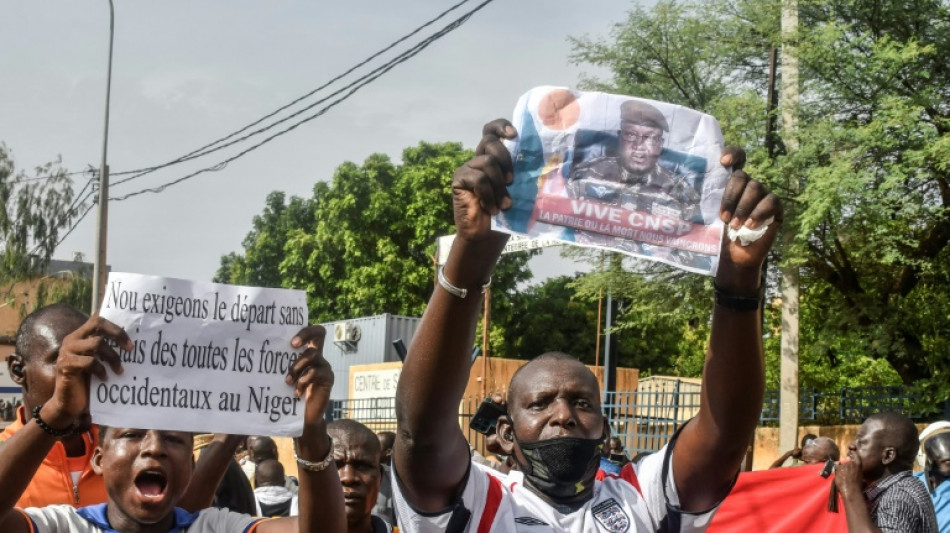
"We don't have a problem with the French" or Europeans, said a Nigerien named Hamidou Ali, aged 58. "We have a problem with European governments."
But student Mahamadou Issoufou Idi said, "The French should leave -- we no longer need them."
"It's France that's behind our suffering," said Niamey resident Almoctar Boukari.
- 'Declaration of war' -
The West African bloc ECOWAS on Sunday slapped sanctions on Niger and warned it may use force as it gave the coup leaders a week to reinstate Bazoum.
The following day, the junta accused France of seeking to "intervene militarily", a charge which drew a French denial, while junta-ruled Mali and Burkina Faso warned any military intervention in Niger would be a "declaration of war" against them.
The events are unfolding in one of the world's poorest and most unstable countries -- a vast semi-desert nation that had already experienced four coups since independence in 1960.
Bazoum was feted in 2021 after winning elections that ushered in Niger's first-ever peaceful transition of power.
But his tenure was already marked by two attempted coups before last week's dramatic events, in which he was detained by members of the elite Presidential Guard.
Guards chief General Abdourahamane Tiani has declared himself leader -- but his claim has been rejected internationally, from ECOWAS, the African Union and the UN to France, the United States and the European Union.
The coup has worried Western countries struggling to contain a jihadist insurgency that flared in northern Mali in 2012, advanced into Niger and Burkina Faso three years later and now overshadows fragile states on the Gulf of Guinea.
Countless numbers of civilians, troops and police have been killed across the region, many in ruthless massacres, while around 2.2 million people in Burkina Faso alone have fled their homes. The economic damage has been devastating.
France had at one point 5,400 troops in its anti-jihadist Barkhane mission across the Sahel, supported by fighter jets, helicopters and drones.
In all three Sahel countries, the disgruntled military intervened against elected presidents as the toll mounted from jihadist attacks.
U.Smet--LCdB