West Africa army chiefs to grapple with Niger crisis as Europeans leave / Photo: Stanislas Poyet - AFP
West African military chiefs were to meet Wednesday to frame a response to the crisis in Niger, a week after the fragile country was shaken by a coup that alarmed its neighbours and prompted France, the former colonial power, to evacuate its citizens.
Economic Community of West African States (ECOWAS) leaders on Sunday imposed trade and financial sanctions and gave the coup leaders a week to reinstate Niger's democratically elected president or face potential use of force.
ECOWAS military chiefs were to launch a three-day meeting in the Nigerian capital Abuja, coinciding with a visit to Niamey by a delegation led by former Nigerian president Abdulsalami Abubakar, sources said.
The current chair of ECOWAS is Nigeria, West Africa's military and economic superpower.
It has vowed to take a firm line against coups that have proliferated across the region since 2020, most of them the outcome of a bloody jihadist insurgency.
"We are ready, and as soon as we receive the order to intervene, we will do so," Nigeria's chief of staff Christopher Musa said in an interview on RFI Hausa on Monday.
But junta-ruled Mali and Burkina Faso warned that any military intervention in their neighbour would be tantamount to a "declaration of war" against them.
General Salifou Mody, one of the Nigerien coup leaders, arrived with a delegation in the Malian capital Bamakou on Wednesday, a senior Nigerien official and a Malian security official told AFP. They did not give further details.
Mody is a former army chief of staff who was fired by President Mohamed Bazoum in April.
- Europeans leave -
Bazoum, 63, was feted in 2021 after winning elections that ushered in the country's first-ever peaceful transition of power.
He took the helm of one of the world's poorest and most unstable countries, burdened by four previous coups since independence from France in 1960.
But after surviving two attempted putsches, Bazoum himself was overthrown on July 26 when members of his own guard detained him at the presidency.
Their leader, General Abdourahamane Tiani has declared himself leader, but his claim has been condemned internationally.
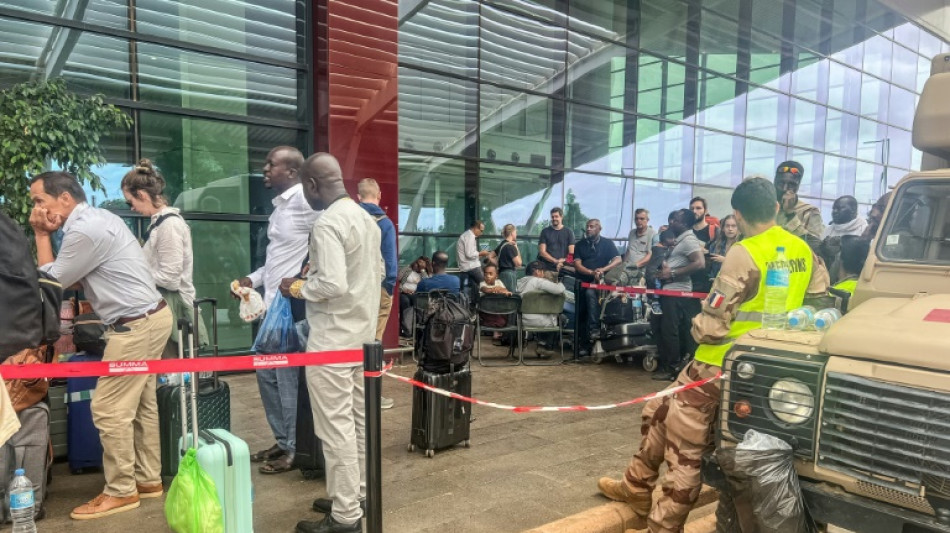
France on Wednesday scheduled more evacuation flights from Niamey following hostile anti-French demonstrations at the weekend.
By early Wednesday nearly 500 people had landed in Paris aboard two flights, including mostly French citizens but also Portuguese, Belgians, Nigerians, Ethiopians and Lebanese evacuees.
The evacuation was "well organised, it was fairly quick, for me everything went well", said a man who gave his name as Bernard and had been working in Niger for the European Union for two months.
"In Niamey, there are no particular tensions in the city, no particular stress, people go about their business," he said.
Italian authorities also said they had evacuated around 100 foreigners living in Niger, who arrived in Rome early Wednesday, with ANSA radio reporting they included 36 Italians and 21 Americans.
Germany has urged its citizens to leave, but the United States -- which has 1,100 troops stationed in Niger -- has opted to not evacuate Americans for now.
The Niger junta announced late Tuesday it had reopened the land and air borders with five neighbouring countries.
- Strategic ally -
Under Bazoum and his predecessor Mahamadou Issoufou, Niger has had a key role in French and Western strategies to combat a jihadist insurgency that has rampaged across the Sahel since 2012.
After joining a regional revolt in northern Mali, armed Islamists advanced into Niger and Burkina Faso in 2015 and now carry out sporadic attacks on fragile states on the Gulf of Guinea.
Countless numbers of civilians, troops and police have been killed across the region, many in ruthless massacres, while around 2.2 million people in Burkina Faso alone have fled their homes.
The impact has contributed to army takeovers in all three Sahel countries and inflicted devastating damage to economies at the very bottom of the world's wealth table.
France at one point had about 5,400 troops in its anti-jihadist Barkhane mission, supported by fighter jets, helicopters and drones.
But that mission had to be drastically refocussed on Niger last year, when France pulled out of Mali and Burkina Faso after falling out with their juntas.
Today, the reconfigured French force has around 1,500 men, many of them deployed at a major air base near Niamey.
Z.Barbier--LCdB