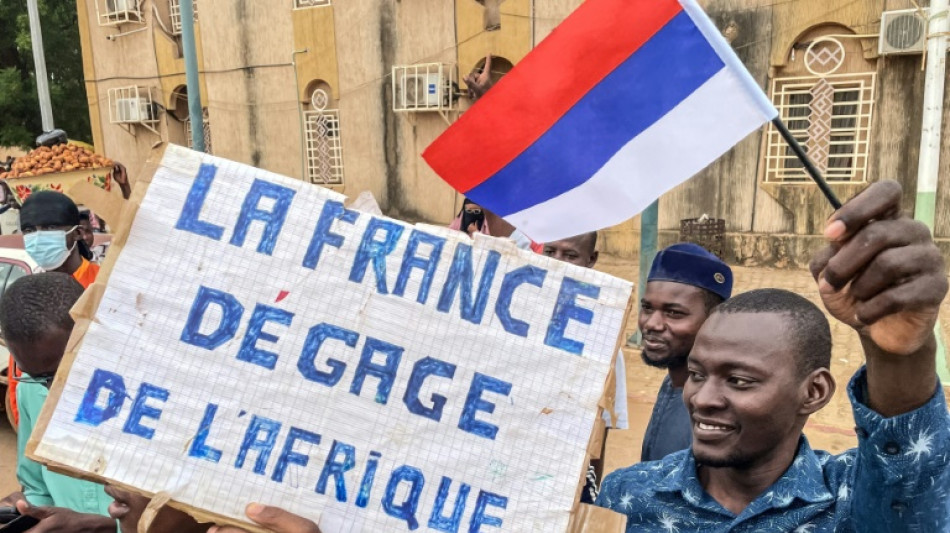
Coup backers rally across Niger / Photo: - - AFP
Thousands of people rallied Thursday across Niger to show support for the coup that toppled democratically elected leader Mohamed Bazoum as US President Joe Biden demanded his immediate release.
Demonstrators in the heart of the capital Niamey, some brandishing giant Russian flags, chanted anti-French slogans at a protest which wrapped up peacefully to mark the anniversary of the west African nation's 1960 independence from France.
The crowd shouted "Down with France", "Long live Russia, long live (Vladimir) Putin".
AFP journalists saw that police blocked access to the French embassy, after Paris had urged the junta to "fully guarantee" the safety of embassies in Niamey ahead of the demonstrations.
A week after the coup, European citizens have been evacuating from Niger, which has had a key role in French and Western strategies to combat a jihadist insurgency that has plagued Africa's Sahel region since 2012.
Protester Issiaka Hamadou said it was "only security that interests us", irrespective of whether it came from "Russia, China, Turkey, if they want to help us".
"We just don't want the French, who have been looting us since 1960 -- they've been there ever since and nothing has changed," he said.
Several thousand people also took to the streets of other cities including Agadez in the north and Filingue, where junta head General Abdourahamane Tiani is from.
- 'One coup too many' -
The clock is also ticking down on Sunday's ultimatum from West African bloc ECOWAS for coup leaders to restore Bazoum to power within a week or face the possible "last resort" of military intervention.
Senegal said Thursday it would send soldiers to join ECOWAS if it decided to intervene militarily in Niger.
"It is one coup too many," said Foreign Minister Aissata Tall Sall.
Niger is the fourth member of the group to undergo a putsch since 2020.
Bazoum has been held by the coup plotters with his family since July 26, prompting Biden to call for his immediate release Thursday, urging the "preservation of Niger's hard-earned democracy".
Britain and the United States have announced the pulling back of embassy personnel in Niger as a precaution.
Economic Community of West African States (ECOWAS) leaders have imposed trade and financial sanctions, with Nigeria cutting off the electricity supplies that account for some 70 percent of Niger's grid.
West African military chiefs were meeting in Nigeria's capital Abuja on Thursday to discuss the possibility of military intervention if diplomacy fails.
As tensions rise across the region, an ECOWAS team headed by former Nigerian leader Abdulsalami Abubakar was also in Niger for talks.
Nigeria, West Africa's pre-eminent military and economic power, is the current ECOWAS chair and has vowed a firm line against coups that have proliferated across the region since 2020.
Junta-ruled Mali and Burkina Faso, however, have warned any military intervention in their neighbour would be tantamount to a "declaration of war" against them.
Anti-French sentiment in the region has continued to rise, often whipped up by Russia which over the last years has taken an increasingly prominent presence via the Wagner mercenary group.
A French diplomatic source said there was "no evidence that Russia played a role in the coup" in Niger, but that it had an "opportunistic attitude" which meant it could seek to capitalise on events.
Publicly, Russia has called for "urgent national dialogue" in Niger, warning that threats of intervention "will not help ease tensions".
- 'Refuse to give in' -
Bazoum, 63, was feted in 2021 after winning elections that ushered in Niger's first-ever peaceful transition of power.
He took the helm of a country burdened by four previous coups since independence.
But after surviving two attempted putsches, Bazoum was overthrown on July 26 when members of his own guard detained him at the presidency.
Their commander, Tiani, has declared himself leader, but his claim has been condemned internationally.
In a televised address Wednesday, Tiani rejected the international sanctions imposed and said he "refused to give in to any threat".
France still has around 1,500 troops in Niger, where it refocused its anti-jihadist mission after pulling out of Mali and Burkina Faso last year.
The impact has contributed to army takeovers in all three Sahel countries and devastated economies at the very bottom of the world's wealth table.
C.Timmermans--LCdB