W. African delegation fails to resolve Niger crisis / Photo: - - AFP
A West African delegation has failed to secure the return to power of Niger's elected government as the junta moved to break military cooperation with former colonial power France.
The ECOWAS regional bloc's team had arrived Thursday in the capital Naimey "but did not spend the night" as scheduled, nor meet with coup leader Abdourahamane Tiani or detained President Mohamed Bazoum, a member of the delegation said on Friday.
Regional powerhouse Nigeria holds the rotating presidency of Economic Community of West African States (ECOWAS), which imposed sanctions and on Sunday gave the putschists a week to restore Bazoum to power or risk possible armed intervention.
Nigerian President Bola Tinubu however said the bloc would do its best to resolve the crisis amicably but ECOWAS said it could resort to military intervention as a last resort.
Regional military chiefs are in Nigeria's capital Abuja to discuss the possibility of such an intervention.
Niger's junta warned it would meet force with force.
"Any aggression or attempted aggression against the State of Niger will see an immediate and unannounced response from the Niger Defence and Security Forces on one of (the bloc's) members," one of the putschists said in a statement read on national television.
This came with "the exception of suspended friendly countries", an allusion to Burkina Faso and Mali, neighbouring countries that have also fallen to military coups in recent years.
Those countries' juntas have warned any military intervention in Niger would be tantamount to a "declaration of war".
Bazoum, who has been held by the coup plotters with his family since his ouster, said Thursday that if the putsch proved successful, "it will have devastating consequences for our country, our region and the entire world".
In a column in The Washington Post -- his first lengthy statement since his detention -- he called on "the US government and the entire international community to help us restore our constitutional order".
- Nationwide protests -
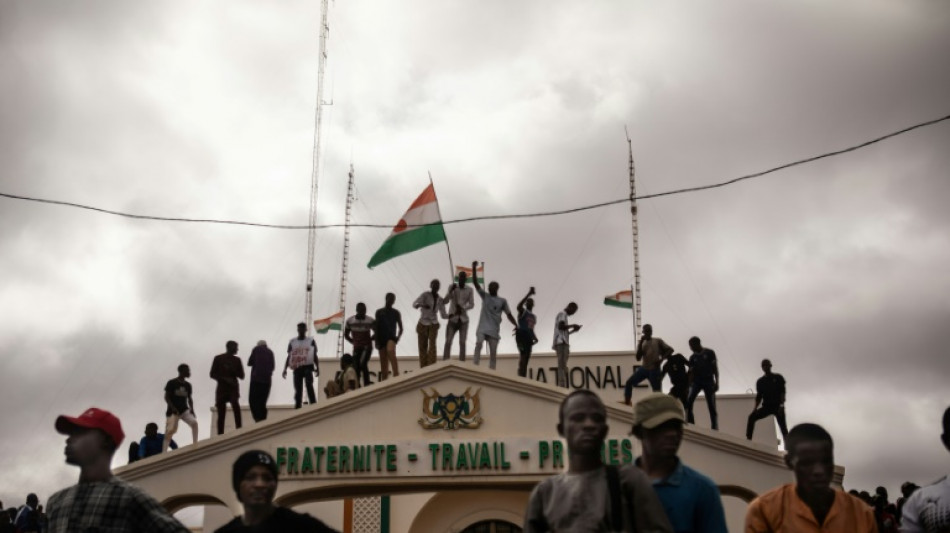
Across Niger on Thursday, thousands of people rallied to back the coup leaders on the anniversary of the country's 1960 independence, some waving giant Russian flags and chanting anti-French slogans.
Anti-French sentiment in the region is on the rise, while Russian activity, often through the Wagner mercenary group, has grown.
Bazoum has warned that Niger's neighbours had increasingly invited in "criminal Russian mercenaries such as the Wagner Group at the expense of their people's rights and dignity".
"The entire Sahel region," he said, "could fall to Russian influence via the Wagner Group, whose brutal terrorism has been on full display in Ukraine".
In a sign of the junta's displeasure with Paris, it announced Thursday that it was scrapping military pacts between Niamey and France, citing the former ruler's "careless attitude and its reaction to the situation".
Paris was also among four capitals from which the junta is recalling its ambassadors.
Niger has had a key role in Western strategies to combat a jihadist insurgency that has plagued the Sahel since 2012, with France and the United States stationing around 1,500 and 1,000 troops in the country, respectively.
The United States has chartered a plane to evacuate non-essential personnel and American citizens wishing to leave the country, the State Department said.
Bazoum, 63, was feted in 2021 after winning elections that ushered in Niger's first-ever peaceful transition of power.
T.Lambrecht--LCdB