W. Africa military chiefs agree plan for possible Niger intervention / Photo: - - AFP
West Africa's regional bloc said Friday its military chiefs have agreed a plan for a possible intervention in Niger, after the junta failed to restore civilian rule there following last week's coup.
The Economic Community of West African States (ECOWAS) on Sunday gave the junta that toppled elected president Mohamed Bazoum in a July 26 coup one week to reinstate him or face the potential use of force.
Military chiefs from the grouping were meeting in Nigeria's capital Abuja to discuss ways to respond to the crisis, the latest of several coups to hit Africa's Sahel region since 2020.
"All the elements that will go into any eventual intervention have been worked out," ECOWAS commissioner Abdel-Fatau Musah said after the talks finished.
These included "the resources needed, and including the how and when we are going to deploy the force", he added.
"We want diplomacy to work, and we want this message clearly transmitted to them (the junta) that we are giving them every opportunity to reverse what they have done," Musah said.
An ECOWAS delegation arrived in Niger's capital Niamey on Thursday but did not stay overnight as scheduled. It did not meet with Bazoum or coup leader Abdourahamane Tiani, a delegation member said on Friday.
In a deepening of the crisis, the junta announced earlier on Friday it was scrapping military pacts between Niger and France, citing the former colonial ruler's "careless attitude and its reaction to the situation".
Meanwhile, Washington is suspending some aid programmes to the Niger government, US Secretary of State Antony Blinken said without giving details.
However, "life-saving humanitarian and food assistance will continue" and the United States will still carry out diplomatic and security operations to protect its personnel in the country, he said.
Niger has played a key part in Western strategies to combat a jihadist insurgency that has plagued the Sahel since 2012, with France and the United States stationing around 1,500 and 1,000 troops in the country, respectively.
France rejected the coup leaders' severing of military ties, insisting only the "legitimate" government could decide.
- 'Authoritarian repression' -
Anti-French sentiment in the region is on the rise, while Russian activity, often through the Wagner mercenary group, has grown.
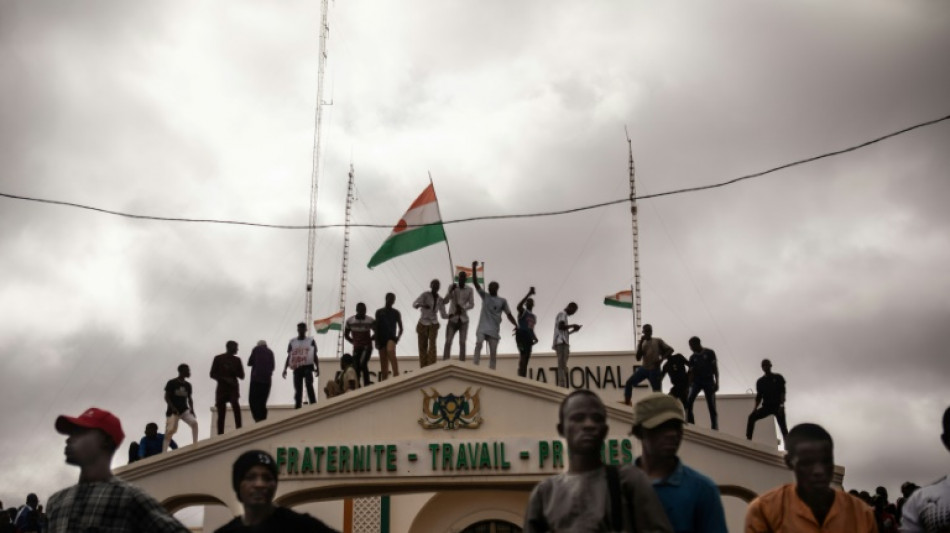
Thursday saw thousands of people rally to back the coup on the anniversary of Niger's independence, some waving Russian flags and chanting anti-French slogans.
A French foreign ministry spokeswoman said "authoritarian repression" was gripping Niger, with members of Bazoum's government and civil society figures being arrested, political parties closed, protests banned and independent media suspended.
Bazoum's detention conditions were worsening, Anne-Claire Legendre told BFM TV, citing information from Niger's ambassador to France, Aichatou Boulama Kane.
The deposed president "is being taken hostage, he has no electricity and has no access to his telephones", Legendre said.
Bazoum, 63, has been held by the coup plotters with his family in his official Niamey residence since July 26.
In a column in The Washington Post on Thursday -- his first lengthy statement since his detention -- he said a successful putsch would "have devastating consequences for our country, our region and the entire world".
Bazoum, who in 2021 won an election that ushered in Niger's first-ever transfer of power from one civilian government to another, urged "the US government and the entire international community to help us restore our constitutional order".
- Warnings against military intervention -
Regional powerhouse Nigeria holds the rotating ECOWAS presidency. Its leader, Bola Tinubu, has said the bloc would do "whatever it takes" to resolve the crisis amicably, with military intervention a last resort.
The bloc has already imposed trade and financial sanctions on the junta, with key electricity supplier Nigeria cutting its deliveries.
The junta has warned it would meet force with force.
Mali and Burkina Faso, where military juntas have taken power since 2020, have warned any regional intervention would be tantamount to a "declaration of war" against them.
Russia, which has increased its footprint across the Sahel in recent years, said a foreign intervention would not resolve the crisis.
Neighbouring Benin and Germany on Friday urged continued diplomacy to defuse the situation.
- Nationwide protests -
On Friday, there were sporadic rallies both for and against the coup.
Around 100 people from several West African nations rallied in Niamey to protest against any potential military intervention.
But in the western town of Tahoua, several hundred people gathered to show support for Bazoum and demand his unconditional release, one local journalist reported.
In a sign of a partial return to normality, the junta on Friday lifted a curfew in force since the takeover.
Spain said it had evacuated more than 70 people, including 16 Spanish nationals, from Niger aboard a government-chartered Airbus A330 military plane.
K.Cox--LCdB