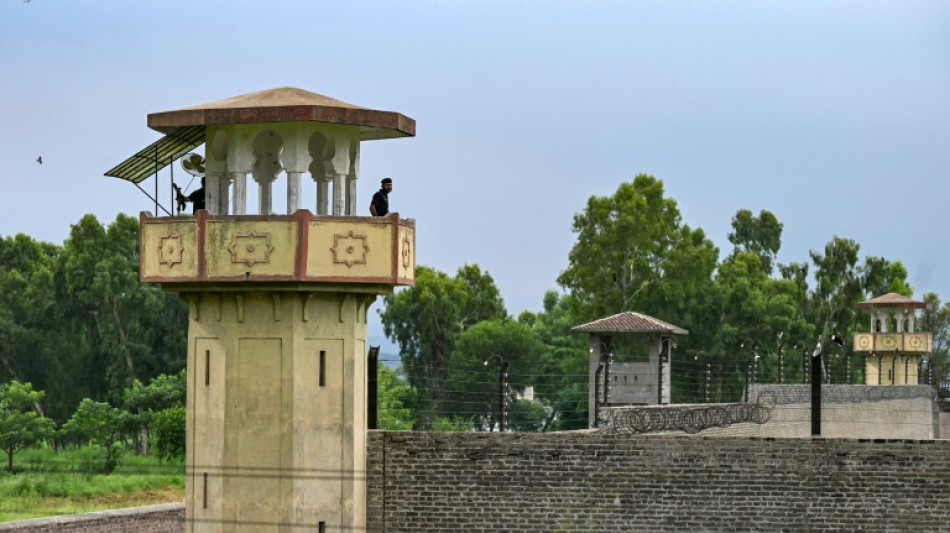
Jailed ex-Pakistan PM Imran Khan's lawyers to apply for bail / Photo: Aamir QURESHI - AFP/File
Lawyers for Pakistan's former prime minister Imran Khan were Tuesday set to file a bail application for him, as he languished in a small cell of a century-old prison at the start of a three-year jail term for graft.
The former international cricket star was arrested Saturday and whisked to prison after being found guilty in one of the more than 200 cases he has faced since being ousted from office by a vote of no confidence in April 2022.
The jail term has ruled him out from contesting upcoming elections.
Khan is being held at a colonial-era jail on the outskirts of historical Attock city, around 60 kilometres (40 miles) west of the capital Islamabad.
His lawyers will file an application for bail on Tuesday at Islamabad high court after visiting him in prison to obtain power of attorney, his spokesman Raoof Hasan told AFP.
"He is being held in deplorable conditions not fit for any human, but he is in good spirits," Hasan said.
"He said to 'tell the people that I will not compromise on my principles'."
The 70-year-old is being held in a so-called "C-class cell", sleeping on a mattress on the floor and with only enough room for a prayer mat.
There is little access to daylight, and a fan but no air conditioner in the summer heat, Hasan said.
Power of attorney allows Khan's legal team to file a bail application on his behalf and also appeal for him to be moved into a more comfortable "A-class cell," usually reserved for VIP inmates.
"We're hopeful that we will be able to secure bail and the decision will be suspended and the disqualification revoked," said Hasan.
- 'Chilling effect' -
At a court hearing that Khan did not attend on Saturday, a judge found him guilty of failing to properly declare gifts he received while in office and sentenced him to three years in jail.
While the sentence disqualifies Khan from taking part in upcoming elections, many politicians -- including current Prime Minister Shehbaz Sharif and his brother, former premier Nawaz Sharif -- have recovered from convictions or had them overturned to make a comeback.
Khan's arrest and detention for three days in connection with the same case in May sparked deadly violence, with his supporters taking to the streets in the tens of thousands and clashing with police.
It also prompted the crackdown that saw almost all of the top leadership of his Pakistan Tehreek-e-Insaf (PTI) party arrested or forced into hiding, leaving the party scrambling to set up a replacement decision-making body.
"The muted response to his arrest is because of the full-throttle crackdown on PTI workers after the first arrest," columnist Usama Khilji told AFP.
"The arrests of PTI workers post the May arrest of Imran Khan coupled with draconian laws passed in haste by (the coalition government) have had a chilling effect on Pakistani citizens."
Y.Bernard--LCdB