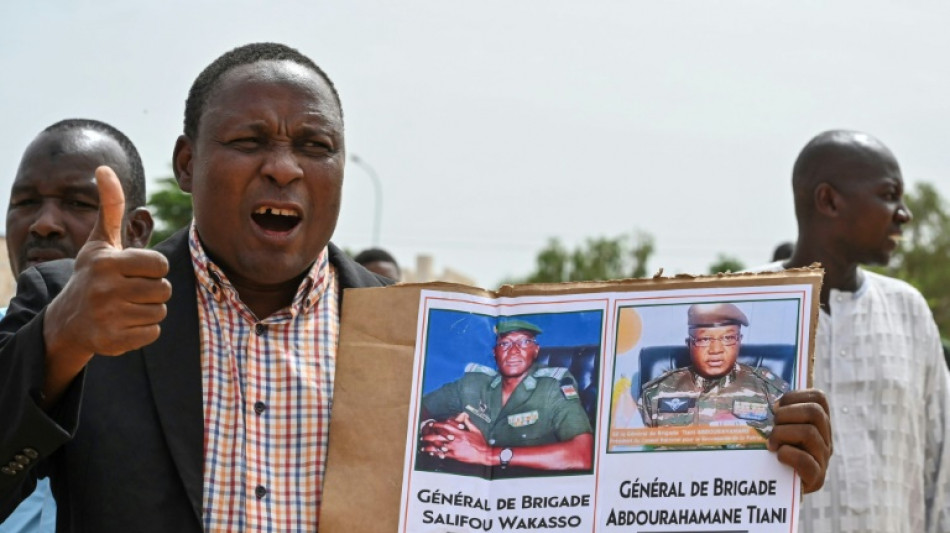
Nigeria says not ruling out force in Niger ahead of West African summit / Photo: - - AFP
Coup-hit Niger's neighbours have not ruled out military intervention, Nigeria's president said, ahead of a West African coalition's crisis summit in Abuja on Thursday.
Bola Tinubu, who also chairs the bloc ECOWAS, still believes diplomacy is the "best way forward" to resolve the crisis, according to his spokesman.
So far efforts by ECOWAS and the United States to convince Niger's new rulers to hand back power to the democratically elected leader have made little headway.
The soldiers who took charge defied a Sunday deadline to reinstate President Mohamed Bazoum or face the possible use of force and have been unswayed by negotiations, instead staging a rally at a stadium in the capital Niamey.
"No options have been taken off of the table," Tinubu's spokesman Ajuri Ngelale said on Tuesday.
The United States said it still hopes the coup could be undone but is "realistic", a day after a top US envoy appeared to make no progress in an unannounced visit.
"At the same time, we are making clear, including in direct conversations with junta leaders themselves, what the consequences are for failing to return to constitutional order," State Department spokesman Matthew Miller told reporters on Tuesday.
On Wednesday, US Secretary of State Antony Blinken said on social media that he had spoken to Bazoum "to express our continued efforts to find a peaceful resolution to the current constitutional crisis".
- Delegation rebuffed -
ECOWAS -- the Economic Community of West African States -- imposed trade and financial sanctions on Niger after the rebel soldiers toppled Bazoum.
Instead of heeding the bloc's seven-day ultimatum to reinstate Bazoum or face potential military intervention, the soldiers who seized power closed Niger's airspace.
The bloc also sought to send a delegation to Niamey on Tuesday ahead of Thursday's crisis summit.
But the ruling military blocked the mission, saying public "anger" triggered by the bloc's sanctions meant the delegation's safety could be at risk.
In a statement, ECOWAS confirmed that the visit by a joint delegation with African Union and United Nations officials had been refused.
In a further show of defiance and possible intent to hold on to power, the military leaders announced on Monday the appointment of Ali Mahaman Lamine Zeine as the new prime minister.
- 'Difficult' talks -
ECOWAS is struggling with a cascade of coups since 2020 that have now hit four of its 15 members.
In Mali, Burkina Faso and now Niger, all the takeovers have been fuelled by jihadist insurgencies that have claimed many thousands of lives, forced at least two million from their homes and dealt crippling blows to some of the world's poorest economies.
On Monday, veteran US envoy Victoria Nuland met with Niger's military rulers for more than two hours but came away empty-handed.
She described her talks as "extremely frank and at times quite difficult".
She said she offered the coup leaders "a number of options" to end the crisis and restore relations with the United States, which like other Western nations has suspended aid.
"I would not say that we were in any way taken up on that offer," she told reporters before her departure.
Niger's new head, General Abdourahamane Tiani, did not attend the meeting, and Nuland was unable to see Bazoum, who has been detained since July 26.
- Warnings -
The military leaders in Mali and Burkina Faso have expressed solidarity with Niger, saying any military intervention would be seen as a "declaration of war" against them.
The two countries sent letters Tuesday to the United Nations and the African Union, calling on them to prevent "military intervention against Niger" where the security and humanitarian consequences of such action "would be unpredictable".
Algeria, which shares a long land border with Niger, has also cautioned against a military incursion, which President Abdelmadjid Tebboune said would be "a direct threat" to his country.
Bazoum, 63, was feted in 2021 after winning elections that ushered in Niger's first-ever peaceful transition of power.
He took the helm of a country burdened by four previous coups since independence, and survived two attempted putsches before he himself was ousted.
France has 1,500 troops in Niger and the United States has 1,000 personnel, most of whom are deployed at two major air bases.
F.Claes--LCdB