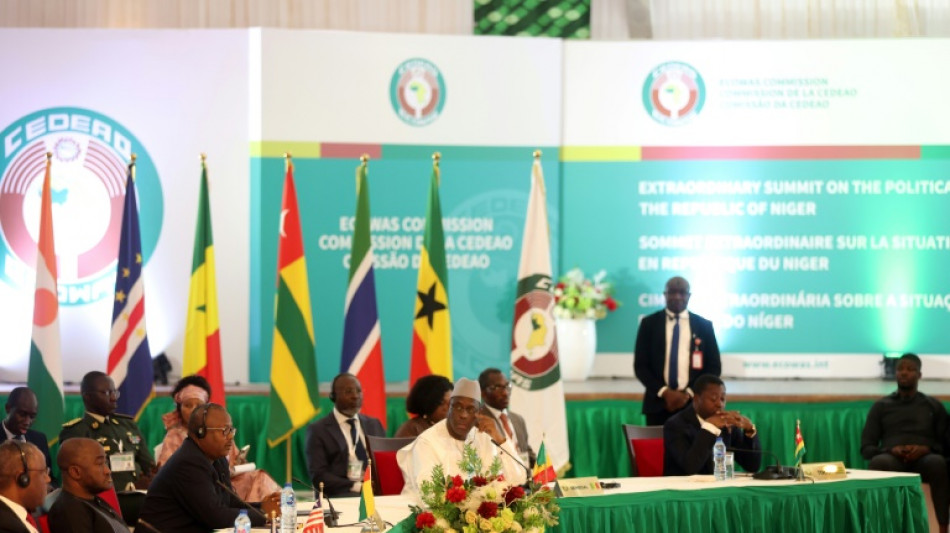
ECOWAS backs military 'standby' force for Niger / Photo: KOLA SULAIMON - AFP
West African leaders have approved the deployment of a "standby force to restore constitutional order" in Niger, an intervention that will take place as soon as possible, Ivory Coast's President Alassane Ouattara said Thursday.
The ECOWAS regional bloc did not provide details on the force to be deployed or the timetable for action against the military officers who seized control of Niger two weeks ago, deposing Mohamed Bazoum as president.
But on his return to Abidjan from the emergency summit in Abuja, Nigeria, Ouattara said: "The Chiefs of Staff will have other conferences to finalize things but they have the agreement of the Conference of Heads of State for the operation to start as soon as possible."
Ivory Coast would provide a battalion of 850 to 1,100 men alongside soldiers from Nigeria and Benin, and other countries would join them, Ouattara said.
"We are determined to restore president Bazoum to his functions."
Earlier, in Abuja, ECOWAS Commission President Omar Touray had announced the deployment of the bloc's force.
Former colonial power France gave its "full support to all the conclusions" the bloc reached, the foreign ministry said.
But even as the summit took place, Niger's new military rulers moved to consolidate their position and signalled further defiance by appointing a new government.
A 21-member cabinet will be headed by Prime Minister Ali Mahaman Lamine Zeine, a civilian, with generals from the new military governing council leading the defence and interior ministries.
The coup leaders have already defied the Sunday deadline set by ECOWAS a week earlier to reinstate Bazoum -- detained since July 26 -- or face military possible intervention.
In Abuja, Nigeria's President Bola Tinubu, who chaired the crisis meeting, said: "All is not lost yet" for a "peaceful solution, as a roadmap to restore democracy and stability".
But he added: "No option is taken off the table, including the use of force as a last resort."
Before the closed-door talks, Tinubu had insisted that "we prioritise diplomatic negotiations and dialogue as the bedrock of our approach".
- 'We must engage' -
The 15-nation bloc is struggling to stem military takeovers that have now swept through four of its members in three years, potentially heralding fresh instability in a region struggling for years against jihadist insurgences.
Before the meeting, Tinubu acknowledged that "the seven-day ultimatum we issued during the first summit has not yielded the desired outcome".
An attempt this week to send a joint team of ECOWAS, UN and African Union representatives to Niger's capital Niamey was rejected by the coup leaders.
"We must engage all parties involved, including the coup leaders, in earnest discussions to convince them to relinquish power and reinstate President Bazoum," Tinubu said.
The possibility of military intervention in Niger, a fragile nation that ranks among the world's poorest, has sparked debate within ECOWAS and warnings from neighbouring Algeria as well as Russia.
Niger's neighbours Mali and Burkina Faso, both ruled by military governments that seized power in coups, also warned an intervention would be a "declaration of war" on their countries.
Mali, Burkina Faso and Guinea, also hit by a recent coup, have been suspended from ECOWAS and like Niger were not represented at the Abuja summit.
Current ECOWAS chair Nigeria had taken a hard line against last month's coup, the fifth in Niger since independence from France in 1960.
Speaking before flying to Abuja on Wednesday, Guinea-Bissau's President Umaro Sissoco Embalo said the future of ECOWAS was at stake following the recent coups among its members.
UN secretary general Antonio Guterres joined a chorus of concern about 63-year-old Bazoum, saying that he and his family were reportedly enduring "deplorable living conditions".
CNN reported Wednesday that Bazoum was being kept in isolation and given meals of only plain rice and pasta.
- Unstable Sahel -
Countries in the Sahel are battling a jihadist insurgency that erupted in northern Mali in 2012, spread to Niger and Burkina Faso in 2015, and is now causing jitters in states on the Gulf of Guinea.
Niger has the misfortune of facing a double jihadist insurgency, both in its southwest and also from militants crossing into the southeast.
Bazoum's election in 2021 had helped Niger cement close ties with France and the United States, which have major bases and troop deployments in the country.
France last year withdrew its forces from Mali and Burkina Faso after falling out with their military leaders, refocussing its anti-jihadist strategy on Niger.
N.Lambert--LCdB