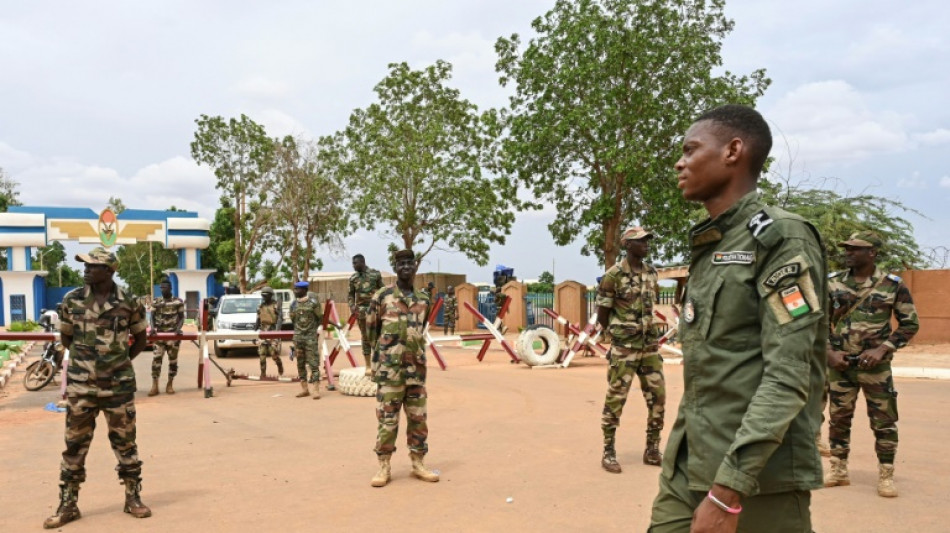
Niger coup supporters protest West African military force / Photo: - - AFP
Thousands of Niger coup supporters took to the streets on Friday to protest against plans by West African nations to deploy a military force to the country, as a key regional meeting on a possible intervention was scrapped.
ECOWAS had approved a "standby force" to reinstate elected President Mohamed Bazoum, with the EU's top diplomat expressing concern about his conditions in detention since he was ousted by members of his guard on July 26.
Chiefs of staff from member states of the West African bloc had been set to attend a meeting on Saturday in Ghana's capital Accra, regional military sources had said on Friday.
But they later said the meeting had been suspended indefinitely for "technical reasons".
The sources said the meeting was originally set up to inform the organisation's leaders about "the best options" for activating and deploying the standby force.
ECOWAS has yet to provide details on the force or a timetable for action, and the leaders have emphasised they still want a peaceful solution.
The last-minute cancellation came as thousands of coup supporters rallied near a French military base in Niger on Friday.
Protesters near the base on the outskirts of the capital Niamey shouted "Down with France, down with ECOWAS".
Niger's new leaders have accused former colonial power France, a close Bazoum ally, of being behind the hardline ECOWAS stance against the coup.
Many protesters brandished Russian and Niger flags and shouted their support for the country's new strongman, General Abdourahamane Tiani.
"We are going to make the French leave! ECOWAS isn't independent, it's being manipulated by France," said one demonstrator, Aziz Rabeh Ali, a member of a students' union.
France has around 1,500 troops in Niger as part of a force battling an eight-year jihadist insurgency.
It is facing growing hostility across the Sahel, withdrawing its anti-jihadist forces from neighbouring Mali and Burkina Faso last year after falling out with military governments that ousted elected leaders.
Niger's new leaders scrapped defence agreements with France last week, while a hostile protest outside the French embassy in Niamey on July 30 prompted Paris to evacuate its citizens.
- Fears for Bazoum -
The European Union and the African Union joined others in sounding the alarm for Bazoum on Friday.
"Bazoum and his family, according to the latest information, have been deprived of food, electricity and medical care for several days," said EU foreign policy chief Josep Borrell.
UN rights chief Volker Turk said Bazoum's reported detention conditions "could amount to inhuman and degrading treatment, in violation of international human rights law".
The AU said "such treatment of a democratically elected president" was "unacceptable".
German Foreign Minister Annalena Baerbock warned that the "coup plotters must face harsh consequences should anything happen" to Bazoum or his family.
Top US diplomat Antony Blinken said he was "dismayed" by the military's refusal to release Bazoum's family as a "demonstration of goodwill".
A source close to Bazoum said: "He's OK, but the conditions are very difficult". The coup leaders had threatened to assault him in the event of military intervention, the source added.
Human Rights Watch said it had spoken to Bazoum earlier this week. The 63-year-old described the treatment of himself, his wife and their 20-year-old son as "inhuman and cruel", HRW said.
"I'm not allowed to receive my family members (or) my friends who have been bringing food and other supplies to us," the group quoted him as saying.
"My son is sick, has a serious heart condition, and needs to see a doctor," he was quoted as saying. "They've refused to let him get medical treatment."
Under pressure to stem a cascade of coups among its members, ECOWAS had previously issued a seven-day ultimatum to the coup leaders to return Bazoum to power.
But the generals defied the deadline, which expired on Sunday without any action being taken.
The coup leaders have since named a new government, which met for the first time on Friday.
- Troubled region -
Since 1990, the 15-country bloc has intervened in six of its members at times of civil war, insurrection or political turmoil.
But the possibility of intervention in deeply fragile Niger has sparked debate within its ranks and warnings from neighbouring Algeria as well as from Russia.
Moscow, whose influence in the region has grown, said a military solution "could lead to a protracted confrontation" in Niger and "a sharp destabilisation" across the Sahel.
The president of ECOWAS member Cape Verde, Jose Maria Neves, spoke out against a military intervention on Friday and said his country was unlikely to participate in such a campaign.
Military-ruled ECOWAS nations Mali and Burkina Faso have warned an intervention would be a "declaration of war" on their countries.
General Salifou Mody, Niger's new defence minister, made a brief visit to Mali on Friday, according to a Malian presidential adviser speaking on condition of anonymity.
Like Mali and Burkina Faso, the country is struggling with a brutal jihadist insurgency that has claimed thousands of lives, forced many people from their homes and undermined faith in government.
K.Smeets--LCdB