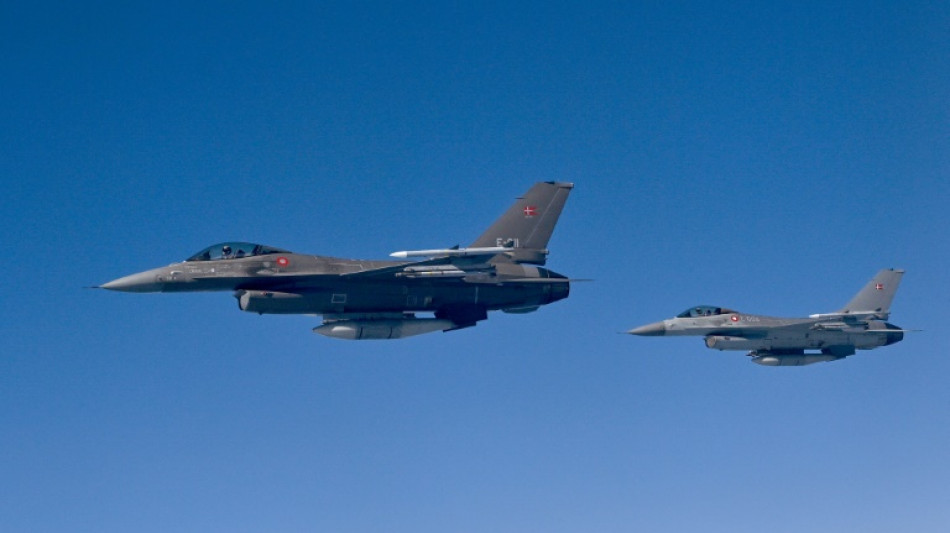
US clears transfer of Dutch, Danish F-16s to Ukraine / Photo: John THYS - AFP
Kyiv on Friday welcomed a US decision to let Denmark and the Netherlands hand F-16 fighter jets over to Ukraine once its pilots are trained to use them.
In Russia, the authorities shut down respected rights group the Sakharov Center and announced fresh international sanctions against its critics abroad.
And earlier Friday Russian forces destroyed Ukrainian drones targeting Moscow and its Black Sea Fleet.
In Washington, a US State Department official said Denmark and the Netherlands had been given "formal assurances" for the jet transfer.
Training by an 11-nation coalition is to begin this month, and officials hope pilots will be ready by early 2024.
Ukrainian Defence Minister Oleksii Reznikov hailed "great news from our friends in the United States".
Kyiv has been pushing for months to get Western fighters to replace the heavy losses incurred by its air force, which flies mostly Russian aircraft. The US F-16 has better combat capabilities than those operated by Ukraine.
- Russian clampdown -
Russia on Friday continued its battle against its critics at home and abroad.
The authorities shut down prominent rights group the Sakharov Center, saying it had illegally hosted conferences and exhibitions.
Named after Nobel Prize winner and Soviet-era dissident Andrei Sakharov, it was set up in 1996 to defend human rights and preserve his legacy.
Critics say the group is the latest target of the Kremlin's clampdown on liberal-leaning organisations that challenge the authorities.
Also Friday, a Russian court placed the co-chair of independent election monitoring group Golos in pre-trial detention until at least October 17.
The ruling by Basmanny District Court comes as Russia gears up for regional elections next month.
And Moscow announced sanctions against International Criminal Court prosecutor Karim Khan, who in March issued a warrant against Putin accusing him of having "illegally deported" thousands of Ukrainian children to Russia.
Two British government ministers were also on the updated sanctions list, as well as journalists from the BBC, the Guardian and the Daily Telegraph.
- Drone attacks -
Russia's defence ministry said its air force had downed a Ukrainian drone over the capital at about 04:00 (0100 GMT) Friday.
"The wreckage of the UAV fell in the area of the Expo Centre, and did not cause significant damage to the building," Moscow's mayor Sergei Sobyanin said on social media.
The walls of the venue's pavilion had partially collapsed, AFP journalists on the scene reported. The centre, on the Krasnopresnenskaya embankment of the Moskva River, hosts exhibitions and trade shows.
Until a series of attacks in recent months, the capital had not been targeted during the conflict in Ukraine, which began more than a year ago.
But Ukrainian President Volodymyr Zelensky warned last month that "war" was coming to Russia and that its "symbolic centres and military bases" were targets.
Last week, Russia destroyed a Ukrainian drone over Moscow's west, with debris landing in a park on the Karamyshevskaya embankment. In May, drones were shot down near the Kremlin, less than five kilometres from the Expo Centre.
Hours before the strike on Moscow, Russia said it had thwarted a Ukrainian marine drone attack on its warships in the Black Sea, the latest in a string of assaults on its fleet.
On the frontlines, Ukrainian forces crossed into the Russian-occupied east bank of Kherson region and took positions there, the region's Russian-installed governor confirmed.
Vladimir Saldo said Ukrainian "sabotage groups" had managed to hide out on the outskirts of the Russian-controlled town of Kozachi Lageri, near the Dnipro river, but that they were later "cleared out" by Moscow's forces.
Ukraine's Deputy Defence Minister Ganna Malyar this week said that "certain units performed certain tasks," on the left bank of the Dnipro river in Kherson, without elaborating.
- Black Sea manoeuvres -
Ukrainian Prime Minister Denys Shmygal hailed "important and constructive" talks on grain exports with his Romanian counterpart Marcel Ciolacu during a visit to Bucharest on Friday.
Ciolacu said Romania wanted to double the amount of Ukrainian grain transiting his country to four million tonnes.
Their talks came a day after the first civilian cargo ship sailed through the Black Sea from Ukraine to Istanbul in defiance of a Russian blockade.
President Zelensky said the ship was using a "new humanitarian corridor" Kyiv established after Russia last month pulled out of a deal that had allowed the safe export of Ukrainian grain through the Black Sea.
At that time, Russia also warned that it would consider any ships nearing Ukraine in the Black Sea as potential military cargo carriers.
Days ago, a Russian navy ship fired warning shots and boarded a Turkish-owned but Palau-flagged cargo vessel that was sailing to a Ukrainian river port.
burs/jj/lcm
H.Vermeulen--LCdB