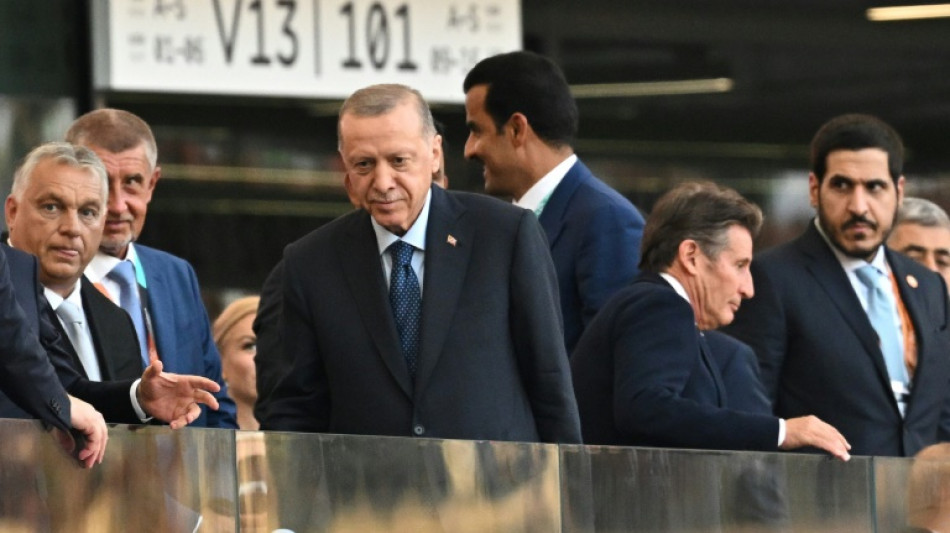
Turkey's leader Erdogan in Hungary for NATO, energy talks / Photo: Attila KISBENEDEK - AFP
Turkish President Recep Tayyip Erdogan met Hungarian Prime Minister Viktor Orban in Budapest on Sunday, with energy security and Sweden's membership of NATO on the agenda for both countries.
Hungary has still not voted to approve the Nordic country's entry into the North Atlantic Treaty Organization, having aligned itself with Turkey which had long blocked Sweden's membership before lifting its veto last month.
Both countries' parliaments are currently on holiday. "We can come back to the issue at the autumn session," Hungary's Foreign Minister Peter Szijjarto said on Facebook, "We have agreed to stay in touch."
The two countries have also discussed strengthening their energy cooperation, given that Hungary already receives a large proportion of its gas via the TurkStream pipeline, which transports Russian gas across the Black Sea.
Budapest and Ankara will also be deepening their "strategic partnership", an announcement due to be made official during a visit by Erdogan scheduled for December.
The Turkish leader's visit is part of a series of diplomatic meetings organised by Orban to mark the World Athletics Championships, which opened on Saturday.
Among other dignitaries welcomed on Sunday were the presidents of Serbia, Azerbaijan, Kyrgyzstan as well as President Serdar Berdymukhamedov of Turkmenistan.
Szijjarto welcomed "the close cooperation between Central Asia and the Western Balkans", which he said was especially important given the energy crisis.
Serbia has promised to "provide the necessary transit capacity" if Ukraine decides to stop allowing Russian gas to pass through its territory to be transported to European countries, he added.
Hungary, the only country EU member state to have maintained links with the Kremlin since the beginning of the Ukraine war, has in recent years pursued a policy of opening up to the East, not only towards Russia, but also towards Central Asia and China.
Viktor Orban was delighted to welcome his "political friends" at the weekend. Hungary's Western partners, who regularly accuse him of authoritarian excess, are absent.
W.Blondeel--LCdB