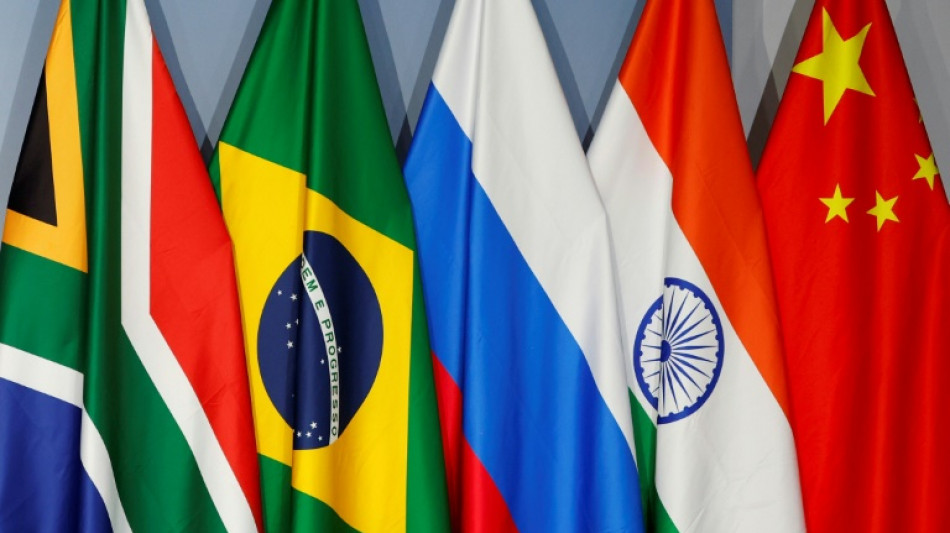
BRICS hails 'historic' entry of new members amid bloc rivalry / Photo: Marco Longari - AFP
BRICS leaders announced Thursday the "historic" admission of six new countries as it seeks to reshape the Western-led global order and expand its influence in an era of strategic competition.
The BRICS -- Brazil, Russia, India, China and South Africa -- agreed at their annual summit to make Argentina, Ethiopia, Iran, Saudi Arabia, Egypt and the United Arab Emirates full members from January 1.
"This membership expansion is historic," said Chinese President Xi Jinping, whose nation is the most powerful in the group of large and populous economies.
"The expansion is also a new starting point for BRICS cooperation. It will bring new vigour to the BRICS cooperation mechanism and further strengthen the force for world peace and development".
Beijing has campaigned to rapidly grow and strengthen the BRICS as a counterweight to US and Western dominance of world affairs, and the push to expand membership headlined the summit agenda in Johannesburg.
Ethiopian Prime Minister Abiy Ahmed hailed what he called "a great moment" for his country, the second-most populous in Africa.
"The benefits of Iran's membership to BRICS will make history, and open a new chapter and a stronger step towards fairness... and lasting peace on the international stage," said Iranian President Ebrahim Raisi.
Egypt and the UAE also broadcast their readiness to work with the loosely defined group that represents billions of people on four continents and a quarter of the world's wealth.
While the announcement indicated all six countries would join, the Saudi response was non-committal, with Foreign Minister Prince Faisal bin Farhan saying Riyadh was "awaiting details" about the invitation and would "take the appropriate decision".
- 'Fight for a new order' -
The bloc makes decisions by consensus and agreed on the six nations after approving rules for admission during three days of bilateral talks and closed-door meetings.
Officials said months of pre-negotiations were needed to reach the breakthrough, though the exact criteria for entry or why these nations were selected from dozens of candidates has not been made public.
It paves the way for future expansion of a disparate group of big and small economies that encompasses both the world's largest democracy and its largest authoritarian state.
More than 20 countries had formally applied to join and about the same number have expressed interest from non-Western nations across the so-called Global South.
Some 50 world leaders attended the summit, underscoring what BRICS leaders say is the attractiveness of its message and growing relevance on the world stage.
The BRICS has risen to prominence at a time of intense geopolitical rivalry and analysts foreshadowed that its 15th summit could be pivotal.
US officials have played down the likelihood of BRICS emerging as a geopolitical rival, describing the bloc as a highly diverse grouping of both friends and rivals.
"Our diversity strengthens the fight for a new international order," said Brazilian President Luiz Inacio Lula da Silva, who advocated for Argentina's membership.
- 'Shot in the arm' -
Michael Kugelman, director of the South Asia Institute at the Wilson Center, said the summit had given BRICS "a shot in the arm".
"In reality, BRICS does have something approximating a common vision, and that is providing alternatives to the West," he said.
"I think it's a goal that's gained momentum amid greatly intensifying power competition."
BRICS leaders championed its New Development Bank as a fairer lender for emerging markets than US-based institutions like the World Bank.
UN Secretary-General Antonio Guterres said an overhaul of the world's "outdated, dysfunctional, and unfair global financial architecture" was necessary "but it won't happen overnight".
"In the absence of such reform, fragmentation is inevitable," he told leaders in Johannesburg.
Analysts said Brazil, South Africa and India would need to balance their proximity to China and Russia without alienating a strong trading partner in the United States.
The admission of oil-producing giants Iran, Saudi Arabia and UAE would boost the BRICS economic heft but some observers said Tehran's inclusion risked colouring the bloc an anti-American hue.
The summit also underlined divisions with the West over the war in Ukraine.
Russia President Vladimir Putin, who is the subject of an international arrest warrant, was the only leader not present in Johannesburg and addressed the summit via video link.
L.Dumont--LCdB