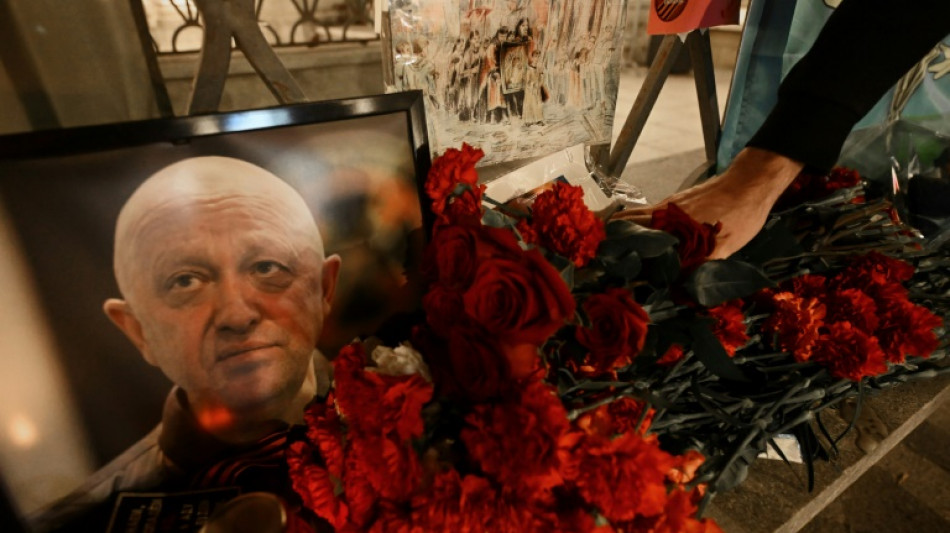
'Absolute lie': Kremlin rejects Prigozhin killed on its orders / Photo: NATALIA KOLESNIKOVA - AFP
The Kremlin on Friday dismissed rumours it orchestrated the death of Wagner chief Yevgeny Prigozhin, presumed dead in a plane crash two months after leading a mutiny in Russia.
It also announced by decree that Russian paramilitary fighters will be obliged to swear an oath to the Russian flag, part of measures to rein in groups like Wagner in the wake of the uprising.
Speculation the Kremlin may have been involved in the crash has swirled since Wednesday, when a private jet reportedly carrying Prigozhin crashed between Moscow and Saint Petersburg.
The rumours have been voiced by Western countries, Kremlin critics and even suggested by some pro-Kremlin figures.
Kremlin spokesman Dmitry Peskov described the incident as "tragic" to reporters on Friday and acknowledged public discourse around foul play and possible involvement of the authorities.
"Of course, in the West, this speculation is being presented from a certain angle. All of this is an absolute lie," Peskov said, urging patience and adding that ongoing probes would reveal facts around the fatal crash.
Russian officials have opened an investigation into air traffic violations but have so far not disclosed details of the probe or the incident.
President Vladimir Putin broke his silence on the crash Thursday, offering condolences to the families of the 10 people onboard and describing the incident as a "tragedy."
He said Prigozhin, who in June led an armed mutiny against Russia's military leadership, had made some "serious mistakes in his life" and had a "complicated fate."
- Suspicious timing -
The short-lived but bloody unrest was seen by observers as having been the biggest threat to Putin's long rule.
Moscow has not yet confirmed Prigozhin's death. Putin used the past tense to refer to him but Peskov said work was being carried out to formally identify Prigozhin as among the victims.
"As soon as the results are in, they will be published," Peskov said.
Asked if Putin would attend Prigozhin's funeral, he said: "At the moment there is no date for the funeral, it is not possible to talk about this."
"The president's work schedule is quite busy at the moment," Peskov added.
In an address Thursday, Putin said he had known Prigozhin -- once a loyal ally -- since the early 1990s. Both hail from Russia's former imperial capital of Saint Petersburg.
Under Putin, Russia has a history of mysterious deaths.
For many in Russia, the fact that Prigozhin's armed march on Moscow ended in an unusual deal that involved the Kremlin allowing the rebellious warlord to go into exile in Belarus had raised eyebrows.
Many Western officials said the timing of the crash was suspicious coming two months to the day after the mutiny.
Moscow moved quickly to disarm the group and transferred its heavy weapons to the defence ministry, and the decree signed by Putin on Friday was aimed at "forming the spiritual and moral foundations for the defence of the Russian Federation".
- 'Heroism not forgotten' -
With Prigozhin's apparent demise, the fate of his private army Wagner -- which shot up in influence during the Ukraine offensive but is also present in African conflicts -- remained unclear.
International NGOs and UN-mandated experts have regularly accused the Wagner group of war crimes.
"I can't tell you anything right now. I don't know," Peskov said, referring to what comes next for the mercenary outfit.
After the June mutiny, Moscow was careful to run a campaign against the outspoken Wagner chief but not his fighters, who spearheaded Russia's advance in key battles in Ukraine and were seen as heroes back home.
"As the president has said many times, the Wagner group made a great contribution to the special military operation," Peskov said, using Kremlin-approved vocabulary to describe the conflict.
"The heroism of these people will not be forgotten. That is what the president said."
Even after his mutiny, Prigozhin enjoyed some popularity in Russia, with many nationalist-leaning Russians embracing his tough-guy speak.
B.Francois--LCdB