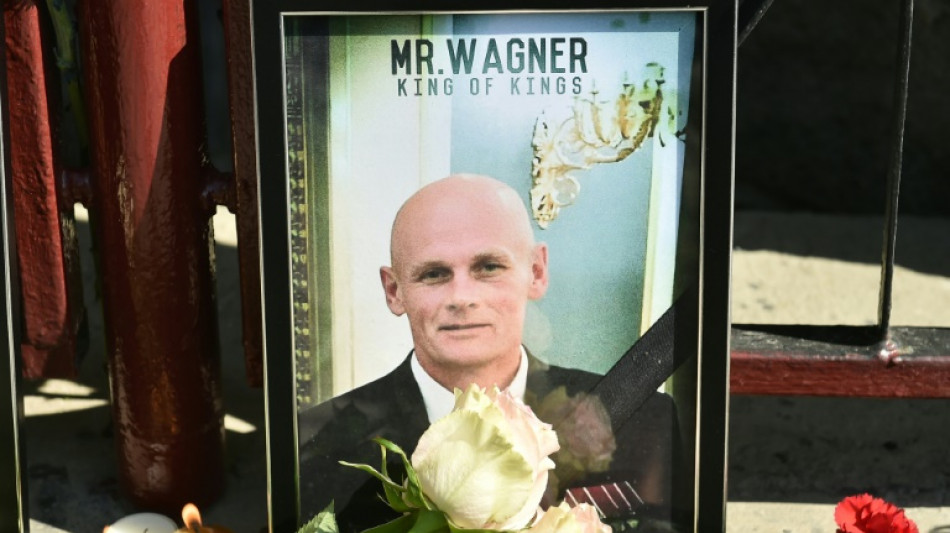
Utkin, the Nazi-tattooed commander who gave Wagner its name / Photo: Vladimir NIKOLAYEV - AFP
A rare photo of the Wagner group's military commander shows a man with a shaved head, a cold stare and the Nazi SS symbol tattooed on both sides of his neck.
Dmitry Utkin, a veteran of Russia's military intelligence division, the GRU, was reportedly beside Wagner boss Yevgeny Prigozhin on the plane that crashed on Wednesday north of Moscow, killing all on board.
Little is known publicly of this former army officer, who Russian media -- including state-run outlets -- were calling the Wagner "commander" as far back as 2015-2016.
At that time, the Kremlin was denying links to the mercenary group, which was already operating in Ukraine and Syria, where Russian forces were shoring up dictator Bashar Al-Assad.
Then, in December 2016, Utkin was pictured alongside President Vladimir Putin at a Kremlin reception for Russian "heros" fighting in the Syrian civil war.
At around about the same time, Utkin's ex-wife, Elena Shcherbinina, gave an interview to Russian state-owned news site Gazeta.ru, saying she was unable to reach him.
She said Utkin was born in 1970 and served in the Russian army in the Chechen wars.
He left the army in 2012 and set up a private security company, according to the dossier.center website founded by anti-Kremlin oligarch Mikhail Khodorkovsky.
Shcherbinina told Gazeta.ru her former husband had found leaving active combat difficult.
"It was very hard for him to adapt. It bothered him a lot not to be fighting. He wanted a military career as a combat officer, not to wear out the seats of his pants sitting in some HQ somewhere."
- Wagner's murky origins -
It is unclear how Utkin met Prigozhin and how what would become the Wagner group was founded in around 2014.
But the mercenary outfit was given Utkin's call sign -- Wagner.
Adolf Hitler was a huge fan of German composer Richard Wagner and many observers see this nom de guerre as another indication of Utkin's Nazi sympathies.
Several Wagner mercenaries have insignia and tattoos inspired by the Third Reich.
The Wagner group was deployed in the Donbas region of eastern Ukraine in 2014, where Moscow was stirring up a separatist rebellion against Kyiv.
The Kremlin needed to have men it could trust on the front line and, at the same time, be able to deny that Russian soldiers were operating on Ukrainian soil.
Utkin, Prigozhin's right-hand man, was responsible for commanding Wagner's military operations.
Prigozhin, who had known Putin since the early 1990s, took care of finances and relations with the Russian state.
The entire mercenary operation was carried out with utmost secrecy.
It flourished and in under a decade, Prigozhin, Utkin and their mercenary outfit had become notorious worldwide.
- Dead 'because of traitors' -
They continued to operate in the shadows, while all the time being accused everywhere they went -- in the Central African Republic, in Libya, in Syria, in Ukraine -- of widespread abuses.
Initially, Russia's military offensive against Ukraine in February 2022 changed nothing.
But when the Russian army was forced to retreat in the east and south of Ukraine in autumn 2022, Prigozhin became a public figure.
After years of denial, he finally acknowledged that Wagner did exist and started recruiting tens of thousands of convicts from Russian prisons to fight on the front line.
Wagner mercenaries led the assault on Bakhmut, a bloody battle that has been ongoing for a year now and has forged the image of Wagner as the most efficient of the Russian military forces on the ground in Ukraine.
Utkin remained out of sight. He appeared in no videos and posted nothing on Telegram -- unlike Prigozhin, who regularly berated and insulted the Russian military top brass.
Utkin is believed to have taken part in the short-lived mutiny in June when Wagner seized control of the army command centre controlling Russia's military operations in Ukraine and marched on Moscow, demanding the sacking of the army chief of staff and the defence minister.
Many observers see the fatal plane crash as an assassination. Putin had, after all, called the mutineers traitors.
"Dmitry Valerievich Utkin was a Hero of Russia," the Wagner-linked Telegram channel Grey Zone said on the night of the plane crash.
"He was awarded the Order of Courage four times and was known the world over by his call sign 'Wagner'. (He) died because of the work of traitors to Russia."
D.Moerman--LCdB