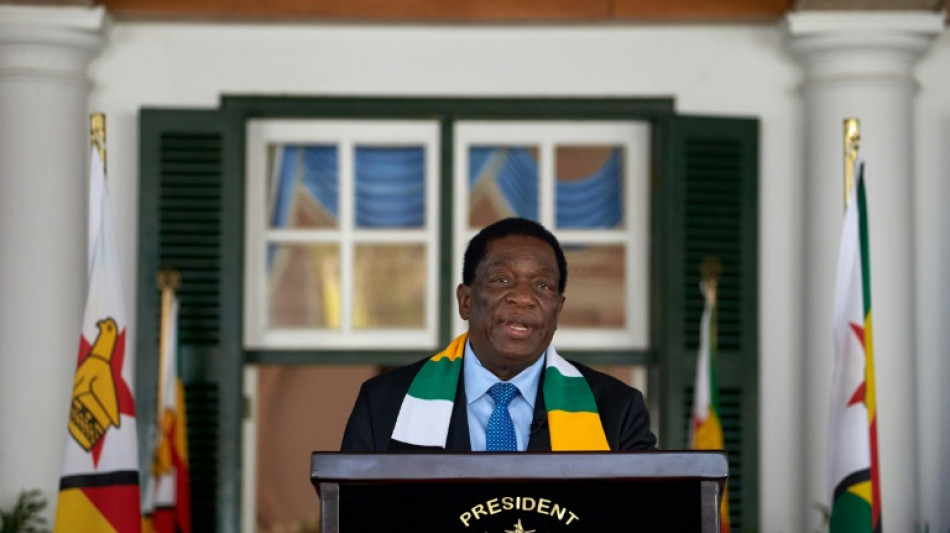
Zimbabwe leader hails 'mature democracy' after disputed re-election / Photo: Jekesai NJIKIZANA - AFP
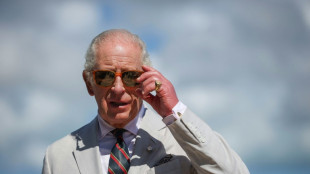
President Emmerson Mnangagwa on Sunday called Zimbabwe a "mature democracy" after winning a second term in office despite the opposition rejecting the result of a vote that international observers said fell short of democratic standards.
Mnangagwa, 80, won 52.6 percent of the ballots against 44 percent for his main challenger, Nelson Chamisa, 45, according to official results announced late Saturday by the Zimbabwe Electoral Commission (ZEC).
"We have demonstrated that we are a mature democracy," the president said, praising a high turnout. "We take pride in the fact that we are an independent and sovereign nation."
Zimbabweans voted Wednesday and Thursday for president and parliament in polling marred by delays that sparked opposition accusations of rigging and voter suppression.
Promise Mkwananzi, a spokesman for Chamisa's Citizens Coalition for Change (CCC), said the party did not sign the final tally, which he described as "false".
"We cannot accept the results," he told AFP, saying the party would soon announce its next move.
The vote has been watched across southern Africa as a test of support for Mnangagwa's ZANU-PF party, whose 43-year rule has been accompanied by a moribund economy and charges of authoritarianism.
Foreign monitors announced Friday that the elections had failed to conform to regional and international standards.
- 'Rigging' -
Observer missions from the European Union, the Commonwealth and the 16-nation Southern African Development Community (SADC) listed a number of concerns, including the banning of opposition rallies, issues with the voter registration rolls, biased state media coverage and voter intimidation.
That did not stop Mnangagwa from thanking "various election observation missions who have been witnessing our electoral processes without bias".
"As a sovereign state, we continue to call on all our guests to respect our national institutions," he said.
But for political analyst Rejoice Ngwenya, "The elections were fraught with irregularities and aggrieved the people of Zimbabwe."
"The CCC has good grounds to go to court and challenge the outcome".
ZEC chairwoman Justice Chigumba said Mnangagwa had garnered more than 2.3 million votes, and Chamisa more than 1.9 million.
By securing more than half the votes cast, the president avoided a run-off. Voter turnout was 69 percent, the commission said.
- 'Crocodile' -
Nicknamed "The Crocodile", Mnangagwa first came to power after a coup that deposed the late ruler Robert Mugabe in 2017.
A year later, he narrowly beat Chamisa a first time in a vote the opposition leader condemned as fraudulent, and which was followed by a deadly crackdown.
This week, voting was forced to stretch into an unprecedented second day because of delays in printing of ballot papers in some key districts, including the opposition stronghold Harare.
Chamisa condemned the delays as "a clear case of voter suppression, a classic case of Stone-Age... rigging".
As a white-ruled British colony named Rhodesia, the country broke away from London in 1965, gaining independence in 1980 after a long guerrilla war, and was renamed Zimbabwe.
But under Mugabe, its first leader, the fledgling democracy spiralled into hardline rule and economic decline, with hyperinflation wiping out savings and deterring investment.
The opposition hoped to ride a wave of discontent over corruption, rising prices, unemployment and entrenched poverty.
But ZANU-PF was also declared the winner in the parliamentary race, securing 136 of the 210 seats up for grabs under a first-past-the-post system, against 73 for the CCC. One seat was not assigned due to the death of a candidate.
strs-ub/bp/js
T.Lambrecht--LCdB