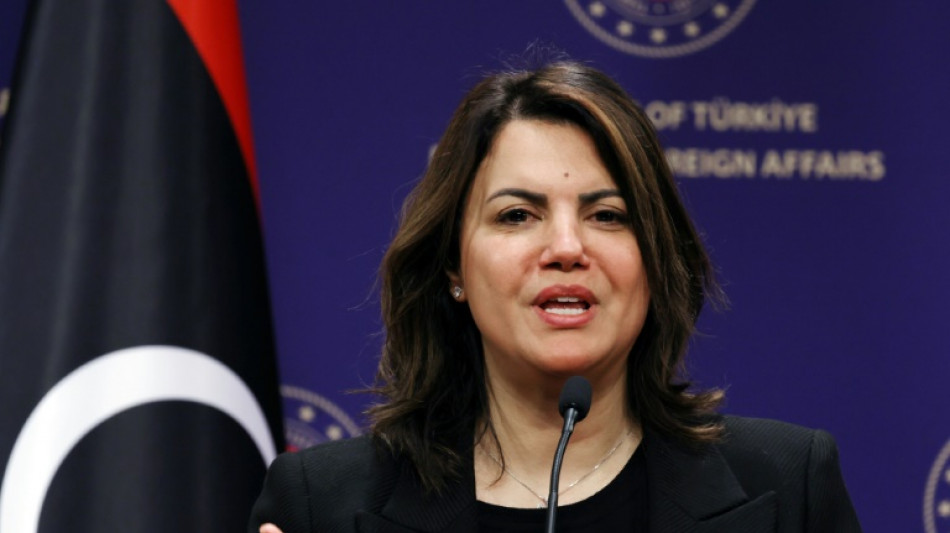
Libya foreign minister suspended after Israel meeting / Photo: Adem ALTAN - AFP/File
Libya's internationally recognised prime minister has suspended his top diplomat after she met her Israeli counterpart, with news of the encounter triggering demonstrations in a country that does not recognise Israel.
Oil-rich Libya, which plunged into chaos after dictator Moamer Kadhafi was toppled and killed in 2011, has been divided since 2014 between the UN-supported government of Prime Minister Abdelhamid Dbeibah in Tripoli and a rival administration based in the country's east.
Angry protesters took to the streets of the capital and other western cities on Sunday night, blocking roads with burning tyres and waving Palestinian flags, after it emerged that Najla al-Mangoush had met with her Israeli counterpart in Rome last week.
Mangoush was "provisionally suspended and subject to an 'administrative investigation'", Dbeibah's government said, hours after Israeli Foreign Minister Eli Cohen said the "unprecedented" meeting had taken place.
On Monday, Libya's Internal Security Agency (ISA) said Mangoush had not been authorised to leave the North African country after reports on social media that she had flown to Turkey overnight as the protests flared.
Internet users had posted the tracking details from the FlightRadar website of a flight said to be carrying Mangoush from Mitiga airport in Tripoli to Istanbul.
"Surveillance cameras will prove this" is false, the ISA said in a statement.
Mangoush "is on the travel ban list until she submits to the investigation", said the security agency.
Turkey's Anadolu news agency, citing security sources, said Mangoush had already left for Istanbul following the diplomatic furore.
There was no official confirmation of the flight from Ankara or Tripoli, however.
- 'Chance and unofficial encounter' -
The Libyan foreign ministry had in a statement defended the meeting with Cohen as a "chance and unofficial encounter".
The minister had reiterated "in a clear and unambiguous manner Libya's position regarding the Palestinian cause", it said, while accusing Israel of trying to "present this incident" as a "meeting or talks".
The Israel foreign ministry statement had quoted Cohen as saying that the two had discussed "the importance of preserving the heritage of Libyan Jews, which includes renovating synagogues and Jewish cemeteries in the country".
"Libya's size and strategic location offer a huge opportunity for the State of Israel," he added.
But on Monday the Israeli foreign ministry appeared to backtrack on Cohen's statement, saying that neither it nor the minister had anything to do with the "leak" about his meeting with Mangoush.
The ministry did not offer details or clarify who was behind the so-called leak.
"Contrary to what has been published, the leak regarding the meeting with Libya's foreign minister did not come from the foreign ministry or the foreign minister's office," the ministry said in a statement released to journalists.
Tajani's office on Monday referred all questions to the Libyan and Israeli authorities. However, an Italian diplomatic source said the Italian minister had not himself been present at the meeting.
In recent years, Israel has pushed for normalising ties with some Arab countries as part of US-backed deals known as the Abraham Accords.
However, Israel Prime Minister Benjamin Netanyahu's hardline government has come under intense criticism from Arab states because of surging violence in the West Bank and for backing expansion of Jewish settlements in the occupied territory.
N.Lambert--LCdB