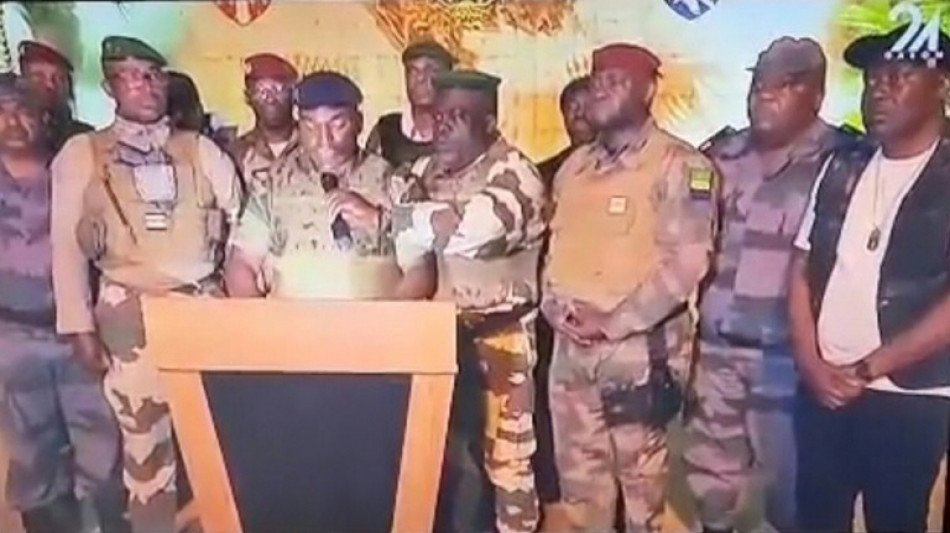
Military coup in Gabon, president under house arrest / Photo: - - Gabon 24/AFP
Rebel officers in the oil-rich central African state of Gabon announced on Wednesday they had seized power following disputed elections in which President Ali Bongo Ondimba, in power since 2009, had been declared victor.
Bongo, 64, whose family has ruled Gabon for over 55 years, was placed under house arrest and one of his sons arrested for treason, the coup leaders said.
In a dramatic pre-dawn address, a group of officers declared "all the institutions of the republic" had been dissolved, the election results cancelled and the borders closed.
"Today, the country is going through a serious institutional, political, economic and social crisis," according to the statement read on state TV.
It was read by an officer flanked by a group of a dozen army colonels, members of the elite Republican Guard, regular soldiers and others.
The elections "did not meet the conditions for a transparent, credible and inclusive ballot so much hoped for by the people of Gabon," the statement said.
"Added to this is irresponsible and unpredictable governance, resulting in a continuing deterioration in social cohesion, with the risk of leading the country in chaos."
"We -- the Committee for the Transition and Restoration of Institutions (CTRI) on behalf of the people of Gabon and as guarantors of the institutions' protection -- have decided to defend peace by putting an end to the current regime," it said.
TV images later showed the head of the Republican Guard, General Brice Oligui Nguema, being carried in triumph by hundreds of soldiers, to cries of "Oligui president."
Bongo's son and close adviser Noureddin Bongo Valentin, his chief of staff Ian Ghislain Ngoulou as well as his deputy, two other presidential advisers and the two top officials in the ruling Gabonese Democratic Party (PDG) "have been arrested," a military leader said.
They are accused of treason, embezzlement, corruption and falsifying the president's signature, among other allegations, he said.
- Disputed election -
Bongo was first elected in 2009 following the death of his father Omar, who had ruled the country for 41 years, reputedly amassing a fortune en route.
The announcement came just moments after the national election authority declared Bongo had won a third term in Saturday's election with 64.27 percent of the vote.
Gabon's main opposition, led by university professor Albert Ondo Ossa, had angrily accused Bongo of "fraud" and demanded that he hand over power "without bloodshed."
The authorities at the weekend imposed an overnight curfew and shut down the internet nationwide. The internet was restored on Wednesday morning after the TV address.
Gabon's 2016 presidential elections were marked by deadly violence after Bongo was named winner, edging out rival Jean Ping by just 5,500 votes, according to the official tally.
- Family ruler -
A country of just 2.3 million people, Gabon has been ruled by the Bongo family for more than 55 out of its 63 years since independence from France in 1960.
Omar Bongo was one of France's closest allies in the post-colonial era and his son has long been a regular in Paris, where his family owns an extensive real estate portfolio that is being investigated by anti-corruption magistrates.
Paris maintains a military presence in many of its former territories -- including Gabon where it has 370 soldiers permanently deployed, some in the capital Libreville, according to the French defence ministry website.
French Prime Minister Elisabeth Borne said her government was following events in Gabon "with the greatest attention."
Russia said it was "deeply concerned" over the situation in Gabon.
China called for "all sides" in Gabon to guarantee the safety of Bongo, "resolve differences through dialogue, (and) restore normal order as soon as possible."
Over the past three years, five other African countries have been wrenched by coups -- Mali, Guinea, Sudan, Burkina Faso and Niger.
J.Jaspers--LCdB